For decades, Europe positioned itself as Africa’s primary benefactor — dispensing aid, shaping governance frameworks, and setting the terms of engagement across the continent. But that model, critics argue, was built for a different era. Now, under pressure from a crowded geopolitical field and a dramatically altered energy landscape, Europe is recalibrating — and fast.
The shift is no longer subtle. As China deepens its infrastructure investments across the continent, Russia courts military alliances from the Sahel to the Horn, and the United States recalibrates its own Africa posture, European policymakers have been forced to confront an uncomfortable truth: a continent that once largely deferred to European frameworks now has options. Africa, long framed as a recipient of Western benevolence, is increasingly being courted as a strategic partner.
Few voices have made this case more forcefully than Younous Omarjee, Member of the European Parliament for France’s The Left and Vice President of the European Parliament. Speaking at the Africa Political Outlook forum in Brussels, Omarjee delivered a blunt assessment of the status quo.
“I believe that we must today revise our policy with African countries and move away from this development aid policy, which is outdated and which does not draw the consequences of concrete realities,” he said, arguing that Europe must now openly acknowledge what has long been implicit — that it has material interests in Africa’s stability and prosperity. “Development and prosperity on the African continent determines development and prosperity in Europe.”
It is a framing that marks a notable departure from the paternalistic logic that long undergirded EU-Africa relations. The language of mutual interest, rather than donor and recipient, is gaining ground in Brussels.
Africa’s Leverage — and Its Own Imperatives
For African leaders, the intensifying competition for the continent’s partnership is less a novelty than an opportunity — one that carries its own internal logic. Former Malawian President Lazarus Chakwera argues that the moment demands African governments focus as much on deepening intra-continental ties as on managing relationships with external powers.
“Europe trades amongst itself far more than African countries do across the continent,” Chakwera observed, pointing to the still-unrealised potential of the African Continental Free Trade Area.
For him, the priority is clear — accelerating the implementation of frameworks that reduce African dependence on any single external partner.
“Whether you’re talking about free trade on the continent, we need to find ways of facilitating the implementation — faster implementation — of such things,” he said.
The Energy Equation:
Underpinning much of Europe’s renewed urgency is a transformed energy calculus. Russia’s full-scale invasion of Ukraine in 2022 severed Europe from one of its most significant energy suppliers virtually overnight. The subsequent scramble for alternative sources thrust Africa — particularly West and North Africa — into sharper strategic focus.
South Africa Losing $4 Billion A Year To Illegal Mining — Now The Military Is Moving In
Ongoing instability in the Middle East following the Iran conflict has further concentrated European minds.
Analysts believe that a deepening of energy ties between the two regions could significantly alter investment flows into Africa, accelerating economic transformation in countries endowed with gas reserves, renewables potential, and critical minerals. Yet the path to realising that potential remains obstructed by well-documented challenges: inadequate infrastructure and fragile security environments in key regions.
Deals on the Ground:
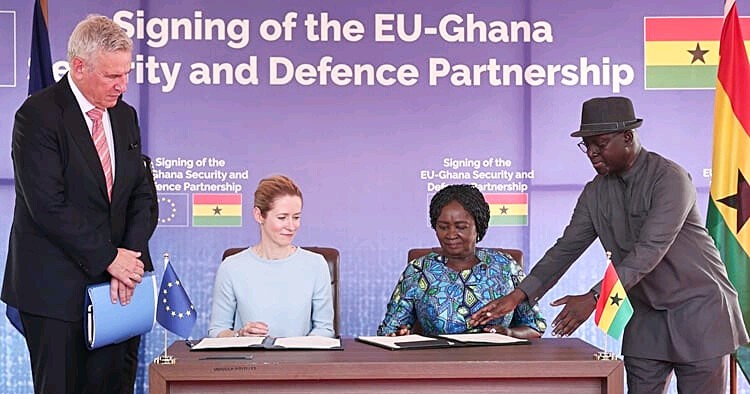
The shift in posture is now translating into concrete agreements. In March, EU foreign policy chief Kaja Kallas made a significant visit to West Africa, travelling to both Nigeria and Ghana in what Brussels framed as a milestone in EU-Africa strategic engagement.
In Nigeria, Kallas signed a readmission agreement on migration and unveiled a €288 million support package spanning healthcare, agriculture, finance, migration, climate, and digital public infrastructure — a package that, notably, blends humanitarian framing with hard strategic interests.
Africa Must Profit From Its Wealth, Says UN Secretary-General
In Ghana, the visit yielded something without precedent: the first-ever EU-Ghana Security and Defence Partnership, covering counter-terrorism cooperation and maritime security in the Gulf of Guinea. The agreement signals a new dimension to the EU’s Africa engagement — one that extends beyond trade and development into the sensitive terrain of defence.
Despite the urgency of the moment, the EU retains a formidable footprint on the continent. According to EU data, the bloc’s trade exchange with Africa reached €355 billion in 2024, making it Africa’s largest trading partner — ahead of China, though the gap is closing. The EU has also formalised trade arrangements with 15 sub-Saharan African countries through six economic partnership agreements, and holds four association agreements with North African states.
But as Mouctar Bah, president of the Brussels-Africa Hub, bluntly observed, the global economy is increasingly oriented toward Africa — and European policymakers have been slow to match that reality with policy. The deals being signed today suggest that Brussels, at last, is beginning to catch up.
Whether Europe’s pivot from aid-giver to strategic ally arrives in time to hold its ground on a continent being reshaped by new powers — and by Africa’s own rising ambitions — remains an open question. What is no longer in doubt is that the old model has run its course.
Credit: euronews