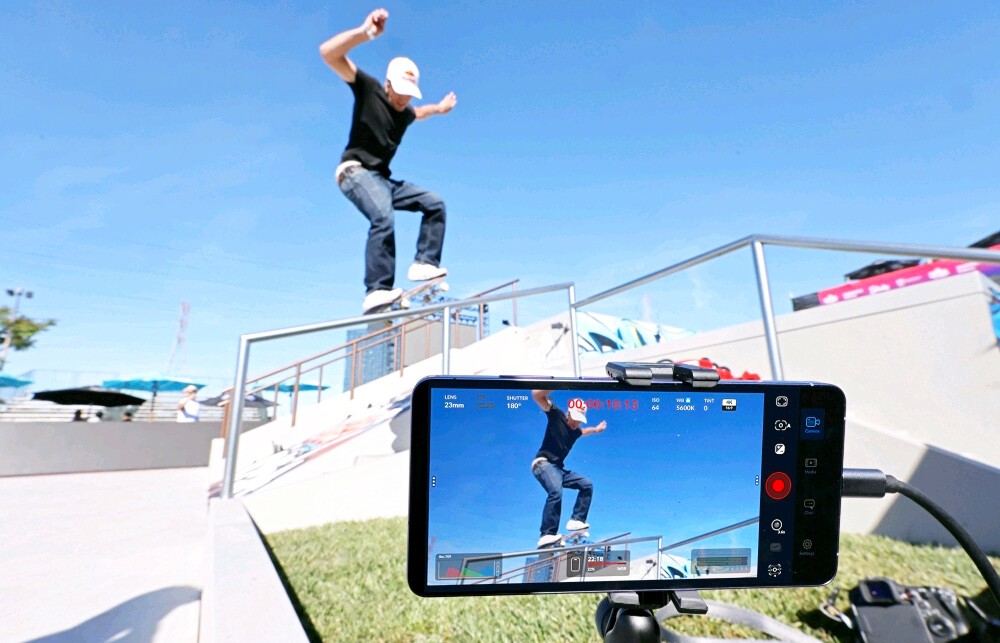
For the first time in Street League Skateboarding history, a smartphone is doing the work of a broadcast camera. Samsung’s newest flagship didn’t just show up courtside — it went inside the course.
On Monday, April 6, Samsung Electronics confirmed what skateboarding fans had already glimpsed at the SLS DTLA Takeover two days earlier: the Galaxy S26 Ultra had been used to film a live Street League Skateboarding competition for the very first time. It was not a promotional stunt or a behind-the-scenes experiment. The footage fed directly into the live production, and the results were impossible to miss.
Embedded Galaxy S26 Ultra devices directly into the course features themselves — the very obstacles that skaters grind, ollie over and fly past at speed. From those positions, the cameras captured angles that traditional broadcast rigs simply cannot reach: skater-level perspectives that place the viewer inside the trick rather than watching from the stands.
A New Language for Skateboarding Coverage:
Skateboarding has always been a sport defined by details. The split-second commitment before a grind. The precise placement of a foot during a flip trick. The suspended moment at the peak of a jump before gravity reasserts itself. Broadcast cameras, positioned for crowd-friendly wide shots, have historically struggled to convey any of it.
Samsung’s Galaxy POV approach changes that equation. By scaling the point-of-view format introduced at the SLS Sydney stop earlier in 2026 across the entire SLS season, the company is effectively building a second visual layer into every competition — one that runs parallel to traditional coverage and pulls fans into dimensions of the sport they have never seen from a broadcast feed.
The footage does not sit in a queue for later highlights. It flows directly into the live production workflow, enabling near-instant replay and giving producers a richer palette to work with in real time.
Saturday’s SLS broadcast was not Samsung’s first foray into live sports reimagined through a mobile lens. Earlier in 2026, the company worked alongside Olympic Broadcasting Services to embed Galaxy flagship devices throughout the venues of the Olympic Winter Games Milano Cortina 2026, with the technology playing a role in streaming the Opening Ceremony — one of the most-watched broadcast moments on the global sporting calendar.
That collaboration demonstrated that Galaxy’s camera system could operate at broadcast-level performance, pairing the mobility of a smartphone with the connectivity demands of a world-stage production. The dynamic perspectives it captured complemented, rather than competed with, traditional coverage — adding visual storytelling layers that conventional rigs could not provide.
This Is Samsung’s Biggest AI Leap With Google Gemini
Samsung carried that same philosophy into Galaxy Unpacked 2026, using its newest device to demonstrate professional-grade video capture and transmission in a high-profile setting before bringing it to the streets — literally — in Los Angeles.
The Bigger Shift in Sports Broadcasting
What Samsung is building toward is part of a broader transformation in how sports are televised. The industry is moving cameras closer to the action, compressing the distance between athlete and audience, between the moment of performance and the moment of experience. The traditional broadcast model, built around fixed camera positions and controlled sight lines, is giving way to something more immersive.
Mobile technology is accelerating that shift precisely because it removes the physical constraints that once defined where a camera could go. A device small enough to mount inside a skateboard rail is also powerful enough — in Samsung’s framing — to deliver broadcast-quality footage from that position. The Galaxy S26 Ultra’s pro-grade camera system is central to that claim.
For Street League Skateboarding, the partnership with Samsung signals an appetite to evolve how the sport presents itself to a global audience. Skateboarding earned its Olympic status partly on the strength of its visual culture — a sport that has always understood the power of a well-captured trick. With the Galaxy S26 Ultra now embedded in the course itself, that visual culture is being extended into the broadcast experience, board flip by board flip.