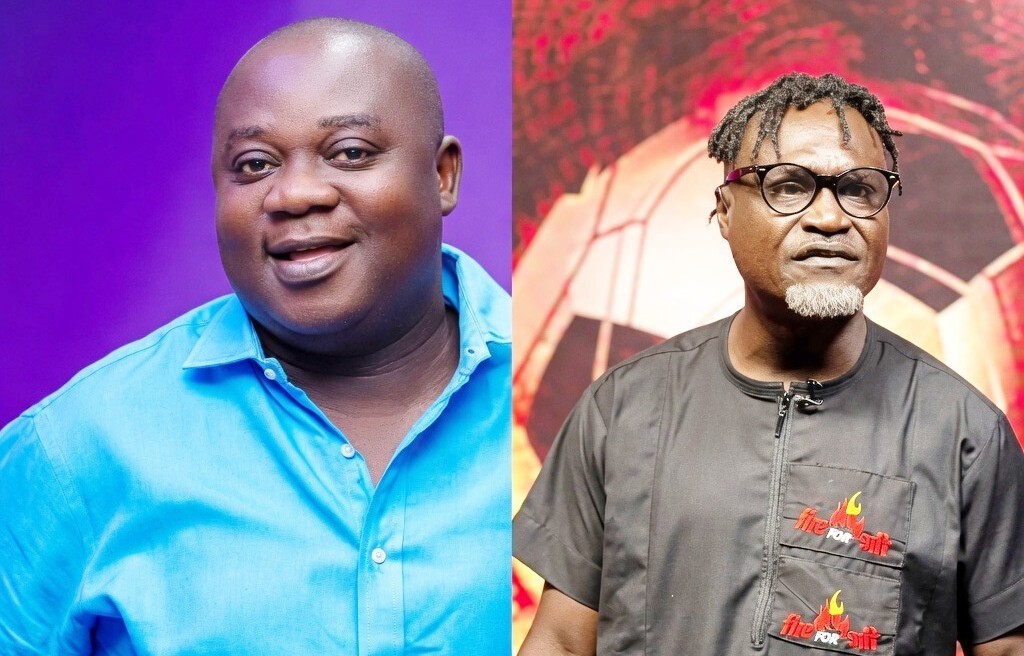
It was the kind of moment Ghanaian radio lives for — unscripted, unfiltered, and unmistakably human. On Monday, May 4, seasoned journalist Omanhene Kwabena Asante walked into the Asempa FM studio mid-broadcast, took a seat, and proceeded to challenge one of Ghana’s most combustible sports voices on his own turf.
The charge against Songo is: the relentless criticism of Black Stars coaches with little to show for it in the way of solutions.
Host O.B. was deep into a live short interview with Songo on Ekosii Sen when Omanhene appeared — unannounced — and redirected the entire conversation. It was a bold move, and it immediately charged the atmosphere in the studio.
His grievance was pointed and direct. Songo, he argued, had built a career out of savaging nearly every coach appointed to lead the national team — a pattern Omanhene found not just repetitive, but ultimately unhelpful to the broader project of developing Ghanaian football.
“You can’t keep attacking every coach who comes in. What are your solutions?” Omanhene demanded, cutting to the heart of a debate that has quietly simmered in Ghana’s sports media for years.
Songo Pushes Back — and Defends His Record:
Songo, never one to absorb a challenge quietly, did not retreat. He walked Omanhene through his reasoning, defending his track record as a journalist who has held the Ghana Football Association and successive technical handlers to account when others looked away.
For Songo, scrutiny is not a flaw in his commentary — it is the point of it. The award-winning sports analyst has long framed himself as a voice for the Ghanaian football public — a constituency he believes deserves honest, unvarnished assessment of decisions made in the corridors of the GFA and the dugout of the Black Stars. That identity was on full display Monday, as he stood his ground against one of the country’s most respected journalistic voices.
The exchange did what great radio always does — it spilled beyond the airwaves. Some listeners rallied behind Omanhene, arguing that criticism without alternatives is noise masquerading as analysis. Others stood firmly with Songo, insisting that holding football authorities accountable is not a burden that requires solutions to be legitimate. Both positions reflect a real and unresolved tension at the heart of Ghana’s sports media culture.
Monday’s confrontation has reignited a question that Ghana’s football commentariat has never fully answered: what is the media’s true role in shaping the national team’s fortunes?
Carlos Queiroz’s World Cup Record: Can He Do Better With Ghana’s Black Stars In The 2026 Edition?
Is a sports journalist’s job simply to report and interrogate — to name failures, expose poor decisions, and amplify public frustration? Or does the weight of influence that figures like Songo carry demand something more — a responsibility to pair critique with the kind of forward-looking analysis that actually moves the conversation? Omanhene clearly believes the latter.
Songo, just as clearly, is not convinced he owes anyone a solution to a problem he did not create.
As the debate continues to reverberate across radio stations and timelines, one thing is certain: in a country as passionate about football as Ghana, the line between holding power accountable and simply holding court remains fiercely contested — and Monday’s live radio collision proved it.