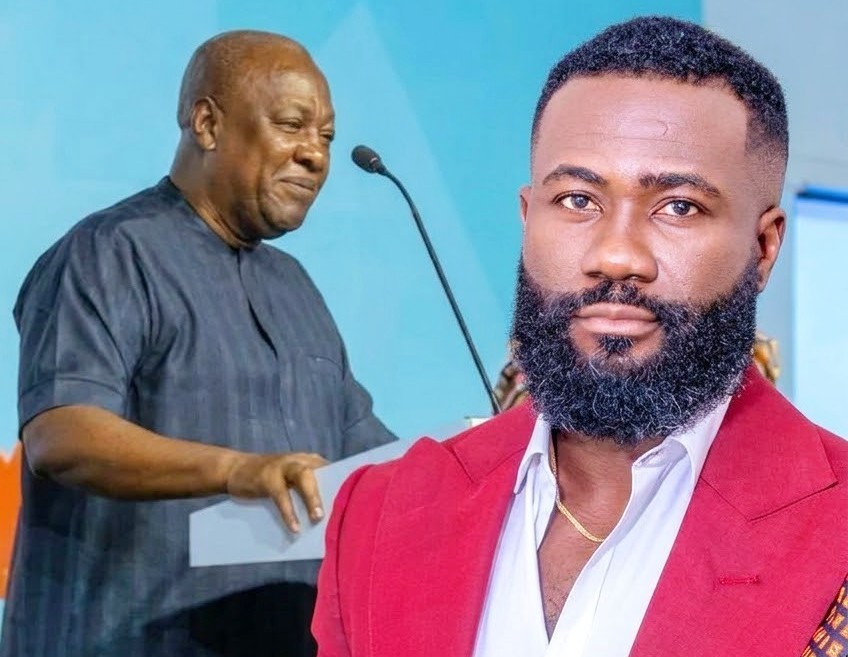
Media personality Okatakyie Afrifa-Mensah has described President John Dramani Mahama as an ordinary leader rather than an exceptional one, arguing that although the President is performing well, he has yet to demonstrate the qualities of a generational thinker.
Speaking during a studio interview with Nana Romeo on Okay FM on September 17, 2026, Afrifa-Mensah shared his assessment of Mahama’s leadership when asked to rate the President’s performance.
According to him, Mahama is doing well in his role as Ghana’s leader, but his performance does not necessarily place him among leaders capable of introducing transformative ideas that could shape the country’s future for generations.
Mahama Is Doing His Best, But Is He Is Not Exceptional
Afrifa-Mensah’s comments offer a distinction between performing the responsibilities of the presidency and demonstrating the kind of vision that can fundamentally change a country’s direction.
While acknowledging that Mahama is doing well, the media personality added that, effective leadership alone may not be enough to qualify someone as an exceptional leader.
His description of the President as a “usual leader” raises questions about the standards Ghanaians should use when assessing political leadership.
For Afrifa-Mensah, the issue is not simply whether the President is performing his duties, but whether his leadership reflects the deeper thinking and long-term vision needed to create a lasting national transformation.
What Does It Mean to Be a Generational Thinker?
A generational thinker is generally understood to be a leader whose ideas, policies and decisions have a lasting impact beyond their time in office.
Such leadership often involves developing long-term solutions to national challenges, strengthening institutions, creating opportunities for future generations and implementing policies that remain beneficial long after a leader leaves office.
Afrifa-Mensah’s assessment suggests that, in his view, Mahama’s current performance has not yet demonstrated that level of transformative thinking.
However, the distinction between a leader who performs well and one who transforms a nation remains a matter of political opinion and depends partly on the criteria used to evaluate leadership.
The comments add to public discussion about Mahama’s performance and the expectations Ghanaians have of his administration.
President Mahama Is A Different Human Being— Beatrice Annan
For supporters, the President’s performance may be assessed through government policies, economic conditions, infrastructure development and the delivery of campaign promises.
Critics, meanwhile, may demand more ambitious reforms, innovative ideas and long-term strategies that address Ghana’s structural challenges.
Afrifa-Mensah’s remarks place particular emphasis on the difference between managing the affairs of a country and introducing ideas capable of shaping its future for generations.
His assessment ultimately raises a question for public debate: should a president be judged mainly by how well he performs in office, or by the lasting changes he leaves behind?
For now, Afrifa-Mensah has acknowledged that Mahama is doing his best while maintaining that, in his view, the President has yet to establish himself as a generational thinker.