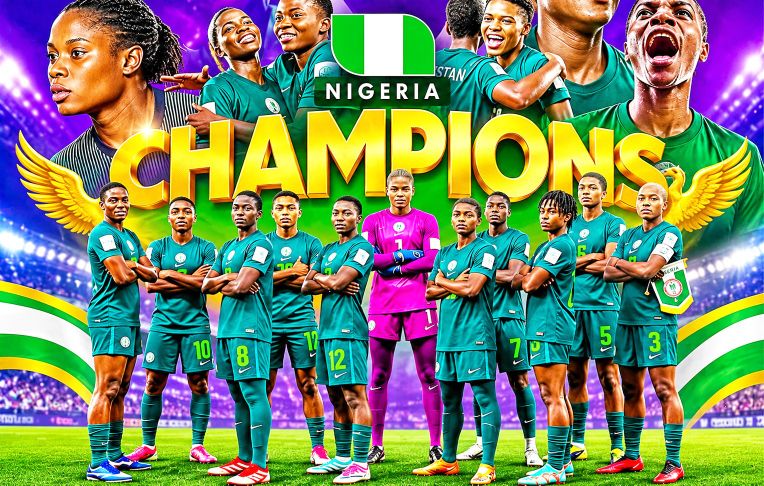
Nigeria’s sensational run at the 2026 FIFA U-17 Women’s World Cup in Morocco culminated in a landmark achievement that transcends sport. When the final whistle blew on Saturday, November 7, the Flamingos did more than just lift a trophy; they ignited national celebration, shattered historical ceilings for African women’s sports, and sent an unmistakable message to the global footballing community about the elite caliber of young African talent.
The Nigerian side clinched the world title with a gritty 2–1 victory over a formidable Japanese team. Dynamic strikes from Awawu Bashiru and Oluebube Umejiaku built a decisive lead for the West Africans. Although Japan managed a late consolation goal courtesy of Fuki Ito in the dying minutes of the match, Nigeria held firm to seal their place in history.
This triumph represents a sea change. For Nigerian football, it marks the opening of an unprecedented chapter of international dominance. For the African continent as a whole, it serves as undeniable proof that its youth teams possess the tactical discipline, technical prowess, and resilience needed to conquer the world’s most competitive stages.
Yet as the fireworks fade and the celebratory fanfare settles, a deeper question remains: what does this historic crowning truly signify for the future of Nigerian sports and society?
- Nigeria Has Broken a Barrier in African Women’s Football
Perhaps the most significant aspect of the victory is that Nigeria has become the first African nation to win the FIFA U-17 Women’s World Cup.
Since the competition was introduced in 2008, no African country had managed to lift the trophy, despite the continent producing several talented teams and players. The Flamingos have now changed that narrative.
By defeating Japan in the final, Nigeria has not only secured its place in the competition’s history but has also opened a new chapter for African women’s football.
The victory sends a strong message that African nations can compete with the traditional powerhouses of women’s football and win on the biggest international stages.
- Nigeria Completes a Remarkable FIFA U-17 World Cup Double
Nigeria’s achievement becomes even more special when viewed against the country’s history in men’s youth football.
The country’s male U-17 national team, the Golden Eaglets, has won the FIFA U-17 World Cup five times, in 1985, 1993, 2007, 2013 and 2015.
With the Flamingos now claiming the women’s equivalent, Nigeria has established itself as the first African country to win both the men’s and women’s FIFA U-17 World Cup titles.
It is a remarkable accomplishment that further strengthens Nigeria’s reputation as a major force in youth football.
For a country with a passionate football culture, having both male and female youth teams reach the summit of world football is an achievement worth celebrating.
- A New Era of Recognition for Nigerian Women’s Football
For years, Nigeria has been one of Africa’s most recognisable names in women’s football, largely through the achievements of the senior national team, the Super Falcons.
However, the Flamingos’ triumph introduces another important dimension to that reputation.
Winning a global title at U-17 level demonstrates that the country has the potential to develop female footballers capable of competing successfully beyond the African continent.
It should also encourage the Nigeria Football Federation and other stakeholders to give women’s football greater attention, particularly in grassroots development, coaching, scouting and infrastructure.
The challenge now is to ensure that this victory becomes the beginning of sustained investment rather than a moment of celebration that gradually fades away.
- The Flamingos Have Introduced a New Generation of Nigerian Football Stars
Every historic football triumph produces players whose names become associated with a defining moment.
For Nigeria, Awawu Bashiru and Oluebube Umejiaku will forever be remembered for their goals in the World Cup final.
Their contributions helped deliver a trophy that had eluded every African nation since the tournament’s inception.
The achievement could also provide these young players with opportunities to attract international attention, secure professional contracts and develop their careers in competitive football environments.
More importantly, their success could inspire thousands of young Nigerian girls who dream of becoming professional footballers.
The message is simple: girls from Nigeria can dream beyond local competitions and aspire to become world champions.
- A Moment of National Unity and Pride
Football remains one of the few things capable of bringing people together across political, ethnic, religious and social boundaries.
Nigeria’s victory offers millions of citizens a shared reason to celebrate.
Whether in Lagos, Abuja, Port Harcourt or among Nigerians living abroad, the Flamingos’ achievement has created a moment of collective national pride.
International sporting victories also help shape how countries are perceived around the world.
By winning the tournament in Morocco, Nigeria has placed its name at the centre of global women’s youth football discussions.
It is an opportunity for the country to showcase its sporting talent, determination and ability to produce champions.
- A Wake-Up Call for Investment in Women’s Football
While the celebrations are justified, Nigeria must recognise that winning the trophy is only one part of a much bigger responsibility.
The country now has an opportunity to use this success as a foundation for improving the future of women’s football.
Greater investment is needed in football academies, school competitions, coaching education, training facilities and the general welfare of female players.
Young talents must also be given a clear pathway from youth national teams into senior professional football.
Without a strong development structure, the country risks losing some of the very talents responsible for this historic achievement.
The Flamingos have demonstrated what is possible. It is now up to football administrators, government and private-sector investors to help sustain that progress.
- A Historic Legacy That Could Inspire Generations
Perhaps the greatest value of this victory will be measured not only by the trophy but also by the number of young girls it inspires.
The Flamingos’ journey to the championship was not without difficulties. Nigeria suffered an opening group-stage defeat against Poland but recovered impressively to win its subsequent matches and eventually conquer the competition.
FIFA Presidential Election Controversy: FIFA Accuses UEFA Of Bad Faith Lawsuit
That comeback makes the achievement even more meaningful. It tells a story of resilience, determination, teamwork and the ability to recover from disappointment. For young Nigerian girls watching from their homes, schools and communities, the players have provided a powerful example of what dedication and opportunity can achieve.
Their victory could inspire a new generation to take football seriously and believe that representing their country at the highest level is an attainable dream.
Can Nigeria Build on This Historic Success?
Nigeria has every reason to celebrate. The Flamingos have achieved what no other African team had managed since the introduction of the FIFA U-17 Women’s World Cup.
However, the real test begins after the celebrations.
Will the country provide these players with the necessary support to develop into senior international stars? Will the victory attract more sponsors to women’s football? Will football administrators use this moment to improve the structures supporting young female players?
These are important questions that deserve attention. Winning a World Cup is difficult, but building a system capable of producing champions consistently is an even bigger task. Nigeria’s 2-1 victory over Japan will go down as one of the defining moments in the history of African women’s football.
The Flamingos have broken a long-standing continental barrier, added another remarkable achievement to Nigeria’s youth football history and given millions of people a reason to celebrate.
But perhaps their greatest contribution is the belief they have created among young girls across Nigeria and Africa.
They have shown that the dream of becoming world champions is not beyond the reach of African footballers.
For Nigeria, this is more than a trophy. It is history, national pride and an opportunity to build a brighter future for women’s football.