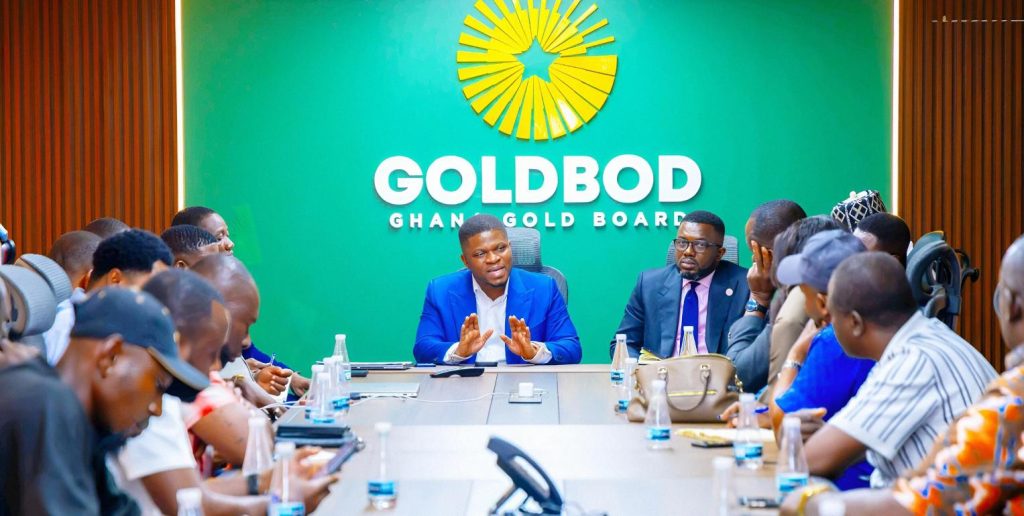
Imagine stripping away a single institutional pillar from a nation’s economic recovery and watching the ripple effects spread from remote mining towns all the way to the central bank’s vaults. That is the thought experiment at the heart of assessing the Ghana Gold Board (GoldBod).
If GoldBod vanished tomorrow, would Ghana’s multi-billion-dollar gold export engine grind to a halt? Would the Bank of Ghana lose its momentum in rebuilding foreign reserves? Most crucially, how much of the immense value buried beneath Ghanaian soil would actually stay within the country’s borders?
As gold remains the bedrock of Ghana’s macroeconomic stability, external balance, and international trade standing, exploring a “no-GoldBod” scenario reveals just how vital—and complicated—institutional oversight of the mineral sector truly is.
Launched in April 2025, GoldBod was designed to inject structure, transparency, and regulatory discipline into Ghana’s gold trade, with a laser focus on the artisanal and small-scale mining (ASM) sector.
Prior to its creation, the domestic gold landscape was plagued by severe leakages. Illicit smuggling routes thrived, export volumes were routinely under-reported, trading networks operated in fragmented shadows, and massive sums of foreign currency bypassed Ghana’s formal banking system altogether. GoldBod stepped in to plug those leaks, aiming to convert raw mineral output into tangible, traceable national wealth. Removing that mechanism from the equation would expose the economy to several immediate vulnerabilities.
Billions in Export Revenue Could Slip Through the Cracks
GoldBod’s primary achievement lies in pulling artisanal and small-scale gold out of the shadows and onto official ledgers. Because gold is Ghana’s premier source of hard currency, every ounce properly documented and sold through formal channels directly fortifies the country’s balance of payments.
Data from the International Monetary Fund (IMF) underscores the sheer scale of this segment: artisanal and small-scale gold exports hit roughly US$10.9 billion in 2025, accounting for nearly 9.5 percent of Ghana’s entire Gross Domestic Product. The IMF credited the expansion of the domestic gold purchase programme—with GoldBod driving the bulk of the sourcing—for channeling massive volumes of small-scale output into verified export pipelines.
Without GoldBod or a similarly robust gatekeeper, a substantial share of those transactions would likely revert to informal pathways. Recorded export earnings would shrink, foreign exchange inflows would weaken, and smuggling syndicates would find far fewer barriers to moving Ghana’s wealth across borders unrecorded.
Renewed Strain on The Ghanaian Cedi
A currency’s resilience depends heavily on a steady, predictable supply of foreign exchange to counterbalance import demand and sustain investor confidence. Ghana relies on hard currency every single day to finance essential imports—from fuel and pharmaceuticals to heavy machinery and industrial inputs.
By formalizing small-scale trade and organizing how export proceeds enter the financial system, GoldBod has helped bolster the supply of foreign currency available to the domestic market. In its 2026 economic assessment, the IMF pointed to surging gold exports as a primary driver behind Ghana’s strengthened external position.
Take away that structured repatriation mechanism, and the foreign exchange market tightens. While the absence of GoldBod would not automatically trigger a currency collapse, it would strip the economy of a critical shock absorber, leaving the cedi far more exposed to seasonal import pressures and global market swings.
National Reserve Targets Would Become Harder to Reach
International reserves act as a country’s financial safety net, enabling the government and the Bank of Ghana to honor external debt obligations, defend currency stability, and weather unforeseen global economic storms. Following the severe economic headwinds of previous years, rebuilding this buffer has been a top national priority.
The IMF has explicitly recognized the role of domestic gold operations in advancing Ghana’s reserve accumulation strategy. Under the government’s Ghana Accelerated National Reserve Accumulation Policy (GANRAP), the state has set an ambitious target of building international reserves to cover 15 months of imports by 2028, relying heavily on local gold purchases to get there.
Without a centralized, high-capacity institution actively capturing small-scale output for sovereign reserve building, hitting that 2028 milestone would become significantly steeper and far more uncertain.
Small-Scale Miners Would Be Pushed Back Toward Informal Networks
Beyond macroeconomic metrics, GoldBod reshapes daily life on the ground across Ghana’s mining communities. For decades, small-scale miners operated within an ecosystem dominated by unregulated middlemen, unauthorized foreign financiers, and weak oversight.
Through structured licensing and an organized buying framework, GoldBod aims to give local miners and licensed traders a legitimate, predictable marketplace. Without that institutional anchor, small-scale operators would have little choice but to rely on informal buyers, making it virtually impossible for state regulators to track production, enforce standards, or verify origins. Still, keeping miners inside the formal tent is not guaranteed by law alone—it hinges on execution.
GoldBod can only outcompete illicit buyers if it consistently offers fair, market-competitive pricing, disburses payments without bureaucratic delays, and treats legitimate local operators equitably.
Losing Leverage In The Global Gold Trade
Being one of Africa’s top gold producers means little if a nation lacks visibility and control over its own supply chain. GoldBod gives Ghana a mechanism to assert greater authority over how its domestic gold is aggregated, traced, and brought to international buyers.
The institution’s own operational data highlights a historic shift in the sector’s balance of power: between January 1 and October 20, 2026, GoldBod exported 85.4 tonnes of artisanal and small-scale gold worth US11.6 billion. Over that exact same window, traditional large-scale mining firms exported 76 tonnes valued at US11.1 billion. Small-scale mining is no longer a peripheral activity—it has outpaced industrial mining in export value.
Without an institution capable of coordinating, verifying, and scaling this segment, Ghana would forfeit crucial leverage, traceability, and pricing power in the global bullion market.
The Other Side Of The Ledger: Accountability and Reform
Recognizing GoldBod’s strategic value does not mean overlooking its flaws. Any honest evaluation must confront the serious operational and financial risks flagged by international observers.
In its 2026 review, the IMF raised red flags over the steep financial costs tied to the domestic gold purchase programme, revealing that the initiative incurred losses exceeding US$1.7 billion in 2025. Those deficits stemmed largely from gold purchasing mechanics and foreign exchange arrangements inherited from the programme’s earlier operational design. Furthermore, the IMF pointed out that persistent smuggling, severe environmental destruction from illegal mining (galamsey), and disappointingly low tax revenues from the small-scale sector remain unresolved threats.
Record-breaking export numbers cannot mask structural inefficiencies or ecological damage. To justify its mandate, GoldBod must prove itself to the Ghanaian public through strict financial discipline, transparent auditing, environmentally responsible sourcing, and genuine value-for-money. Export milestones only matter if they translate into tangible improvements in the lives of everyday citizens.
GoldBod And EOCO Join Forces To Strengthen Financial Security
So, what would Ghana’s economy actually look like without GoldBod? In short, the country would face far steeper hurdles in bringing small-scale gold into the formal economy, capturing hard currency earnings, and coordinating domestic reserve purchases.
That does not mean the economy would grind to a halt. Multinational large-scale mining companies would continue extracting and exporting gold independently, and alternative regulatory or banking mechanisms could eventually be fashioned to handle parts of GoldBod’s mandate. The real debate is whether any patchwork alternative could match a dedicated institution’s ability to curb smuggling, enforce export reporting, and ensure foreign currency actually comes home.
Ultimately, GoldBod’s legacy should not be measured merely by the tonnage of bullion passing through its hands. Its true yardstick is net national benefit: how much wealth remains in Ghana, how cleanly and efficiently the agency is run, and whether its sourcing practices protect rather than destroy the country’s rivers and forests.
Ghana does not just need a state-backed gold trader. It needs a holistic mineral ecosystem that fuels local enterprise, creates dignified jobs, anchors the cedi, fortifies national reserves, expands the tax base, and safeguards the environment. Gold is Ghana’s birthright—the defining test of this institution is whether it can help turn that natural endowment into enduring prosperity for every Ghanaian.