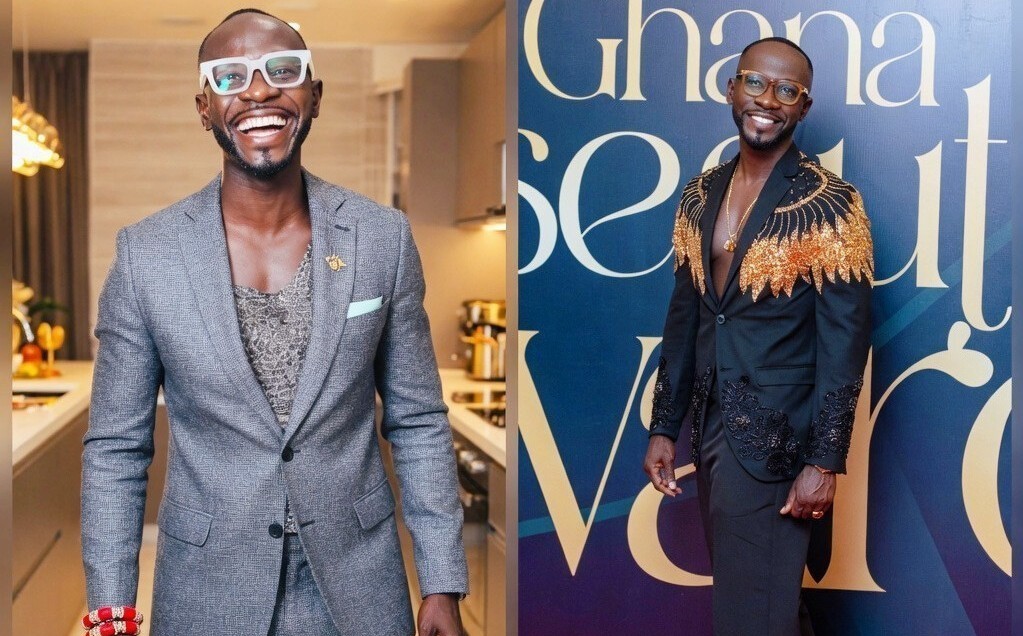
Half a century of life. Three decades of music. One artist who never stopped evolving — and never lost himself in the process. Some careers are measured in years. Others are measured in eras. Okyeame Kwame — born Kwame Nsiah-Apau on April 17, 1976 — belongs unmistakably to the latter.
At 50, the man Ghana knows as the Rap Doctor is not simply celebrating a birthday. He is marking the passage of a life lived entirely in service to a culture he helped shape, a genre he helped define, and an audience he has never once taken for granted.
From the moment he stepped onto the scene, there was something different about Okyeame Kwame’s presence. It was not just the delivery — though that was distinctive enough, carrying a quiet confidence that felt less like performance and more like conviction. It was the sense that he understood, even early, that he was not merely making music. He was documenting reality. He was shaping narratives. He was carving out space in a genre that was still in the process of defining its own boundaries—Hip-life.
His early work carried the grit of lived experience alongside the sharp intellect of someone who had already fixed his eyes on legacy. Survival was the floor, not the ceiling.
What followed across three decades is what separates the generational artists from the merely successful ones: Okyeame Kwame evolved without losing his essence. His transition from the celebrated rap duo Akyeame into a solo career produced ‘Boshe Ba’ — a record that redefined hip-life’s sonic possibilities in the early 2000s, trading in introspective lyricism at a moment when the genre was still finding its emotional range. Later projects like ‘Made in Ghana’ and ‘The Clinic’ revealed something rarer still: the maturity of an artist who had already conquered the industry and chose, rather than coasting, to go deeper.
His catalogue reads like chapters in a biography — each project a reflection not just of where he stood in life, but of where the culture itself stood at that precise moment. Nana Quame, Mary Agyapong, Yoggi Doggi, Obrafour, Lord Kenya — the names that populate his early collaborative years are themselves a roll call of a hip-life era, a reminder that Kwame was not operating at the margins of the scene but at its very centre.
Beyond the Microphone:
To speak of his impact solely in musical terms, however, is to tell only half the story. Okyeame Kwame has long understood that influence, real influence, extends well beyond the studio. He has studied the game, disrupted it, and in meaningful ways rewritten its rules — building a platform that speaks to culture, identity, and what it means to be Ghanaian in the world. The Rap Doctor is not a nickname bestowed lightly. It reflects a relationship to the craft that is diagnostic, deliberate, and always searching for what lies beneath the surface.
What Fifty Means in Hip-Life
There is a particular symbolism in reaching 50 at this level of relevance. Hip-life was once thought to belong exclusively to the young — a genre powered by the urgency of youth, by hunger, by the need to prove. Okyeame Kwame has spent the last decade quietly dismantling that assumption with a few others.
The hunger has not disappeared. It has transformed. What once drove ambition now drives purpose. The lyrics that once carried the urgency of a young man establishing himself now carry something weightier: reflection, responsibility, and a quality of foresight that only comes from having lived enough to see the longer arc.
Growth, he has proven, does not diminish relevance. It deepens it. At 50, Okyeame Kwame is not a relic of Ghana’s hip-life golden age. He is its most eloquent witness — and, by every available measure, still one of its most vital voices.
The Collaborator, the Blueprint, the Legend
The breadth of Okyeame Kwame’s collaborative footprint is, in itself, a statement about the kind of artist he chose to become.
As his career matured, he gravitated toward the guardians of Ghanaian musical tradition — Daddy Lumba, Kojo Antwi, Ofori Amponsah, the ensemble Wulomei — while simultaneously reaching toward contemporaries and cross-genre voices like Wiyaala, Atongo Zimba, King Ralph, Nana Yaa, Afriyie of Wutah, and Kofi Bee. It was never about proximity to fame. It was about the conversation — about what two artists in a room together could say that neither could say alone.
Stonebwoy On What Working With Angélique Kidjo Really Meant
That same instinct carried him into the modern era. His work with Kwabena Kwabena, Kuami Eugene, KiDi, Kurl Songx, King Promise, Medikal, Feli Nuna, Trigmatic, Raquel, Abiana, Ayesem, and his brother Flowking Stone — the Bradez connection made flesh — reads as both mentorship and creative renewal. He did not treat younger artists as features to be collected. He treated them as collaborators worth showing up fully for.
Internationally, his reach extended to Jamaican reggae legend Sizzla Kalonji and diaspora-driven projects like the ‘You Are Not Alone’ collaboration with Meredith O’Connor.
Across a career now exceeding 200 recorded collaborations, the through line is unmistakable: Okyeame Kwame has always understood that music, at its best, is a collective act.
Beneath the grandeur of that catalogue lies something deeply relatable — and that is precisely what makes his story resonate beyond the boundaries of fandom.
At its core, this is a story of transformation. Of turning limitation into leverage. Of converting doubt into determination and opportunity into something as culturally durable as hip-life itself. Greatness of this kind is never accidental. It is assembled, piece by piece, decision by decision, across years that test whether the vision can outlast the obstacles.
From Bands To Ballads: Kojo Antwi’s Autobiography ‘Mr. Music Man – The Journey’ Now Out!
At 50, Okyeame Kwame is no longer simply an artist to be heard. He is a figure to be studied — a career that offers working lessons in resilience, reinvention, and the power of ownership. He has shown that reaching the summit is only part of the achievement. Staying there with integrity, while actively lifting others on the way up, is the rarer thing. That is what separates the successful from the legendary.
The hits matter. The awards matter. But the blueprint matters most — the one he leaves for every young artist in Ghana and beyond who needs proof that it is possible to dream bigger, move smarter, and build something that outlasts the moment it was made in.
To mark five decades of life and nearly three of them spent reshaping Ghanaian music is to do more than celebrate a milestone. It is to acknowledge a journey that has not yet finished — a voice that has not yet said everything it came to say, and a legacy still being written in real time.
Icons, they say, may age. But true influence only deepens with time. Okyeame Kwame has spent fifty years proving exactly that. And if the arc of his career is any indication, the most enduring chapters may still be ahead.