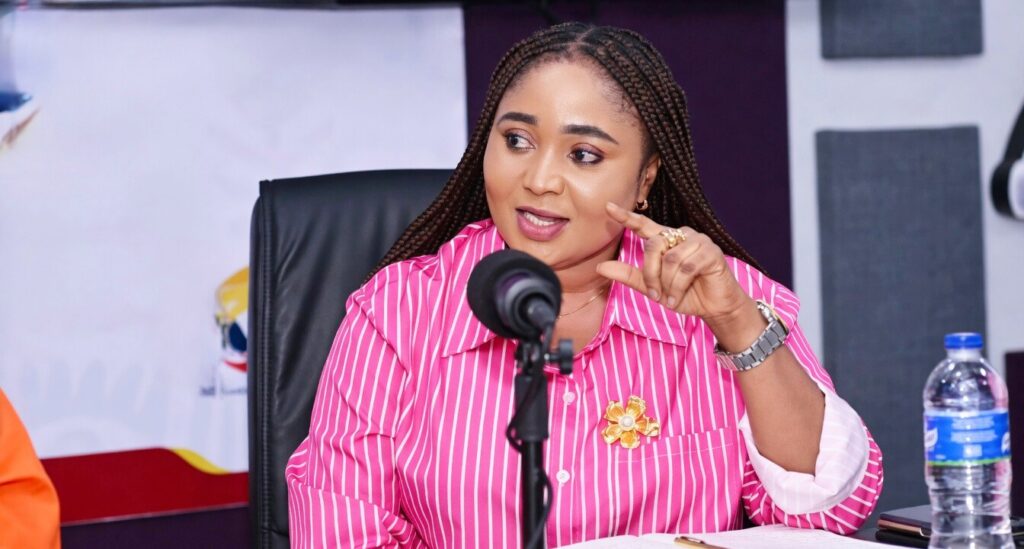
Political commentator Afia Korankyewaa has thrown herself into the centre of Ghana’s ever-churning political debate, delivering a pointed broadside against the New Patriotic Party (NPP) while simultaneously issuing a cautionary word to presidential brother and businessman Ibrahim Mahama.
Speaking on a panel discussion on Accra FM on Monday, April 20, Korankyewaa did not mince her words. She accused the NPP of cultivating a culture of relentless fault-finding — one she argued had come to define the party’s approach to opposition politics in the current political dispensation.
“The NPP keeps attacking, attacking, attacking,” she said in effect, characterising the party’s posture as one driven more by political mischief than genuine accountability.
In her view, the frequency and often thin justification behind the NPP’s salvos not only deepens political divisions but actively distracts the public from the substantive national conversations that deserve attention.
Korankyewaa was particularly animated on the subject of Ibrahim Mahama, the influential businessman and brother of President John Mahama. She said she simply could not understand why the NPP continues to train its sights on a private citizen whose primary identity is that of a businessman — a man whose only apparent offence, in her telling, is being related to the sitting President.
Yet even as she defended Ibrahim Mahama from NPP attacks, Korankyewaa turned to offer him a word of caution of her own. She advised the businessman to exercise serious discretion when it comes to extending support or assistance to individuals with NPP affiliations.
“Those who come to him for help today, she warned, are the very ones most likely to turn around tomorrow and use that access against him”.
It was a frank, insider-flavoured observation that underscored just how transactional and treacherous Ghana’s political landscape can be — even for those who operate primarily in the business world.
Ghana Boosts Gold Value Chain With New Refining Deal
Her remarks carry a broader subtext that will not be lost on political observers. By questioning the NPP’s moral authority to criticise anyone, Korankyewaa is tapping into a narrative that has gained considerable traction among NDC sympathisers and a section of the commentariat — namely, that a party fresh from electoral defeat and still grappling with its own credibility questions is ill-positioned to sit in judgment of others.
The exchange is the latest episode in the long-running and often combustible rivalry between the NPP and the NDC, two parties whose political fortunes have alternated with near-clockwork regularity, and whose supporters on both sides remain deeply invested in contesting every narrative that emerges from Accra’s political class.
What makes Korankyewaa’s commentary notable, however, is less the partisan thrust and more the strategic layer beneath it — the reminder that in Ghana’s political economy, the lines between business, family loyalty, and political allegiance are rarely clean, and that figures like Ibrahim Mahama must navigate that terrain with as much care as any elected official.
In that sense, her caution may have been directed at one man, but the lesson on offer was very much a public one.