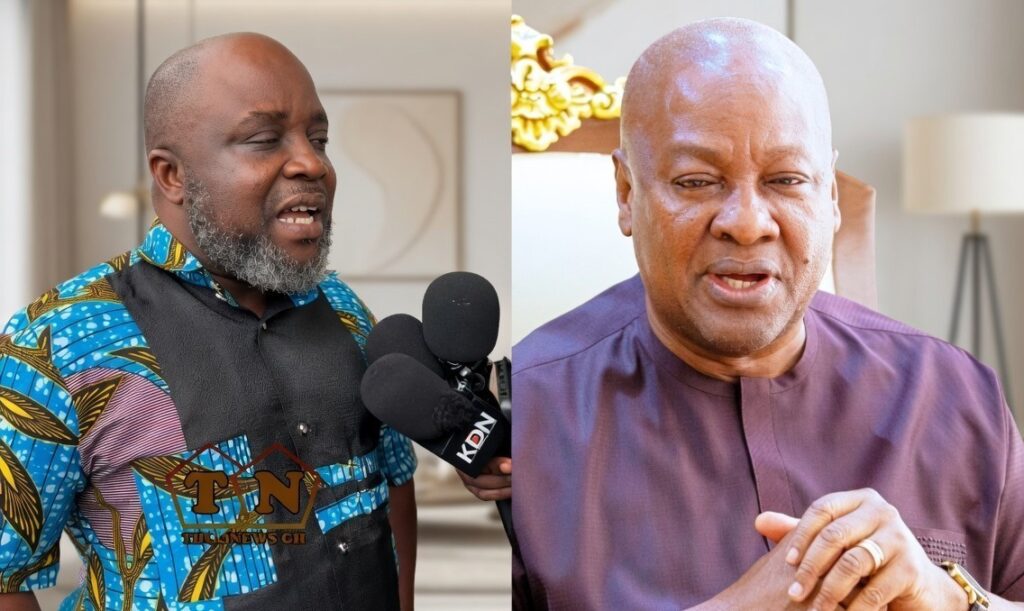
Journalist and politician Godwin Asare Bediako has levelled serious allegations against President John Dramani Mahama, accusing him of being the driving force behind what he characterises as a deliberate campaign to suppress communication and curtail freedom of expression in Ghana.
Speaking on Peace FM’s Kokrokoo programme with host Kwame Sefa Kayi on Friday morning, Bediako argued that a pattern of arrests targeting members of the opposition New Patriotic Party and other individuals since Mahama assumed office amounts to a coordinated strategy of political intimidation — one he claims the President is fully aware of and, he alleges, complicit in.
Central to Bediako’s argument is what he presents as a striking act of political hypocrisy. He recalled that President Mahama, while serving in opposition, wrote directly to former President Nana Addo Dankwa Akufo-Addo, condemning his administration over the alleged suppression of communication and the killing of investigative journalist Ahmed Hussein-Suale — a case that drew widespread condemnation and remains a defining scar on Ghana’s press freedom record.
The implication of Bediako’s argument is pointed: the man who once positioned himself as a champion of free expression and critic of state-sponsored intimidation now stands accused, in the eyes of his critics, of presiding over the very conduct he once publicly denounced.
Sticking To The Rule Of Law Can Punish You— Chakwera’s Blunt Verdict
Bediako alleged that at least 16 arrests have taken place since Mahama returned to the presidency — incidents he contends reflect not independent institutional action, but a deliberate and orchestrated pattern of repression targeting political opponents and dissenting voices.
Meanwhile, Pro-government voices insist that state institutions — including law enforcement and prosecutorial bodies — are acting independently, within the bounds of the law, and free from any direction or interference from the presidency.
In their telling, the arrests in question are legitimate exercises of institutional authority, not evidence of political persecution — and the suggestion that the presidency is orchestrating a crackdown on opposition figures or critics is, they argue, without foundation.
The exchange reflects a broader and increasingly charged debate about the health of Ghana’s democratic freedoms under the current administration. Accusations of political intimidation are not new to Ghanaian politics, and governments of both major parties have faced similar charges at various points in office.
But the invocation of Ahmed Hussein-Suale’s case — a wound that never fully healed in Ghana’s journalism community — gives Bediako’s allegations a sharper edge, drawing a direct line between past failures to protect free expression and what he portrays as a present-day continuation of that troubling trend under a different flag.