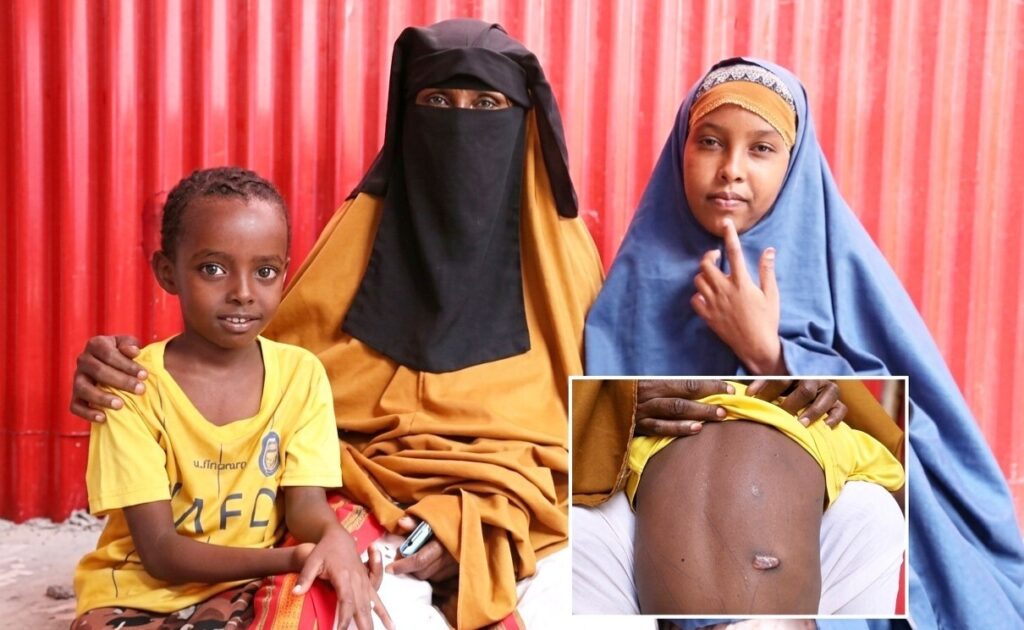
A seven-year-old boy left with bullet fragments lodged in his body following a deadly US airstrike in Somalia could lose the use of his legs unless his family can urgently raise £750 for surgery — money they simply do not have.
Abdiqadir Salah has been living with metal fragments embedded in two places in his back and in his upper thigh since the November 2025 strike, and doctors warn his mobility is at risk without emergency intervention. Compounding the family’s anguish, the United States continues to deny that any civilians were harmed in the operation, leaving little hope of compensation for those affected.
The strike, which claimed the lives of at least 12 civilians — including eight children — ranks among the deadliest assaults on non-combatants in Somalia under either Trump administration, and is considered one of the most devastating incidents in the country since the infamous 1993 Black Hawk Down operation in Mogadishu.
Abdiqadir’s mother, Marian Haji Abdi Guled, recounted the horror of 15 November 2025, when her son was struck by a missile while playing in the street outside their home in Jamaame. Three of her children were caught in the assault.
“That’s where three of my children got wounded. All three of them were laying on the ground covered in blood,” she said. Describing the chaos that followed, she recalled drones droning overhead before the bombardment began. “There was no warning before the strikes but we could hear drones hovering above town before the strikes. It was very loud.”
With shells falling indiscriminately around her, Guled was forced to gather her wounded children and flee into the countryside, desperate to escape further drone strikes. Her eldest son, Mohamed, 16, suffered shrapnel wounds to his fingers, while her 14-year-old daughter, Sumaya, had three metal fragments embedded in her skull — since surgically removed.
Medical imaging reviewed by the Guardian confirms that Abdiqadir still carries shrapnel near his hip socket, having entered through his lower back. The family endured a harrowing night in hiding.
“They bled throughout the night,” Guled said. “We couldn’t leave the countryside because we feared the drones hovering above would bomb us again.”
A day after the incident, Guled undertook a gruelling 40-mile journey to Jilib — the de facto administrative capital of territory controlled by al-Shabaab, the militant group the US identified as the intended target of the Jamaame strikes — in search of medical assistance for her children. With no acknowledgment of civilian casualties from Washington and no compensation forthcoming, Abdiqadir’s family now faces an agonising race against time to secure the funds needed to save his ability to walk.
The hospital in Jilib was unable to treat Abdiqadir, forcing his mother to borrow money for a punishing two-day journey to Somalia’s capital, Mogadishu, with the boy and his sister in tow.
“My oldest still has shrapnel lodged in his body but I left him back in Jamaame because I couldn’t afford to take him to Mogadishu and took the younger ones,” Guled explained. The journey itself was an ordeal: “During the two nights and two days to reach Mogadishu, we couldn’t even eat anything. All I thought about was saving my children.”
While her daughter was able to receive treatment once they reached the capital, Abdiqadir’s situation remains critical. Doctors at Kaafi hospital in central Mogadishu have warned that the shrapnel embedded in the boy must be surgically removed without delay to prevent permanent damage.
“They [doctors] told me if the shrapnel isn’t removed from his body, it could affect his ability to continue walking,” Guled said. Yet the cost of the operation remains far beyond her means. “But I don’t have $1,000 [£750] needed for the operation to remove the shrapnel from my son’s body. What’s worse than being a mother who can’t do anything for her wounded children?”
Alpamayo In Peru: The Story Behind The World’s Most Beautiful Mountain
Unable to afford the surgery but unwilling to leave the only place where her son can access proper care, Guled has remained in Mogadishu. Yet even this comes at a steep price — accommodation costs nearly £190 a month, swallowing up any hope of the family saving toward the operation.
The US government has not provided compensation to any Somali civilian injured or bereaved by its airstrikes. Adding to concerns, the Trump administration’s Pentagon has quietly dismantled a programme that had legally obligated the military to prevent and respond to civilian casualties.
The strikes were carried out in conjunction with Somali ground forces as part of a joint operation directed by the US military’s Africa Command, raising questions over whether ground troops may have contributed to the casualties. Witnesses, however, uniformly attribute the deaths and injuries in Jamaame to drone-launched bombs rather than ground fire. US officials have declined to clarify the role played by Somali forces in the operation.
For Guled, there is no ambiguity about who bears responsibility. She is adamant her children’s wounds were not caused by infantry weapons such as mortars, but by the airstrikes themselves. “It is the Americans who are responsible for our suffering,” she said.