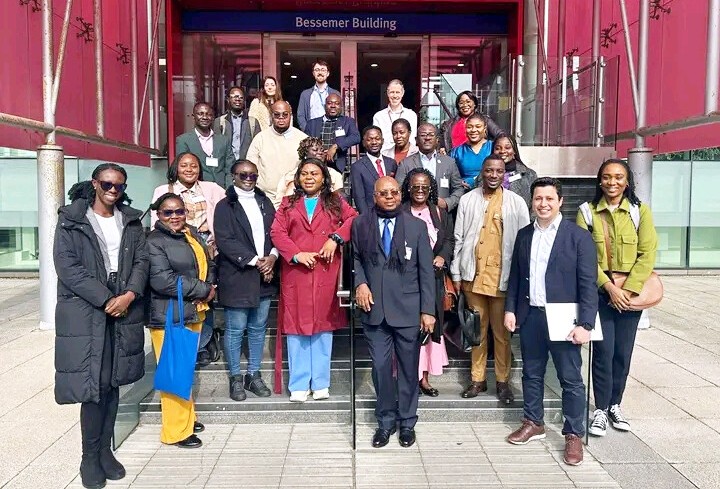
A cohort of Ghanaian journalists is in London for advanced training at Imperial College, deepening their ability to report on science, technology and innovation in ways that inform and engage the public back home.
The nine-strong delegation — selected on the strength of their pitches on issues affecting Ghanaian society — is taking part in intensive academic and practical sessions covering some of the most consequential areas of emerging global research. The programme is backed by the Ministry of Communication, Digital Technology and Innovations and forms part of the implementation of the UK-Ghana Science, Technology and Innovation Strategy.
At Imperial College, the journalists have been introduced to cutting-edge work in digital diagnostics, with particular attention to innovations relevant to African health systems. They have engaged with ongoing malaria research, exploring the technologies being developed to combat one of the continent’s most persistent public health challenges. Discussions throughout have stressed the importance of reporting on sensitive and rapidly evolving scientific developments with accuracy and responsibility.
The delegation also toured facilities focused on sustainable energy, including research using autonomous laboratory systems — a window into how science is being applied to the energy challenges facing developing economies. Cybersecurity in healthcare featured as another key area, giving participants a clearer picture of the vulnerabilities and safeguards shaping digital health systems worldwide.
Alongside the technical sessions, the journalists are attending specialist media workshops on health reporting and science storytelling through short-form video — practical skills designed to help them reach broader, more diverse audiences when they return.
Ghana Opens Bidding For One Of Its Most Prized Assets
Those on the ground say the experience has already shifted how they think about their work. Linda Naa Dedei Aryertey of the Ghana News Agency described the training as giving the delegation hands-on exposure to how science and technology directly shape society, and strengthening their capacity to simplify complex research without sacrificing accuracy. Karen Antwi of Bullet TV pointed to the storytelling dimension as equally transformative — learning not just the science, but how to connect innovation to everyday life in ways that resonate with ordinary Ghanaians.
For the Ministry, the London programme is one piece of a longer-term strategy. The goal is not simply to develop science and technology, but to ensure that what is being developed is understood and debated by the public it is meant to serve.
An earlier phase of the initiative, held in Accra, provided foundational training to 24 journalists in collaboration with academic and international partners — building the pipeline from which this advanced cohort has emerged.