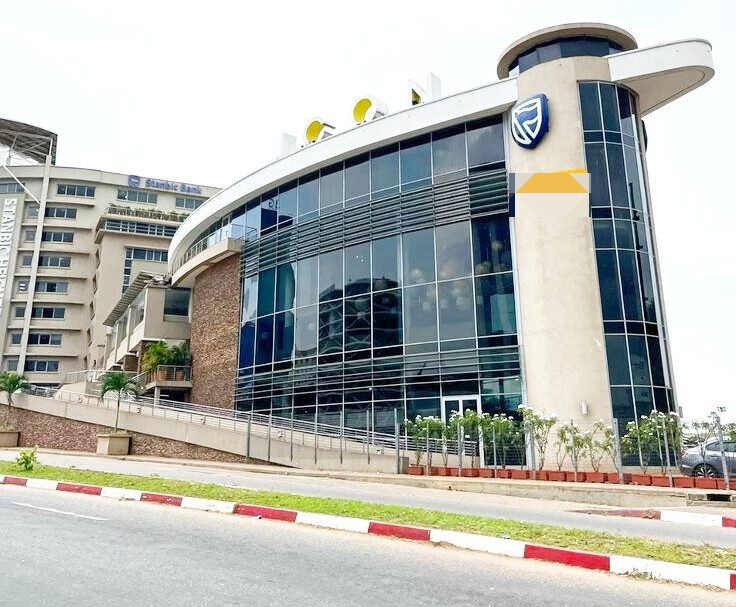
Stanbic Bank Ghana has delivered one of its most compelling financial performances in recent memory, closing 2025 with a profit after tax of GHS1.61 billion — a 38.4 percent jump from the GHS1.16 billion recorded in 2024 and a result that places the lender firmly among the standout performers in Ghana’s tier-one banking space.
The numbers tell a story of deliberate transformation. Against a backdrop of cautious post-debt restructuring recovery, Stanbic has quietly repositioned itself — diversifying its revenue base, tightening its credit book, and expanding its balance sheet with measured confidence.
Revenue Growth:
Total net income rose 22.2 percent year-on-year to GHS4.46 billion, with growth recorded across both funded and non-funded income lines. Net interest income climbed 13 percent to GHS2.84 billion, supported by improved yields on earning assets and sharper funding optimisation. But the real headline was non-interest revenue, which surged 42.4 percent to GHS1.63 billion.
Within that figure, trading revenue alone expanded by a striking 71 percent to GHS1.01 billion — a reflection of heightened activity in financial markets and a treasury operation firing on all cylinders. Chief Executive Kwamina Asomaning was clear that the results are structural, not cyclical.
“What we are seeing is the outcome of a multi-year effort to rebalance our earnings profile. We are building a bank that is less dependent on traditional lending cycles and more anchored on diversified, quality revenue streams,” he said.
Credit Quality: A Dramatic Turnaround
Perhaps the most striking single data point in the results was the collapse in credit impairment charges — down to GHS52 million from GHS364 million in 2024. That dramatic reduction eased significant pressure on earnings and signalled a material improvement in borrower performance and portfolio health.
The bank’s loan loss ratio reflected the shift in equally sharp terms, improving from 4.57 percent to 1.35 percent — a turnaround that speaks to both tighter risk underwriting and a more stable macroeconomic environment for borrowers.
Washington To Host World Bank Group Spring Meetings This Year
Asomaning attributed the improvement to an unrelenting focus on portfolio discipline. The bank’s priority, he noted, has been strengthening asset quality while continuing to channel credit toward productive sectors of the economy.
A Stronger Balance Sheet:
Beyond the income statement, Stanbic’s balance sheet tells a story of steady expansion. Total assets grew 12.6 percent to GHS36.7 billion, while shareholders’ equity rose nearly 39 percent to GHS5.74 billion — underpinned largely by retained earnings growth rather than capital injections.
The bank delivered a return on equity of 32.6 percent, reflecting efficient capital deployment in an improving business environment, and maintained a Capital Adequacy Ratio of 23.2 percent — comfortably above regulatory thresholds and a signal of resilience heading into the year ahead.
With earnings diversification deepening, credit conditions stabilising, and capital buffers well-stocked, Stanbic Bank Ghana enters 2026 with clear momentum. For a banking sector still navigating the aftermath of debt restructuring, the results offer a measured but meaningful signal: recovery, for those who positioned well, is no longer a projection — it is a result.
One thought on “How Stanbic Bank Ghana Delivered Its Strongest Earnings In Years”