The war between Israel, the United States and Iran is entering a more devastating phase, with industrial infrastructure now firmly in the crosshairs — and neither side showing any sign of stepping back.
Israeli Prime Minister Benjamin Netanyahu declared on Friday, April 3, that Israeli air strikes had destroyed approximately 70% of Iran’s steel production capacity, dealing a severe blow to the Islamic Republic’s ability to fund and equip its military.
“Together with our American friends, we continue to crush the terror regime in Iran. We are eliminating commanders, bombing bridges, bombing infrastructures,” Netanyahu said in a video statement. “In recent days, the Air Force has destroyed 70% of Iran’s steel production capacity — a tremendous achievement that deprives the Revolutionary Guards of both financial resources and the ability to produce many weapons.”
Iran’s Industrial Heartland Takes the Hit:
The damage is not abstract. Iran’s two largest steel producers — the Khuzestan Steel Company and the Mobarakeh Steel Company — have both been forced offline following several waves of coordinated US and Israeli air attacks. Officials at both facilities have acknowledged that restructuring the plants could take months, a timeline that signals long-term economic pain extending well beyond the battlefield.
Steel is not merely a commodity for Iran — it is a strategic resource. Its production funds the Revolutionary Guards and feeds directly into weapons manufacturing. Gutting that capacity, Israeli officials argue, is a blow to Iran’s war machine as much as any missile strike on a military installation.
Even as Netanyahu announced the scale of the destruction inside Iran, Israel came under renewed attack, with Iranian forces launching a fresh barrage of missiles toward Israeli territory. Israeli emergency services reported damage to homes and vehicles from a cluster missile that evaded interception, while Israeli military radio confirmed that a train station in Tel Aviv sustained shrapnel damage.
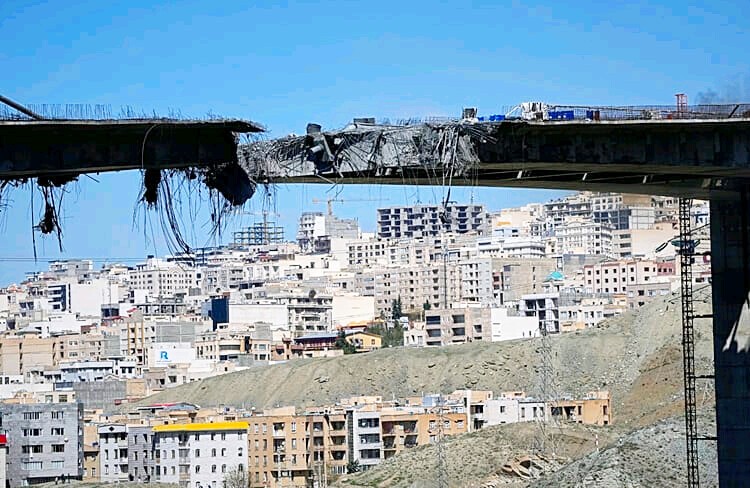
The exchange unfolded against a backdrop of escalating rhetoric from Washington. President Donald Trump, posting on his Truth Social platform, warned that the United States had not yet begun “destroying what’s left in Iran,” adding: “Bridges next, then Electric Power Plants!” His message came hours after he had announced the destruction of Iran’s tallest bridge in an earlier strike — an attack that local authorities said killed eight people and left at least 95 others injured.
Iran Strongly Denies Trump’s Ceasefire Request—The Latest Updates
Iranian Foreign Minister Abbas Araghchi pushed back sharply, posting online that striking civilian structures, including unfinished bridges, would not force Iranians into submission.
The pattern emerging from both sides tells a grim story. Strikes are no longer limited to military targets — they are systematically dismantling the economic and industrial foundations that sustain everyday life and long-term national capacity. That trajectory is raising urgent alarm over potential disruption to global energy supplies and the wider economic fallout of a conflict that has already convulsed markets worldwide.
The war, which began more than a month ago with US-Israeli strikes on Iran and triggered a cycle of retaliation that has since spread throughout the Middle East, shows no signs of a near-term resolution. Trump has threatened to bomb Iran “back to the Stone Ages” and warned that US strikes will intensify unless Tehran agrees to a negotiated settlement. Iran, for its part, has vowed to carry out what it describes as “crushing” attacks against both the United States and Israel.
With infrastructure crumbling, civilians caught in the crossfire, and two nuclear-armed allies pressing deeper into Iranian territory, the distance between a damaging war and a catastrophic one is narrowing by the day.