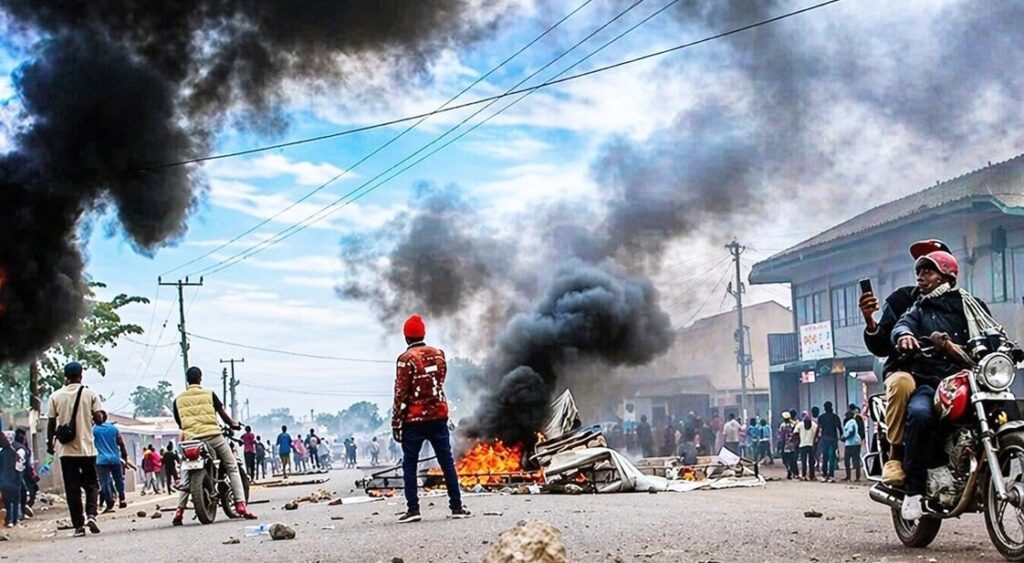
A country long regarded as one of East Africa’s more stable democracies now finds itself at the centre of a profound and blood-soaked reckoning. What began as a general election has unravelled into one of Tanzania’s most devastating political crisis in living memory — one defined by mass protests, a brutal security crackdown, and a death toll so contested that the full truth may never be known.
On 29 October 2025, Tanzanians went to the polls in what the government would later describe as a democratic exercise. President Samia Suluhu Hassan was declared the winner with a staggering 98% of the vote — a margin that strained credibility even before the ink had dried on the official results.
Opposition groups rejected the outcome outright. Their central grievance was not merely the numbers, but the conditions under which the election had been conducted: key opposition candidates, they alleged, had been systematically barred from contesting, gutting any meaningful competition before a single ballot was cast. For critics, the election was not a reflection of the people’s will — it was a performance staged to simulate one.
The repudiation of the results was swift and visceral. On election day itself, demonstrations erupted across Tanzania’s major urban centres — Dar es Salaam, Mwanza, Arusha — as citizens took their anger onto the streets. Protesters accused the government of electoral manipulation, political repression, and a systematic effort to silence dissent.
As the days wore on, demonstrations grew. Some turned violent, with crowds targeting government buildings and public infrastructure. In response, authorities moved quickly and forcefully: curfews were imposed, and police and military units were deployed across the country in a show of force intended to restore order — or, critics would argue, to crush resistance.
Bullets and Bystanders:
What followed would generate some of the most alarming human rights allegations in Tanzania’s post-independence history. According to accounts from eyewitnesses and leading rights organisations, security forces responded to the unrest with tear gas, live ammunition, and sweeping mass arrests.
Human Rights Watch documented instances in which police and other security personnel opened fire not only on protesters, but on bystanders who had no involvement in the demonstrations. Particularly chilling were reports from Mwanza, where witnesses described officers firing into a civilian neighbourhood, killing several people — far removed from any protest zone. The pattern raised urgent and deeply troubling questions about the indiscriminate use of lethal force.
A Death Toll Shrouded in Dispute:
Perhaps nothing has complicated the picture more than the savage uncertainty surrounding the number of lives lost. The figures in circulation vary wildly, and each carries its own political weight.
Opposition leaders have put the death toll at somewhere between 700 and over 1,000, with some accounts going even higher. The United Nations, while exercising more caution, has acknowledged credible reports of hundreds killed — though verification has been rendered near-impossible by restricted access on the ground. Meanwhile, a government-commissioned inquiry has itself reportedly referenced more than 500 deaths linked to the unrest, a figure that, if accurate, would represent a catastrophic loss of life by any measure.
The absence of independent verification — compounded by the alleged intimidation of journalists, the disappearance of witnesses, and severe access restrictions — has made any conclusive accounting an exercise in frustration. The true toll may be far higher than any official figure dares to admit.
Simultaneously, Tanzanian authorities imposed a nationwide internet shutdown that choked the flow of information at precisely the moment the world most needed to see what was happening. Social media platforms were cut off. Warnings were issued against sharing images or footage of the violence. In effect, the country was sealed.
For critics and press freedom advocates, the blackout was not a neutral security measure — it was a deliberate attempt to suppress evidence, limit accountability, and ensure that the full horror of the crackdown could not reach the eyes of the international community. Whatever occurred in those darkened days, the architecture of concealment was in place.
As the situation stabilised and the first accounts began trickling out, rights groups raised alarms that went well beyond a security crackdown gone awry. Allegations emerged of extrajudicial killings — targeted assassinations of activists, not incidental casualties of crowd control. Reports of disappearances followed, alongside deeply disturbing claims about mass graves and the deliberate removal and concealment of bodies.
How Europe Is Rethinking Its Relationship With Africa
If independently verified, such allegations would constitute grave violations of international humanitarian law, potentially opening the door to accountability mechanisms well beyond Tanzania’s borders. The United Nations and international human rights bodies have called for a full, independent inquiry — though whether Dar es Salaam will cooperate remains an open and troubling question.
The Tanzanian government has maintained throughout that its security forces acted proportionately and that operations were a necessary response to violent disorder. Officials have pushed back firmly against what they describe as inflated death toll figures propagated by opposition figures and foreign commentators.
President Hassan has not denied that lives were lost — she has acknowledged as much — but she has insisted that the scale of the crisis has been deliberately exaggerated by her critics. It is a position her administration has held with remarkable consistency, even as the evidence emerging from the ground tells a far darker story.
Tanzania has long worn its reputation for political calm as a point of national pride — a counterpoint to the volatility that has periodically convulsed some of its regional neighbours. That reputation now lies in ruins. The events of October 2025 and their grim aftermath have exposed deep fault lines in the country’s democratic architecture: an electoral system susceptible to manipulation, institutions unable or unwilling to hold power to account, and a security apparatus whose response to dissent has raised the spectre of state violence on a massive scale.
The world is watching. Whether Tanzania chooses accountability or impunity in the weeks and months ahead will define not only its international standing, but the arc of its own democratic future.