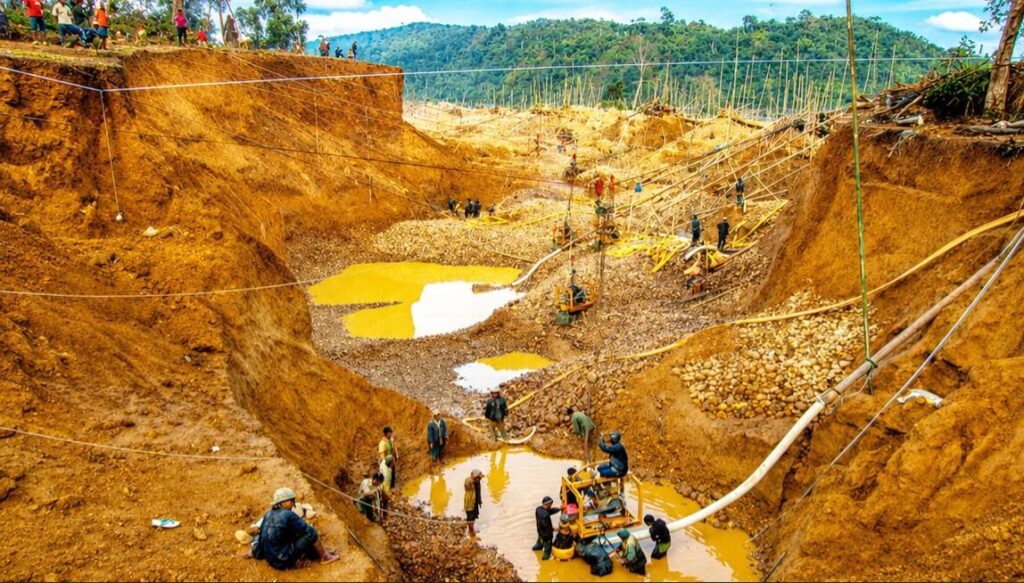
Illegal mining — known locally as galamsey — has become one of the most corrosive crises in Ghana’s modern history. Despite years of military deployments, high-profile arrests, government task forces, and impassioned political promises, a growing number of Ghanaians have reached a troubling conclusion: the country is losing the fight.
The evidence is visible to the naked eye. Rivers that once ran clear through mining communities have turned a thick, murky brown. Farmlands that fed families for generations are disappearing beneath the treads of excavators. Forest reserves, which once served as the lungs of entire regions, are being hollowed out hectare by hectare. If this trajectory continues unchecked, experts warn, the Ghana inherited by future generations will be one defined not by prosperity, but by water scarcity, environmental ruin, and agricultural collapse.
The scale of the damage is staggering. Galamsey activities have now spread across most of the country, cutting deeply into cocoa-growing communities in the Ashanti, Western, Eastern, and Central regions. Major water bodies — the Pra, Offin, Ankobra, and Birim rivers — have been severely polluted, forcing water treatment facilities to spend significantly more to render water safe for public consumption. In some areas, access to clean drinking water has become a genuine crisis.
Agriculture is bleeding:
Cocoa farming, a cornerstone of Ghana’s rural economy, is under direct assault. Many farmers are reportedly abandoning their lands or selling them outright to illegal miners, drawn by the lure of immediate cash in communities where few other economic opportunities exist. Entire cocoa farms have been swallowed by mining pits.
The Forestry Commission has confirmed that thousands of hectares of forest reserves have already been destroyed, raising fears among environmental scientists of worsening climate conditions, reduced rainfall, and accelerating biodiversity loss.
Ghana has launched wave after wave of anti-galamsey interventions over the years — Operation Vanguard, various military crackdowns, community mining schemes, and successive task forces. Each has generated press conferences, arrests, and temporary headlines. None has produced lasting change.
Critics argue that the reason is not difficult to find. Powerful financiers with political connections continue to operate largely untouched behind the scenes, while junior players absorb the consequences of enforcement.
Fuseini Pushes For Direct DCE Performance Targets In Anti-Galamsey Drive
Illegal miners routinely return to sites shortly after security operations withdraw, producing what observers have bluntly described as a “raid today, return tomorrow” cycle. Corruption and political interference have repeatedly blunted the edge of enforcement, turning well-intentioned campaigns into exercises in frustration.
Political Will Under Question
Public anger over the issue has reached new levels. On social media and in community conversations, Ghanaians are asking openly and without apology whether the political will to defeat galamsey still exists — or whether it ever truly did. The suspicion, widely shared, is that the problem has endured for so long precisely because those with the power to end it have too much to gain from its continuation.
The government has recently announced a fresh round of measures, including bans on mining in forest reserves and the creation of new enforcement units targeting illegal mining and gold smuggling. Environmental advocates have welcomed the intent while cautioning that announcements alone carry little weight.
What is needed, they argue, is sustained and politically neutral enforcement, prosecution of high-level financiers, and credible long-term economic alternatives for rural communities where galamsey has become the primary source of income for young men with nowhere else to turn.
Beyond Politics
For many Ghanaians, the galamsey crisis has long since crossed the threshold from a policy debate into a genuine national emergency — one that is unfolding slowly enough to be managed politically, but seriously enough to be catastrophic in the long run.
The calculus is simple and devastating: the gold extracted through illegal mining enriches a small number of individuals in the short term, while the cost — in poisoned rivers, destroyed farmland, depleted forests, and compromised public health — is borne by the entire nation across generations.
Ghana has faced difficult problems before and found its way through. But galamsey demands more than political theatre and periodic crackdowns. It demands the kind of sustained, courageous, and genuinely accountable action that the country has so far struggled to deliver.
4 thoughts on “Ghana Seems To Have Lost The Fight Against Galamsey”