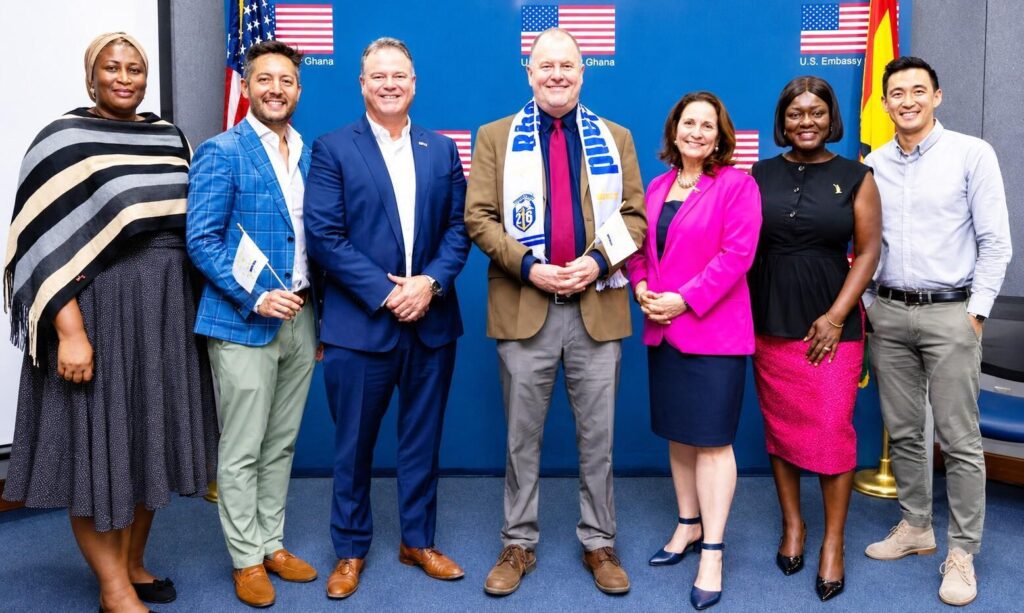
With the 2026 FIFA World Cup drawing closer, the United States Embassy in Ghana has opened a significant diplomatic and commercial front — convening high-level discussions with Bryant University and Ocean State 2026 to chart a course for deeper educational, sporting, cultural, and economic partnerships between Ghana and the United States around the global tournament.
At the centre of those discussions is a development that gives the engagement immediate, concrete weight: Bryant University has been selected as the official base camp for Ghana’s senior national football team, the Black Stars, during the World Cup.
The choice of Bryant University — located in Smithfield, Rhode Island — as the Black Stars’ preparation and recovery base is more than a logistical arrangement. It is a platform.
The presence of a prominent African football nation on a U.S. university campus during the world’s most-watched sporting event creates a natural focal point for cultural exchange, tourism promotion, media attention, and community engagement that extends well beyond the pitch.
For Rhode Island, the selection puts the state on the map of one of the largest sporting events in history in a tangible, visible way. For Ghana, it offers a structured launchpad from which to project the country’s culture, heritage, music, and business potential to a global audience gathered in North America.
The discussions ranged across a broad agenda that reflects the scale of ambition both sides are bringing to the World Cup moment. Priorities identified during the engagement include higher education collaborations, sports diplomacy, diaspora engagement, youth empowerment, and cultural initiatives — all areas where Ghana-U.S. relations carry existing depth and untapped potential.
Officials on both sides expressed confidence that the World Cup provides a rare alignment of timing, global attention, and institutional goodwill that could accelerate partnerships which might otherwise take years to develop.
The conversations also explored how universities, local governments, businesses, and diaspora communities can collaborate to ensure that the relationships forged around the tournament outlast the final whistle — generating educational and economic value well into the future.
FIFA Makes New Football Laws Ahead Of 2026 World Cup
The U.S. Embassy in Ghana signalled its active role as a facilitator in this process, reaffirming its commitment to supporting connections between Ghanaian institutions and U.S. cities and states seeking to engage with Ghana during the World Cup period.
Stakeholders and organisations interested in building partnerships around the tournament have been encouraged to approach the Embassy directly for support.
It is a posture that reflects a broader understanding of what major sporting events can do when approached strategically — not just as competitions, but as diplomatic and economic inflection points.
The 2026 FIFA World Cup will be the largest in the tournament’s history, featuring 48 nations competing across multiple cities in the United States, Canada, and Mexico. Ghana is among the African nations in contention for qualification as preparations intensify across the continent.
Bryant University will not merely be a training ground for the Black Stars. It will be the first chapter of Ghana’s World Cup story — and if the ambitions discussed at this week’s engagement are realised, the beginning of something considerably larger than football.