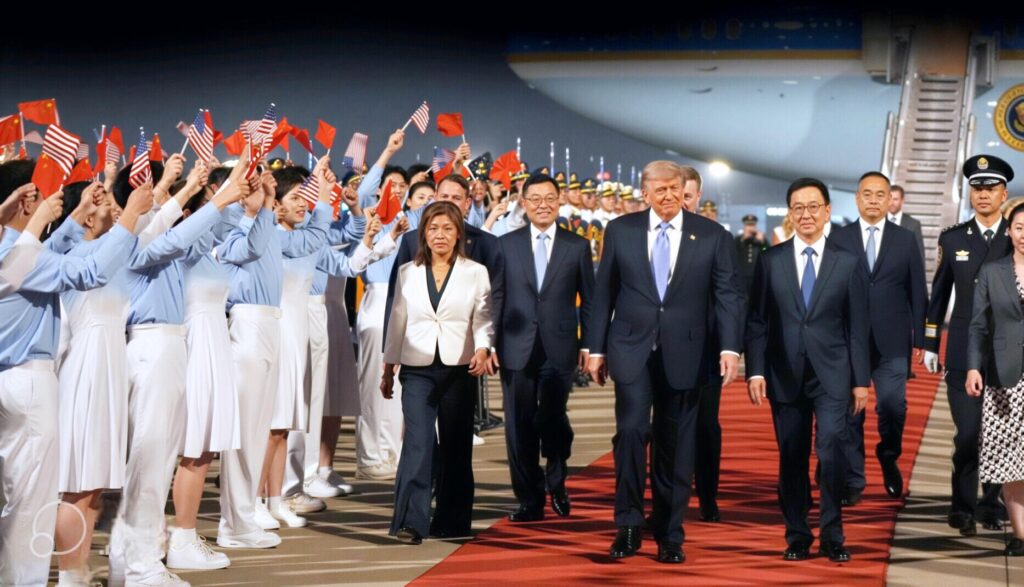
U.S. President Donald Trump has touched down in Beijing for a landmark summit with Chinese President Xi Jinping — the first visit by a sitting American president to China in nearly a decade — as both powers seek to steady a relationship strained by years of rivalry, mistrust, and escalating tensions across multiple fronts.
The visit, framed by both governments as an effort to stabilise rather than fully resolve their differences, covers an expansive agenda: trade and economic access, the ongoing Iran conflict, Taiwan, artificial intelligence, and the future of the global tech race.
At the top of Trump’s wish list are concrete commercial breakthroughs. His administration is pushing for expanded market access for American companies in China, increased Chinese purchases of U.S. goods, progress on rare earth mineral supply chains, and an easing of the tariff and technology restrictions that have long defined the two countries’ economic standoff.
In a signal of his priorities, Trump reportedly made the trip with a delegation that included senior figures from the AI and semiconductor industries, underscoring the administration’s intent to convert diplomatic goodwill into tangible business outcomes.
Enlisting Beijing on Iran
Perhaps the most urgent item on the agenda is the ongoing Iran conflict. Trump is expected to appeal directly to Xi for China to leverage its considerable influence over Tehran — as one of Iran’s largest economic partners and oil buyers — to help reduce hostilities and reopen global shipping lanes disrupted by the war.
With energy prices elevated and economic pressure mounting worldwide, analysts say Trump needs Beijing’s cooperation on this front as much as any other.
The Truth About Trump And King Charles III’s Viral Handshake Moment
Taiwan remains one of the most combustible issues in U.S.-China relations, and both sides are expected to address it carefully. Beijing continues to push back firmly against American arms sales and security support for Taipei, while Washington shows no sign of abandoning its commitments to Taiwan’s defence. The talks are expected to focus on managing the flashpoint rather than resolving the underlying dispute — keeping the issue from spiralling into direct confrontation.
Technology and the AI Race
The summit will also confront the two countries’ deepening rivalry in advanced technology. Discussions are expected to touch on AI governance frameworks, semiconductor export controls, and the broader competition for technological dominance. Trump reportedly wants Beijing to ease restrictions that have hampered American tech firms operating in the Chinese market — a demand that sits at the intersection of commerce and national security.
Beyond the specifics, experts say the summit’s deeper purpose is to prevent the world’s two most powerful economies from drifting further apart. Rather than a grand reconciliation, both governments appear to be seeking a managed de-escalation — a reset of diplomatic temperature that buys space for future engagement without requiring either side to concede on core interests.
The symbolism of the visit alone carries weight. A sitting U.S. president in Beijing for the first time in nearly a decade is, in itself, a statement that both Washington and Beijing see value in keeping the door open.