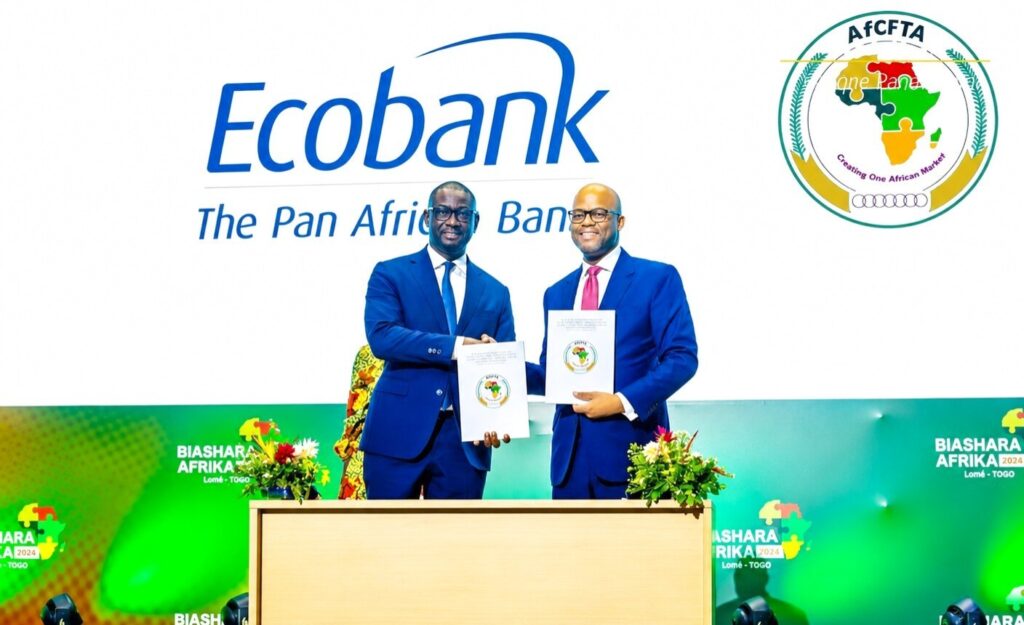
Ecobank has formalised a strategic partnership with the African Continental Free Trade Area Secretariat, signing a Memorandum of Understanding that positions the pan-African lender as a key financial engine behind the continent’s ambitious single-market project.
The agreement was concluded on the sidelines of Biashara Afrika 2026, one of the continent’s premier trade and investment forums, and marks a significant moment in Ecobank’s four-decade mission of deepening financial integration across Africa.
For Ecobank, the MoU is more than a statement of intent — it is an institutional commitment to translate its pan-African rhetoric into measurable commercial action. The bank has framed the partnership as a direct extension of its recently announced US$3 billion trade finance facility, a war chest it intends to deploy in narrowing the persistent trade finance gap that continues to throttle growth for businesses operating across African borders.
The scope of the collaboration spans the full AfCFTA architecture — targeting the reduction of trade barriers, expanding access to cross-border markets, and improving the financing environment for businesses seeking to scale within the continental free trade framework. Critically, the partnership has earmarked specific attention for constituencies that have historically been left on the margins of formal trade finance: small and medium-sized enterprises, women-led businesses, and young entrepreneurs.
The Reason Smart Ghanaians Are Moving Their Money to EDC Investments Ltd Right Now
The timing carries weight. As African governments push deeper into the AfCFTA implementation phase — working to operationalise a single market covering 54 countries and a combined GDP exceeding US$3 trillion — the involvement of a bank with Ecobank’s continental footprint is seen by analysts as a meaningful accelerant. Few financial institutions can match its on-the-ground presence across 35 African markets, a network that gives the partnership practical reach where it matters most.
Industry observers have welcomed the agreement as a signal that private financial capital is prepared to align itself more deliberately with the continent’s integration architecture. The expectation is that Ecobank’s participation will also encourage other financial institutions to deepen their engagement with regional trade bodies — creating a broader ecosystem of support for AfCFTA’s commercial ambitions.
With intra-African trade currently accounting for only a fraction of the continent’s total trade volume — a structural imbalance the AfCFTA was designed to correct — partnerships that bring financing, market access and institutional credibility together under one framework are increasingly seen as indispensable to the agreement’s long-term success.
For Ecobank, now entering its fifth decade of operations, the MoU with the AfCFTA Secretariat represents both a consolidation of its founding purpose and a forward-looking bet on the continent’s economic trajectory.