The 2026 Technical Group Meeting of the Intergovernmental Group of Twenty-Four (G-24) on International Monetary Affairs and Development was held in Abuja, Nigeria, from February 18 to 20, 2026. Nigeria, as the chair country for the year, jointly hosted the event through the Federal Ministry of Finance and the Central Bank of Nigeria (CBN).
The meeting convened senior finance officials, central bank representatives, technical experts, and policymakers from developing and emerging economies across Africa, Asia, Latin America, and the Caribbean.
The theme was “Mobilising Finance to Promote Sustainable, Inclusive, and Job-Rich Economic Transformation”. Discussions focused on reforming the global financial architecture—particularly as the Bretton Woods institutions (IMF and World Bank) mark their 80th anniversary—amid challenges like debt distress, fiscal tightening, trade fragmentation, geopolitical uncertainties, digital transformation, and the need for equitable climate finance and South-South cooperation.
Opening Remarks by Dr. Iyabo Masha (Director and Head of the G-24 Secretariat), she described the global economy as experiencing “measured resilience but constrained ambition.” Global merchandise trade growth for 2026 is projected at just 0.5%, due to tariffs and policy uncertainty, weakening external demand and technology diffusion. Developing economies face tightening policy space, with external public debt service reaching $487 billion in 2023.
She noted near-term risks including renewed inflation, supply shocks, trade fragmentation, prolonged debt distress, and human capital erosion. Masha urged strengthening fiscal/monetary frameworks, domestic resource mobilisation, climate adaptation, and regional partnerships. She compared the current uncertainty to 1971 (when G-24 was founded amid the end of dollar-gold convertibility), emphasizing Bretton Woods reforms as “renewal, not replacement” for fairer architecture and deliberate actions to achieve convergence.
Keynote by Wale Edun (Nigeria’s Minister of Finance and Coordinating Minister of the Economy, and G-24 Chair): Titled “The Global Economy: Fragmentation, Integration, and Harnessing South-South Cooperation,” Edun described the era as an “Age of Competition” with geopolitical rivalry, structural distrust, and weakening multilateralism.
Citing World Economic Forum surveys, he noted expectations of prolonged turbulence (57% foresee instability over the next decade). He warned that geoeconomic confrontation could reduce global output by 2% and trade by 2.3%, with over a quarter of emerging markets losing access to capital markets and over half of low-income countries in/approaching debt distress.
Edun called for a united, solutions-oriented G-24 reform agenda, including expanding multilateral development banks’ (MDBs) concessional lending, revising capital adequacy rules, strengthening the IMF’s Global Financial Safety Net, prioritizing local currency financing, modernizing digital payments, and supporting regional development banks.
He highlighted Nigeria’s shift from costly external debt to private capital/domestic reforms, targeting 7% medium-term growth via higher investment-to-GDP (to 30%), PPPs, asset optimization, and tax reforms to raise tax-to-GDP to 18%. “The era of waiting for trickle-down prosperity from the North has passed. The future belongs to regions that collaborate, innovate, and integrate with purpose.”
The Central Bank of Nigeria (CBN) Governor Olayemi Cardoso also stressed cross-border payments as the “backbone” of the international monetary system, yet too slow, costly (remittances over 6%), and fragmented—especially for developing economies, barring MSMEs from global trade. Digital innovations (instant systems, interoperable platforms, distributed ledger tech, digital ID) offer historic opportunities to cut costs, speed settlements, boost inclusion, and enable local currency use/South-South integration.
Ghana Tree Crops Summit 2026: A Sustainable Growth & US$500M Push
He highlighted Nigeria’s progress: monthly remittances averaging $600 million (aiming for $1 billion), new instruments (NRNOA, NRNIA, Non-Resident BVN), simplified KYC/AML for low-value cross-border via PAPSS, fintech sandboxes, National Payment Stack (launched June 2025 on ISO 20022 for multi-currency/cross-border), and upcoming Payment System Vision 2028 focused on innovation, resilience, and inclusion. Risks include currency substitution, FX volatility, capital flows pressures, systemic non-bank risks, regulatory arbitrage, and fragmentation undermining monetary sovereignty in EMDEs.
He praised models like PAPSS for reducing reliance on external banks, lowering costs, and supporting AfCFTA/MSMEs.
The G-24 (founded 1971, 29 members) coordinates developing countries’ voices in Bretton Woods negotiations, advocating inclusive reforms in debt restructuring, development financing, tax cooperation, monetary stability, digital taxation, financial inclusion, climate/energy transition, and regional integration.
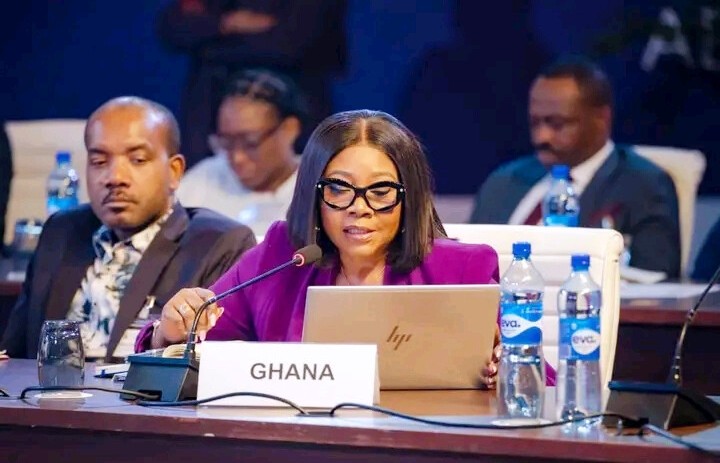
Ghana was represented at the G-24 2026 Technical Group Meeting in Abuja by Matilda Asante, the 2nd Deputy Governor of BoG.
Ghana remains committed to turning dialogue into tangible results that drive inclusive, resilient, and job-rich growth.