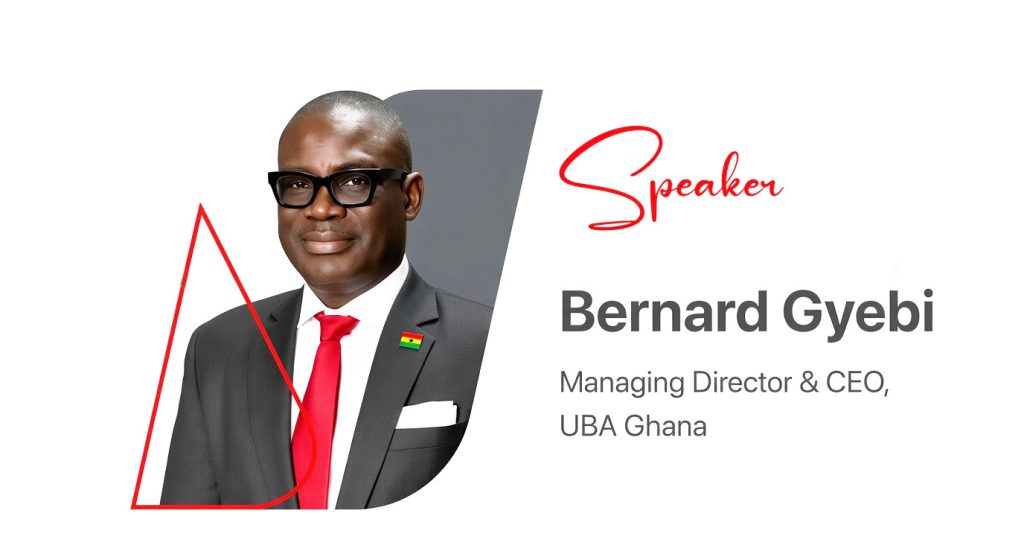
Banking executive to speak on energy reliability and digital innovation as Ghana seeks to strengthen industrial competitiveness
Bernard Gyebi, Managing Director and Chief Executive Officer of UBA Ghana, is set to take the podium at the Ghana Industrial Summit & Exhibition 2026, organised by the Association of Ghana Industries (AGI), where he will lead a conversation on what it will take to reshape the country’s industrial fortunes.
The summit takes place on Tuesday, September 15, 2026, at the Underbridge Annex in East Legon, Accra, drawing together industry leaders, policymakers, entrepreneurs, investors and other stakeholders to chart a path forward for Ghana’s industrial sector. Gyebi’s session carries the theme “Driving Sustainable Export-Led Industrial Growth through Energy Reliability and Digital Innovation” — a title that doubles as a blueprint for the issues he is expected to unpack.
His appearance comes at a moment of mounting pressure on Ghanaian businesses to lift productivity, trim operating costs and hold their own against regional and international competitors.
Much of the discussion is expected to circle back to a familiar but stubborn constraint: electricity. Reliable, affordably priced power remains non-negotiable for manufacturing and other productive sectors, and its absence carries a real price tag — interruptions and cost volatility push up production expenses and chip away at the competitiveness of locally made goods.
For firms with ambitions beyond Ghana’s borders, that makes energy reliability far more than a technical infrastructure concern; it becomes a direct determinant of whether their exports can compete on price and consistency. Gyebi is expected to explore how sturdier energy systems, paired with the right financing and investment, could let industries run leaner and scale up output for both home and overseas markets.
Beyond the power grid, the conversation is expected to turn to digital transformation — a force increasingly reshaping how Ghanaian businesses manufacture, manage supply chains, raise capital, serve customers and break into foreign markets. Digital adoption offers a practical route to lower administrative overhead, sharper efficiency and smarter use of data.
For manufacturers and exporters operating with fewer resources than rivals in larger, more industrialised economies, this could prove to be an equaliser — a way to punch above their weight on international markets. Framed this way, the summit’s conversation is less about Ghana producing more for itself and more about building industries capable of holding their own against global standards.
The emphasis on export-led growth reflects a long-standing ambition: shifting Ghana’s economy away from exporting raw materials and toward exporting processed, value-added goods. Doing so would let the country capture more value from its own resources, generate jobs and strengthen its foreign exchange position.
Local processing of agricultural produce, minerals and other raw materials has the potential to anchor entire value chains — pulling in farmers, manufacturers, logistics providers, financial institutions and exporters alike. But that vision hinges on businesses having consistent access to infrastructure, affordable financing, appropriate technology and, ultimately, markets willing to buy what they produce.
As head of one of Ghana’s major banking institutions, Gyebi’s remarks are also expected to spotlight the financial sector’s role in industrial expansion. Banks provide the working capital, trade finance and investment funding that businesses need to grow — and for exporters specifically, access to trade finance can be the deciding factor in whether a company can fulfil a large overseas order or sustain a relationship with an international buyer.
Bank Of Ghana Celebrates 50 Years Of Rural Banking
A tighter link between financial institutions and industry, in other words, could be what carries Ghanaian businesses from small-scale production into genuine export-oriented operations.
The AGI’s Industrial Summit & Exhibition has steadily grown into one of the country’s key forums for confronting the challenges facing industry and surfacing opportunities for sustainable growth. This year’s focus on export-led industrialisation lands at a pointed moment, as policymakers and business leaders alike look to deepen domestic production and reposition Ghana within regional and global supply chains. Beyond the formal sessions, the event is also expected to offer space for networking and the kind of cross-sector engagement that turns policy talk into partnerships.
Ghana’s push to become a stronger manufacturing and export hub is not something government can deliver alone. It calls for coordinated effort across government, private enterprise, financial institutions, technology providers, energy stakeholders and development partners. Reliable energy lays the groundwork for production; digital innovation sharpens efficiency; access to finance supplies the capital for expansion; and export-oriented policy opens doors beyond Ghana’s borders. How these pieces come together will likely shape how competitive Ghanaian industry becomes over the next decade.
In that sense, Gyebi’s appearance at GISE 2026 is expected to reach beyond the usual banking talking points. At its core, the discussion will grapple with a bigger national question: how does Ghana build an industrial base that is productive, technologically capable and genuinely competitive on the world stage?
As the country continues its push for economic transformation, the capacity to produce competitively and export higher-value goods will remain central to that ambition. Tuesday’s summit gives industry stakeholders a chance to interrogate what still needs to change — from the dependability of the power supply to the pace of digital adoption and the availability of financing — to turn that ambition into reality. With Gyebi bringing the financial sector’s vantage point to the table, the session is expected to offer a grounded look at how energy reliability, digital innovation and strategic financing can combine to build a more resilient, export-ready Ghanaian industrial economy.