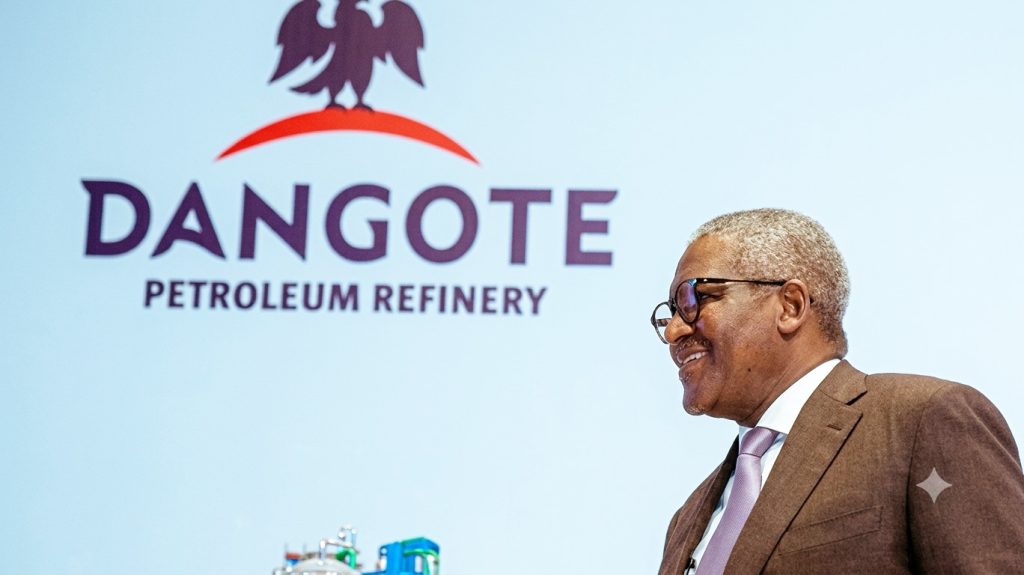
The Dangote Petroleum Refinery and Petrochemicals FZE’s eagerly awaited Initial Public Offering (IPO) has officially launched, marking a significant milestone for Nigeria’s capital market and one of the largest public share offers in African history.
After receiving regulatory permission from Nigeria’s Securities and Exchange Commission (SEC), the IPO started on Monday, September 14, 2026, and it would be available to investors until October 13, 2026.
By offering 4.1 billion common shares at ₦525 each, Dangote Refinery hopes to generate roughly ₦2.15 trillion, or roughly US$1.6 billion.
Retail and institutional investors have the chance to own a share in one of Africa’s most ambitious industrial enterprises thanks to this development. The IPO’s comparatively low entrance barrier for individual investors is among its most noteworthy characteristics. Investors must have at least ₦5,250 to participate at the offer price in order to subscribe for a minimum of 10 shares.
You can purchase additional subscriptions in multiples of ten shares. The framework aims to increase participation and give common people ownership of a significant industrial asset that has historically been connected to Aliko Dangote, one of Africa’s wealthiest industrialists.
Investors who receive shares would become shareholders in Dangote Petroleum Refinery and Petrochemicals FZE, according to the official IPO paperwork. Dividends are not assured, though, and the shares’ value could increase or decrease upon listing.
Speaking at the debut ceremony on the Nigerian Exchange (NGX) trading floor in Lagos, Aliko Dangote presented the deal as more than just a fundraising endeavor.
The wealthy entrepreneur claims that the goal is to increase ownership and enable common people to share in the wealth produced by the refinery.
He claimed that an industrial project of the refinery’s size should not generate value for a select few investors and referred to the IPO as a way of “democratizing wealth creation.”
Additionally, Dangote voiced optimism about the refinery’s future, stating that by the end of 2026, he believes the business will be the biggest in Africa.
Dangote sounded the gong at the NGX to commemorate the debut, and prominent members of Nigeria’s political and commercial establishment were there.
According to sources, the event was also the first time in the 66-year history of the Nigerian Exchange that a refinery was made available for public subscription on the country’s stock market.
Located in Lagos’ Lekki Free Zone, the Dangote Refinery was built over the course of nearly ten years at an estimated cost of US$20 billion. Since it started operating in 2024, the facility has grown to be a significant player in Nigeria’s petroleum sector. It is Africa’s largest oil refinery, producing up to 700,000 barrels of crude oil per day.
Petrochemicals and a variety of petroleum products, such as gasoline, diesel, and aviation fuel, are produced at the refinery. Nigeria’s shift from being largely dependent on imported refined petroleum products to becoming a refined product exporter has also been aided by its emergence.
Mahama Unveils Multi-Billion Dollar Plan To Revive Ghana’s Petroleum Industry
The refinery’s long-term growth and investment ambitions are anticipated to be supported by the funds acquired through the IPO. Dangote Refinery plans to double its existing processing capacity by raising it to about 1.4 million barrels per day.
According to Reuters, the business plans to finance the expansion over the upcoming years using the proceeds. It is anticipated that the development will improve Dangote Refinery’s standing in the global petroleum market and possibly make it the biggest single-train refinery in the world.
Therefore, while Dangote pursues its ambitious expansion goal, the IPO serves as both a means of accessing the financial markets and an opportunity to increase ownership.
According to Reuters, the refinery is estimated to be worth ₦63 trillion, or around US$47.6 billion, at the IPO price of ₦525 per share. Investors and market analysts have already paid close attention to that valuation. The company’s financial performance has significantly improved, and it is now entering the market.
In contrast to a loss of over US$476 million for the all of 2025, Dangote Refinery reported a net profit of about US$1.82 billion in the first half of 2026, according to IPO data published by Reuters. The improved performance reflects the refinery’s increasing production capacity and stronger demand for its refined petroleum products.
The IPO is particularly significant because it changes the ownership structure of one of Nigeria’s most strategically important industrial assets. The public offer represents approximately 3% of the refinery, with Dangote retaining a dominant stake in the company.
The transaction follows a private placement earlier in 2026 that reportedly raised approximately US$2.5 billion from institutional investors for a stake in the refinery.
The public offer, therefore, gives retail investors a chance to participate alongside larger institutional investors. Dangote has repeatedly stressed that the ambition is to bring millions of ordinary people into the investment.
Reports indicate that the company is targeting as many as 10 million retail investors, potentially making the exercise one of the biggest attempts to expand retail participation in Nigeria’s capital market.
The IPO has also been structured to make participation easier through digital channels. Investors can apply through SEC-approved receiving agents and electronic application channels.
SEC warns investors against fraud
With the enormous public interest surrounding the IPO, regulators have also issued a warning to prospective investors. The Securities and Exchange Commission has cautioned the public against unauthorised and fraudulent platforms claiming to offer access to the Dangote Refinery shares.
Investors have consequently been urged to use only officially approved channels when subscribing to the offer.
The warning is particularly relevant because the low minimum investment and huge public interest could make the IPO attractive to fraudsters seeking to exploit unsuspecting investors.
A defining moment for Nigeria’s capital market
Beyond Dangote Refinery itself, the IPO could have a much wider impact on Nigeria’s financial markets. The transaction has the potential to introduce millions of new investors to the Nigerian Exchange and deepen public participation in equities.
It could also encourage other large privately owned African companies to consider public listings as a means of raising capital and broadening ownership. For ordinary Nigerians, however, the significance may be even more personal.
For decades, Dangote’s businesses have been familiar to Nigerians largely through the products they buy and consume. The IPO now gives them an opportunity to move from being consumers of a Dangote business to becoming shareholders in one of the group’s most important assets.
Offer remains open for one month
The Dangote Refinery IPO opened on September 14, 2026, and is scheduled to close on October 13, 2026. The offer price is ₦525 per share, with a minimum subscription of 10 shares at ₦5,250.
If fully subscribed, the company expects to raise approximately ₦2.15 trillion. With the refinery targeting an eventual capacity of 1.4 million barrels per day, investors are effectively being invited to take a stake not only in the refinery’s current operations but also in its ambitious future expansion.
Whether the IPO ultimately lives up to the enormous expectations surrounding it will depend on investor demand, the company’s future financial performance and its ability to execute its expansion plans.
For now, however, September 14, 2026, will go down as the day Africa’s largest refinery formally opened its doors to public ownership.