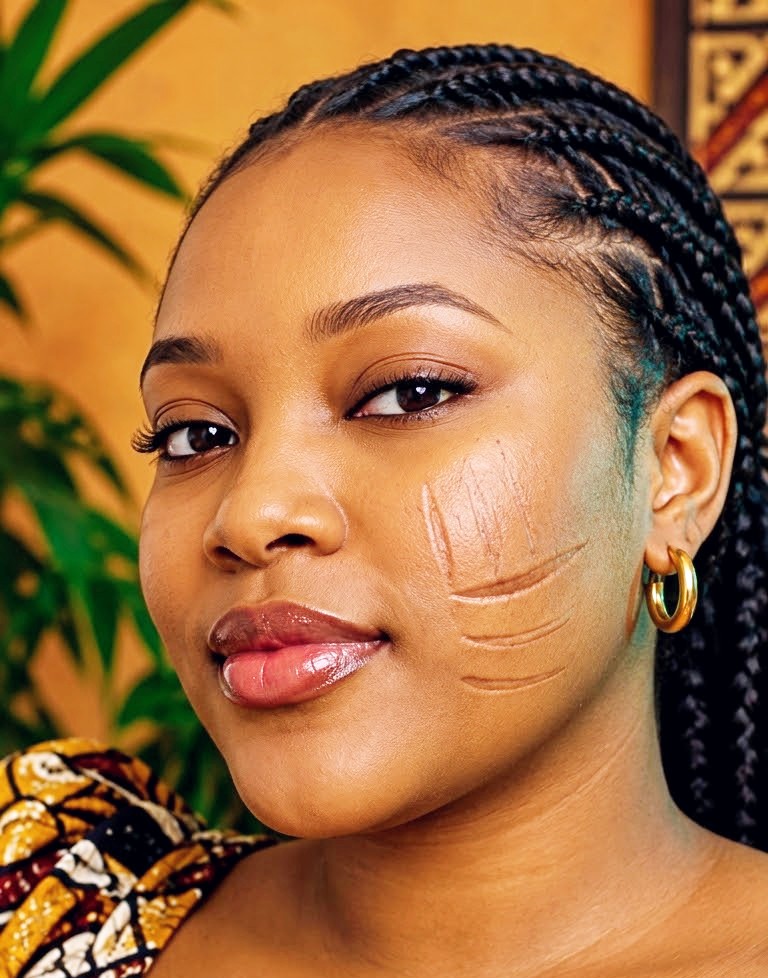
Beauty rarely follows a single formula, and often the very details that set a person apart are the ones we remember longest. Among the most distinctive of these details are tribal marks, traditional facial markings that carry deep cultural, historical and personal meaning in several African communities.
Some people find tribal marks unfamiliar or unusual. Others see in them a proud statement of identity, heritage and beauty. When such markings appear on a strikingly attractive face, the result is a captivating blend of natural good looks and cultural distinction. And what the eye sees is only the surface, because these marks carry stories far deeper than appearance.
What Tribal Marks Have Meant
Across many African societies, especially in Ghana, Nigeria and other parts of West Africa, tribal marks have served a range of purposes over the generations. Depending on the community, they could signal a person’s ethnic group, family line, clan or ancestral home.
They were also treated as valued cultural symbols, handed down through families and communities for generations. The practice has faded considerably in many places, but tribal marks remain a meaningful part of the historical and cultural identity of certain African societies.
When Tradition Meets Beauty
There is something undeniably arresting about tribal marks on a beautiful face. Modern beauty standards often prize smooth, unblemished skin, yet tribal markings invite a different way of seeing attractiveness.
Their patterns, shapes and positions can make a face distinctive and hard to forget. For admirers of African heritage, the marks add character and individuality to features that are already appealing.
They also push back against the notion that beauty must fit a narrow mould. What makes a person beautiful is not necessarily the absence of marks on the skin, but the uniqueness of their look and the confidence with which they carry it.
The Cultural Stories Behind the Marks
Tribal marks are far more than decoration. Their meanings have historically differed from one ethnic group to another. In parts of Nigeria, for instance, facial markings have been linked to Yoruba and other cultural identities, while Ghana and other West African communities have had their own traditional forms of facial and body marking.
Those meanings are not universal. A mark that signals family identity in one community may carry a completely different historical significance in another. That variety is what makes tribal marks such a rich topic in conversations about African identity, ancestry and the preservation of culture.
As African societies evolve, so do views on tribal marks. Many younger people feel increasingly removed from customs that were once considered central to cultural life. Some wear their inherited markings with pride as part of who they are, while others feel conflicted.
This Music Industry Does Not Favor Women At All!
Important questions of consent also arise, especially when markings are made on children who cannot decide for themselves. Honouring cultural heritage should go hand in hand with protecting individual rights and personal choice.
Perhaps the biggest takeaway from this conversation is that beauty should never be confined to one look. A beautiful face does not become less attractive because it bears traditional markings, scars or other distinguishing features. Such traits can make a person even more recognisable and meaningful.
In an age dominated by cosmetic procedures, beauty filters and heavily edited photos on social media, tribal marks are a reminder that natural individuality deserves to be appreciated.
Tribal marks form part of Africa’s complex cultural history. They recall generations who used physical markings to express identity, belonging and tradition. Not everyone agrees with the practice, but its historical significance deserves thoughtful discussion.
A beautiful face with tribal marks can be more than a striking image. It can be a powerful meeting point of physical beauty, cultural heritage and individuality.
In the end, beauty is not about a flawless face. Sometimes the very feature that makes someone different is exactly what makes them unforgettable.