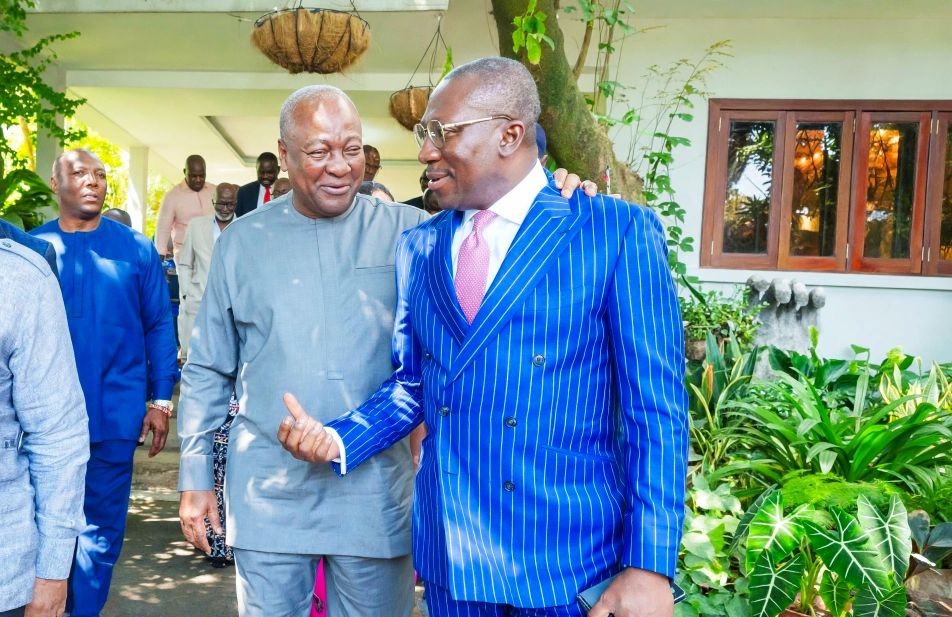
In a notable display of political maturity and cross-party camaraderie, Minority Leader Alexander Afenyo-Markin joined former President Nana Addo Dankwa Akufo-Addo and former First Lady Mrs. Rebecca Akufo-Addo at their private residence in Nima on Tuesday, November 17, 2026, to formally welcome President John Dramani Mahama.
The high-profile gathering has quickly become a major talking point across Ghana, drawing widespread public interest for bringing together heavyweight figures from the nation’s two dominant political traditions. In a political climate frequently defined by intense partisan rivalry, the warm reception at Nima serves as a compelling reminder of the enduring importance of civility, dialogue, and cordial personal relationships among the country’s top leaders.
As the leader of the New Patriotic Party (NPP) caucus in Parliament, Afenyo-Markin’s presence alongside the former First Couple adds a particularly intriguing layer to the visit. Given his position as the chief spokesperson and leading strategist for the parliamentary opposition, his participation in welcoming President Mahama offers a striking contrast to the fiery debates and sharp policy disagreements that routinely characterize proceedings on the floor of the House.
For decades, Ghana’s Fourth Republic has been anchored by fierce competition between the governing National Democratic Congress (NDC) and the opposition NPP. While this vigorous two-party dynamic is essential for democratic accountability, it often creates the public impression of an unbridgeable divide between opposing camps.
However, seeing President Mahama graciously received at his predecessor’s home by both Akufo-Addo and the sitting Minority Leader demonstrates that deep ideological differences and distinct constitutional responsibilities do not preclude mutual respect and personal warmth.
Political analysts and observers have pointed out that Afenyo-Markin’s involvement carries special weight precisely because of his institutional mandate. As Minority Leader, he stands at the forefront of holding the Mahama administration accountable—scrutinizing executive decisions, questioning government policies, and challenging state programs.
Stepping outside the combative arena of legislative oversight to stand side-by-side with the former President in receiving the sitting Head of State projects a broader, more statesmanship-driven model of leadership.
Moreover, the Nima meeting represents a rare convergence of Ghana’s institutional leadership. Under one roof, the gathering united the current occupant of Jubilee House, the immediate past First Family, and the active leadership of the parliamentary opposition.
Damang Mine Handover: Ibrahim Mahama Applauds Akufo-Addo’s Outstanding Intervention
The sheer stature of the individuals involved, combined with the historical and political weight of the offices they hold or have previously occupied, naturally elevates the occasion beyond a routine social visit.
For many everyday Ghanaians watching the developments unfold, the encounter invites a timely reflection on the delicate balance between fierce political competition and national cohesion.
Even when the NDC and NPP clash strongly over economic recovery, governance frameworks, and national development priorities, visible moments of unity among their principals reassure citizens of the underlying stability of Ghana’s democracy.
Ultimately, President Mahama’s visit to the Akufo-Addo residence—and the unified, welcoming front presented by the former First Couple and Alexander Afenyo-Markin—stands out as a memorable milestone in contemporary Ghanaian politics.
As discussions surrounding the meeting continue across traditional and social media, the enduring takeaway remains clear: that above partisan lines and political battles, a shared commitment to mutual respect and national unity continues to bind Ghana’s leadership together.