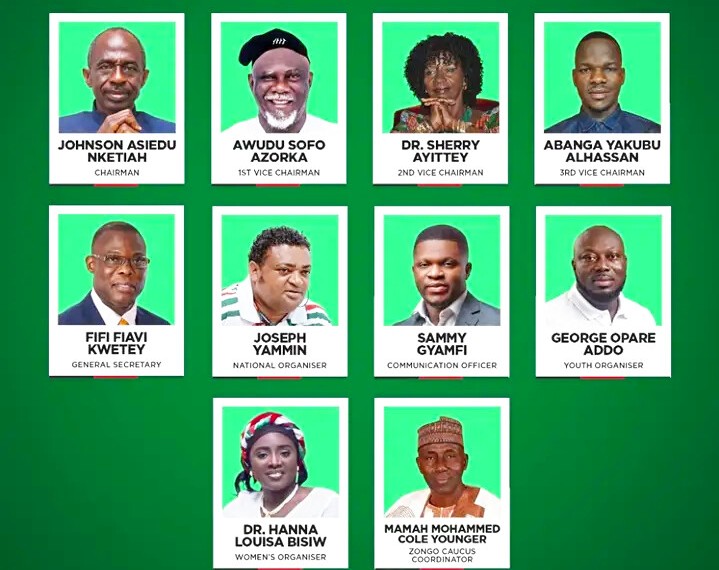
The National Democratic Congress has issued a firm, constitutionally grounded directive requiring government appointees who wish to contest internal party positions to step down from their public roles — with the first wave of resignations due before the end of April 2026.
The directive, framed by the party as non-negotiable, forms the backbone of a structured transition process designed to govern how the ruling party reorganises itself while simultaneously holding the reins of government under President John Mahama.
The resignation requirement targets a specific class of officeholders: Ministers and Deputy Ministers, Chief Executives and Managing Directors of state institutions and their deputies, and Metropolitan, Municipal, and District Chief Executives — collectively, those occupying full-time public appointments funded by the state.
Any such official harbouring ambitions for a party executive role must choose between their government post and their political candidacy. The party has staggered the resignation deadlines by level of contest:
Constituency-level aspirants face the earliest cutoff, with resignations required by April 2026. Those targeting regional executive positions have until May 2026, while aspirants for national-level roles must resign by June 2026. Notably, chairpersons and members of government boards are broadly exempted from the requirement.
The Principle Behind this move:
The NDC has been explicit about the reasoning underpinning the directive. Party leadership has described it as a measure to level the playing field, eliminate conflicts of interest, and address what has been characterised as institutional greed — the practice of officials simultaneously drawing the benefits of government appointment while positioning themselves for party office. The imagery deployed by the party is pointed: no one should be permitted to stand with “one leg here and another there.”
Official: Burkina Faso Withdraws Tomato Export Ban On Ghana
The policy’s constitutional grounding is central to how the party is presenting it — not as a discretionary guideline open to interpretation or negotiation, but as a binding condition of participation in the internal elections process.
Eyes on December:
The immediate resignations feed into a broader electoral calendar culminating in the National Executive Congress elections, scheduled for December 19, 2026, when the party will elect its next crop of national executives. The internal polls represent a significant moment for the NDC as it navigates the demands of governing while simultaneously managing a competitive internal reorganisation.
By enforcing clean breaks between state appointments and party ambitions well ahead of that date, the NDC is signalling an intent to ensure that its internal democracy is seen — and experienced — as structurally fair, with no incumbent advantage derived from the resources or visibility of public office.