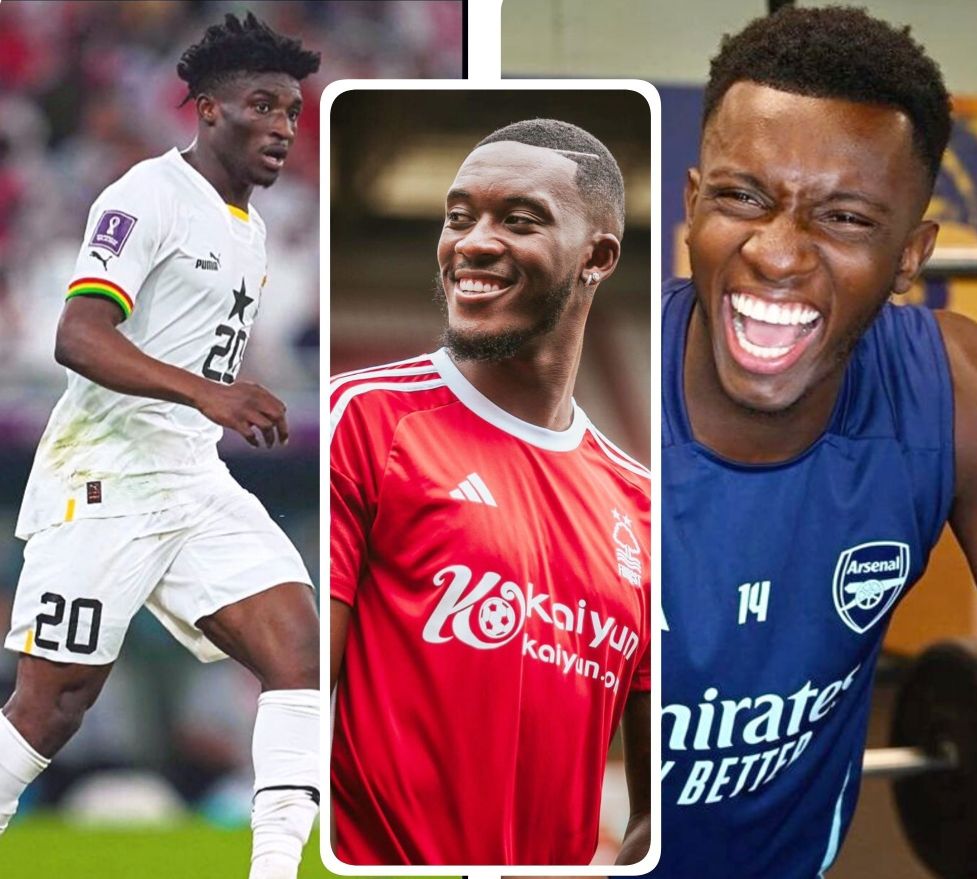
Mohammed Kudus gets injured, and suddenly the questions that were simmering quietly in the background of Ghanaian football begin to boil over.
It is a measure of just how central the West Ham midfielder has become to the Black Stars’ attacking identity that his absence — however temporary — is enough to trigger an urgent reassessment of Ghana’s squad building strategy ahead of the 2026 World Cup. And at the heart of that reassessment lie two names that have been circulating in Ghanaian football circles for some time: Callum Hudson-Odoi and Eddie Nketiah.
The Kudus Problem:
To understand why his injury carries such weight, you need only look at what Kudus brings to the Black Stars. His creativity in tight spaces, his relentless ball-carrying, and his ability to conjure moments of individual brilliance have made him Ghana’s most dangerous and unpredictable attacking weapon. He is, in many ways, irreplaceable in profile — but that is precisely why the question of squad depth has become so pressing.
An extended absence exposes a vulnerability that Ghana’s technical team can no longer afford to paper over. With a World Cup on the horizon, the margin for error is slim, and the conversation around reinforcing the attacking ranks has moved from casual debate to genuine urgency.
Hudson-Odoi and Nketiah: The Case for Action
In the past week, the noise around both Hudson-Odoi and Nketiah has grown considerably louder — fuelled by fans, pundits, and a football public that senses an opportunity slipping away if decisive action is not taken.
Hudson-Odoi’s situation is the more complex of the two. Having previously represented England at senior level, his eligibility for a nationality switch hinges on FIFA’s regulations governing international allegiance changes — a process that is possible but requires careful navigation. What is beyond dispute, however, is what he would bring to the Black Stars. His pace, his directness, and his experience across Europe’s top leagues make him a natural fit for the wide attacking role that Kudus vacates. In profile, he is perhaps the closest approximation available.
Nketiah offers something altogether different. Where Hudson-Odoi provides width and creativity, the Arsenal striker brings penalty box intelligence — clinical finishing, sharp movement, and a physical presence that Ghana’s attack has often lacked. His inclusion would not slot neatly into the Kudus void, but it would force a tactical rethink that could ultimately make Ghana a more balanced and unpredictable attacking unit.
It would be misleading to suggest that the dual-nationality conversation began with Kudus’ injury. These discussions have been ongoing for months, quietly building as Ghana’s World Cup preparations gathered pace. What the injury has done is strip away the luxury of time.
Dede Ayew Is Exceptional And Spiritually Strong —Prophet
The Ghana Football Association now faces a question that demands more than a diplomatic response — it demands action. Convincing high-profile dual-national players to commit their international futures to the Black Stars requires more than an informal approach. It requires vision, persistence, and the kind of compelling football project that makes the choice feel worthwhile.
There is, buried within this moment of concern, an opportunity. Kudus’ injury — if it forces Ghana to finally make its move on players like Hudson-Odoi and Nketiah — could end up being the catalyst for a squad transformation that serves the Black Stars well beyond any single tournament.
The 2026 World Cup represents Ghana’s chance to re-establish itself on the global stage after years of near-misses and disappointments. Building the strongest possible squad is not optional — it is existential. And sometimes, it takes a crisis to force the decisions that should have been made all along.