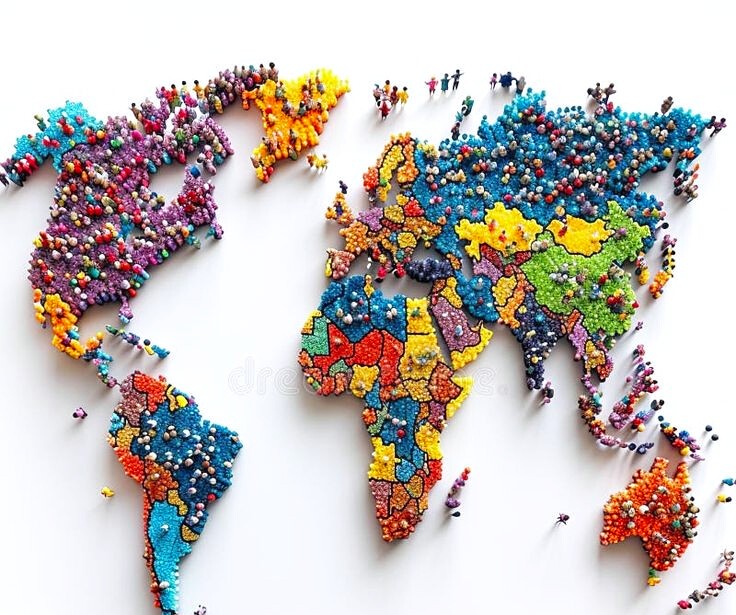
The global population has reached approximately 8.3 billion people. Growth continues, but the pace has eased — the world now adds roughly 60 to 70 million people annually, a slower clip than the explosive expansions of the 20th century. Yet even at this tempered rate, the compounding weight of billions more lives is reshaping economies, ecosystems, and geopolitics in ways that will define the coming decades.
It has become fashionable to treat population growth as an unambiguous threat. The reality is considerably more nuanced.
More people means greater demand — for food, water, energy, land, and housing. In regions where infrastructure is weak and governance is thin, that pressure can translate into shortages, price spikes, and social strain.
Cities across Africa and Asia are expanding at a pace that often outstrips planning capacity, generating a paradox of opportunity and dysfunction: new markets and labour pools on one hand; overcrowding, gridlock, and housing deficits on the other.
Yet a growing population — particularly a youthful one — carries genuine economic promise. A larger workforce supports production, expands consumer markets, and furnishes the raw material for innovation and entrepreneurship.
The crucial qualifier, as economists have long noted, is whether education systems and job markets can absorb that potential. Where they do, demographic growth becomes a dividend. Where they fall short, it becomes a liability.
The environmental stakes are harder to reframe. More people means more carbon emissions, more waste, and intensifying pressure on forests, oceans, and biodiversity. This is not a matter of framing or governance — it is arithmetic. Addressing it requires technological ingenuity and political will on a scale the world has rarely sustained.
Public services face their own arithmetic. Healthcare, education, transport, and sanitation systems designed for smaller populations must either scale or buckle. Governments that invest strategically in their people tend to bend that curve. Those that do not find themselves in a compounding crisis with few easy exits.
Washington To Host World Bank Group Spring Meetings This Year
Population growth, in short, is neither good nor bad in itself. Its consequences are downstream of policy, planning, and political will.
Africa’s Coming Demographic Dominance:
Within the global story, one regional shift stands apart in its scale and consequence: Africa’s population trajectory over the next two to three decades is among the most significant demographic developments in modern history.
While Europe ages, East Asia contracts, and parts of North America struggle to maintain population replacement rates, Africa is growing — fast, young, and with enormous momentum.
By 2050, roughly one in four people on Earth will be African. The median age across much of the continent will remain below 25. Africa will not merely be part of the global demographic picture; in important respects, it will be that picture.
The Labour Shift:
The first-order consequence is economic. As older regions confront acute labour shortages — a dynamic already reshaping policy in Germany, Japan, South Korea, and Canada — Africa will hold the world’s largest concentration of working-age people. Countries such as Nigeria, Ethiopia, Egypt, and the Democratic Republic of Congo are on course to develop enormous productive-age populations at precisely the moment the rest of the world needs them most.
The mechanisms of that connection are already visible: remote work, outsourcing, and migration are increasingly routing African talent toward global demand.
Manufacturing and service industries are beginning to follow the logic that drove investment into East and Southeast Asia in earlier decades. The direction of travel is clear, even if the pace remains uncertain.
Alongside the labour story runs a consumption story. As African incomes rise and cities expand, the continent’s middle class is projected to grow substantially — generating demand for technology, housing, transport, food, and retail at a scale that will attract serious global capital.
Africa is positioning itself as one of the world’s next great consumer markets, with all the investment attention and infrastructure development that historically accompanies that status.
Megacities are the physical expression of this shift. Lagos, Cairo, Nairobi, and Kinshasa are already expanding dramatically. New urban centres are emerging. Construction, energy, and technology companies with a clear read on the future are already repositioning accordingly.
Developing Nations Using Wrong Tools For Industrial Growth – World Bank
Not all the consequences are straightforwardly positive. If job creation fails to keep pace with population growth — a real and present risk in several African economies — the result will be accelerated migration. More young Africans will seek opportunities abroad, and remittances back to the continent will grow even more critical to household and national economies. Migration managed well is a resource; migration born of desperation is a source of political instability on both ends of the journey.
Ultimately, what Africa’s demographic surge produces depends less on the numbers themselves than on the institutional environment that shapes them.
Education quality, employment generation, infrastructure investment, and political stability are the decisive variables. Get those right, and Africa becomes the most consequential growth engine of the 21st century — a counterweight to global ageing, a new frontier of consumption, and a reservoir of innovation.
Fail to get them right, and the same numbers become a source of strain: for African societies first, and for a globally interconnected world by extension.
The demographic story has already been written. What remains to be determined is what the world does with it.