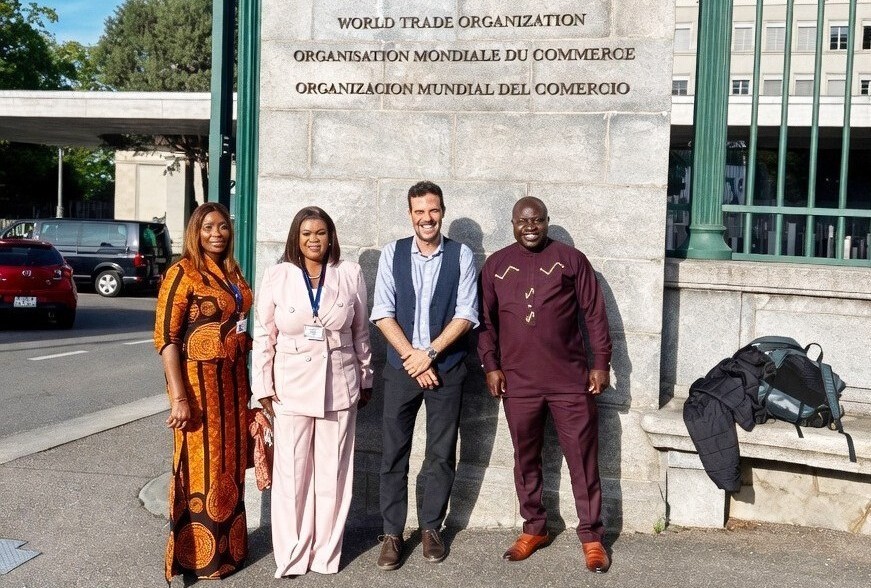
Ghana’s trade delegation arrived in Geneva last week carrying more than briefing documents — they carried a statement of intent. From April 27 to 30, officials from the Ghana Free Zones Authority (GFZA), the Ghana International Trade Commission (GITC), and the Ministry of Trade, Agribusiness and Industry (MOTAI) participated in a series of high-level World Trade Organization committee meetings at the WTO’s headquarters in Switzerland, signalling Accra’s continued commitment to playing an active, rules-compliant role in the multilateral trading system.
The engagements covered three of the WTO’s most technically demanding forums: the Committees on Safeguards, Subsidies and Countervailing Measures (SCM), and Anti-Dumping Practices (ADP) — bodies that sit at the heart of global trade governance and shape how nations structure their economic incentive frameworks.
The centrepiece of Ghana’s participation was the SCM Committee meeting, where member states submit and defend their subsidy notifications under the rigorous scrutiny of trading partners. The process is a cornerstone of WTO transparency architecture — member governments are required to disclose their subsidy programmes, respond to technical questions, and clarify policy positions before the full membership.
Ghana fulfilled its obligations under Article 25 of the WTO Agreement on Subsidies and Countervailing Measures, submitting its national subsidy notification in line with the treaty’s disclosure requirements.
It was a procedural step, yes — but one that carries considerable diplomatic and economic weight. In the language of international trade, a timely, accurate subsidy notification is a country’s way of saying: we are here, we are serious, and we play by the rules.
For Ghana, whose Free Zones Programme offers a suite of investment incentives designed to attract export-oriented businesses, maintaining that credibility is not optional — it is foundational.
Beyond the formality of notifications, the Geneva meetings offered Ghana’s delegation something arguably more valuable: a front-row seat to the evolving conversation about what international trade rules will look like in the years ahead.
Global standards on subsidies and countervailing measures are not static. They shift in response to geopolitical pressures, changing economic orthodoxies, and the ongoing tug-of-war between development imperatives and free trade principles. For a country like Ghana — still deepening its industrial base and working to position itself as a competitive destination for foreign direct investment — staying ahead of those shifts is essential.
How Patricia Poku-Diaby Became Ghana’s Most Powerful Female Entrepreneur
The insights gathered in Geneva will feed directly into how Ghana calibrates its incentive frameworks going forward, particularly those governing the Free Zones Programme. The goal is a balance that has always been delicate but is now more important than ever: incentives generous enough to attract serious investors, structured in ways that keep Ghana fully on the right side of its international obligations.
On the sidelines of the formal meetings, the delegation paid a courtesy call on His Excellency Emmanuel Antwi, Ghana’s Ambassador and Permanent Representative to the WTO. The briefing served as an opportunity to align the delegation’s objectives with the Mission’s diplomatic priorities in Geneva.
Ambassador Antwi used the occasion to reinforce a point that underpins Ghana’s entire trade engagement strategy: the Ghana Free Zones Authority is not a peripheral institution in this story. It is a central driver of the country’s export-led industrialisation agenda — an engine for investment, competitiveness, and job creation whose work has direct implications for how Ghana is perceived in boardrooms and trade ministries around the world.
GFZA’s Delegation:
The Authority was represented in Geneva by Mr. Musah Sibiri Hamidu, Deputy Chief Executive Officer in charge of Finance and Administration, and Dr. Patience Agbleze Acorlor, Director of Corporate Affairs, Public Relations and Aftercare — two senior officials whose presence at a WTO committee meeting reflects the seriousness with which the GFZA is approaching Ghana’s trade compliance responsibilities.
Their participation is a reminder that the work of ensuring Ghana’s business environment remains both competitive and compliant is not done in Accra alone. It is done, in part, in the committee rooms of Geneva — where the rules of global trade are written, debated, and defended.