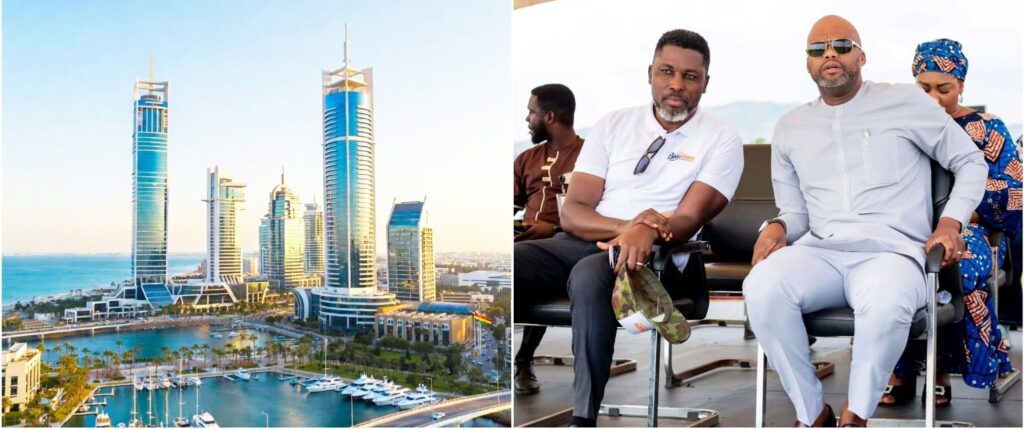
A bold development vision attributed to Gomoa Central MP Kwame Asare Obeng (A Plus) is sparking debate after he declared that Gomoa could, within a decade, become to Ghana what Dubai is to the United Arab Emirates.
The proposal, framed under what has been described as “Vision 2036,” paints an ambitious picture of rapid transformation—one that would see the Central Region enclave evolve into a major economic, tourism, and infrastructure hub within ten years.
A vision of rapid transformation
According to the concept, Gomoa would be repositioned as a modern urban centre, attracting both local and international investment while developing world-class infrastructure. The comparison to Dubai suggests aspirations for:
•High-end real estate and smart city developments
•A thriving tourism and hospitality industry
•Efficient transport systems and logistics networks
•Strong private-sector participation in economic growth
Dubai, widely regarded as a global city, achieved its status through decades of strategic planning, heavy investment, and deliberate economic diversification.
While the vision has captured public attention, development analysts caution that replicating Dubai’s trajectory within a decade would be extremely challenging.
He shared on social media:
Vision 2036:
“In 10 years, Gomoa will be to Ghana what Dubai is to the UAE. We may not have the money or big financiers today, but we will build an industrial city because what we carry cannot be measured in dollars. We have faith in God. We have clarity of vision. And above all, we have common sense in commercial quantities”.
“We understand trade. We understand people. We understand opportunity. Where others had capital, we will use conviction. Where others had support, we will use strategy. Where others had a head start, we will create momentum”.
“Vision 2036 is not a dream, it is a decision to use what we have to build what we need; A hub of industry, commerce, innovation, and opportunity. A place where the ordinary Ghanaian can rise, work, create, and prosper”.
“And when it is done, we will build a cemetery where one day our gravestones it will read: Here lie the men and women who touched the sky with a ladder.”
Urban planners point to the scale of investment required—running into billions of dollars—as well as the need for consistent policies, institutional efficiency, and long-term planning. Dubai’s transformation, they note, was not instantaneous but the result of sustained effort over several decades, backed by strong governance and global capital inflows.
“Ambition is important, but timelines must reflect economic and structural realities,” one policy analyst noted. “What is achievable in ten years is significant progress—not necessarily parity with a global city like Dubai.”
Opportunities for growth:
Despite the skepticism, observers acknowledge that Gomoa holds real potential for accelerated development. Its proximity to Accra, expanding population, and available land make it a viable candidate for:
•Satellite city expansion
•Real estate and housing projects
•Tourism development along coastal areas
•Small- to medium-scale industrial growth
A Plus’ Gomoa Waterfall Feasibility Studies Now Underway
If properly planned, such initiatives could position Gomoa as a key growth pole within the Central Region and beyond.
Reactions:
Public responses to the Vision 2036 concept have been divided. While some Ghanaians see it as an inspiring and forward-thinking agenda, others view it as overly optimistic, questioning the feasibility of such rapid transformation given current economic constraints. Still, supporters argue that bold visions are necessary to drive change and attract investment, even if the ultimate outcome falls short of the initial comparison.
At its core, the Gomoa–Dubai comparison underscores a broader conversation about Ghana’s development trajectory—how quickly it can urbanise, industrialise, and compete globally.
Whether or not Gomoa becomes “the Dubai of Ghana” by 2036, analysts agree that the real measure of success will be tangible improvements in infrastructure, job creation, and quality of life for residents.
For now, Vision 2036 remains a powerful statement of intent—one that has ignited both hope and healthy skepticism about the future of development in Ghana.
One thought on “Gomoa Could Become Ghana’s Beautiful Dubai By 2036— MP”