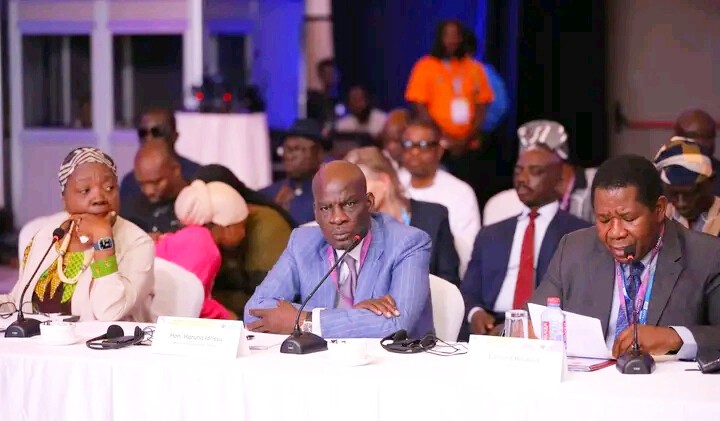
Education leaders, policymakers, development partners, and technology experts gathered at the 18th Ministerial Round Table this week with a clear and unified message: Africa’s digital education transformation must be driven by African minds, African values, and African leadership — not imported solutions.
Delivering the keynote address, Ghana’s Minister for Education, Haruna Iddrisu, set a bold tone from the outset. He issued a direct challenge to the continent — to move from being a passive consumer of globally developed technologies to becoming an active architect of its own digital learning future.
Minister Iddrisu pointed to Ghana’s ongoing investments in digital education, STEM, artificial intelligence, robotics, and curriculum reform as evidence that the shift is already underway. But he made clear that individual national efforts must be part of a broader continental commitment. Africa, he argued, must prioritise the development of locally relevant educational content, reinforce its educational institutions, and guarantee that technology-enabled learning reaches every student — not just those in well-resourced urban centres.
On artificial intelligence specifically, Iddrisu called for deliberate investment in AI literacy across the continent and urged the establishment of ethical frameworks rooted in African values and realities. His warning was pointed: a future in which Africa simply adopts and consumes AI technologies designed elsewhere — without shaping their creation or governance — is a future in which the continent surrenders its agency in one of the most consequential technological shifts of the century.
UNESCO: Foundations First, Technology Second
Also addressing the round table, Edmond Moukala, UNESCO Representative to Ghana, offered a complementary perspective — one that grounded the conversation in the enduring importance of foundational skills even as digital tools reshape the educational landscape.
Moukala emphasised that reading, writing, critical thinking, and information literacy remain the essential building blocks upon which digital and AI competencies must be constructed. No amount of technological investment, he cautioned, can substitute for a learner who cannot read fluently or reason independently. He further advocated for the creation of public digital learning platforms designed to support teachers, protect student data, and ensure that education remains a public good — accessible to all, not a commodity available only to those who can afford it.
Why Ghana’s Education System Needs an Urgent Revamp Now!
The round table concluded with stakeholders reaffirming a collective commitment to responsible technology use, deeper cross-continental collaboration, and the advancement of home-grown, inclusive, and sustainable digital learning systems.
The conversations throughout the gathering reflected something beyond policy consensus — they captured a growing continental conviction that Africa’s educational future cannot be outsourced. From curriculum design to AI governance, from teacher training platforms to data sovereignty, the decisions made now will determine whether Africa’s digital education revolution is one the continent leads or one it merely inherits.
The message from the 18th Ministerial Round Table was unambiguous: the time for African-led, African-owned educational transformation is not approaching — it is now.