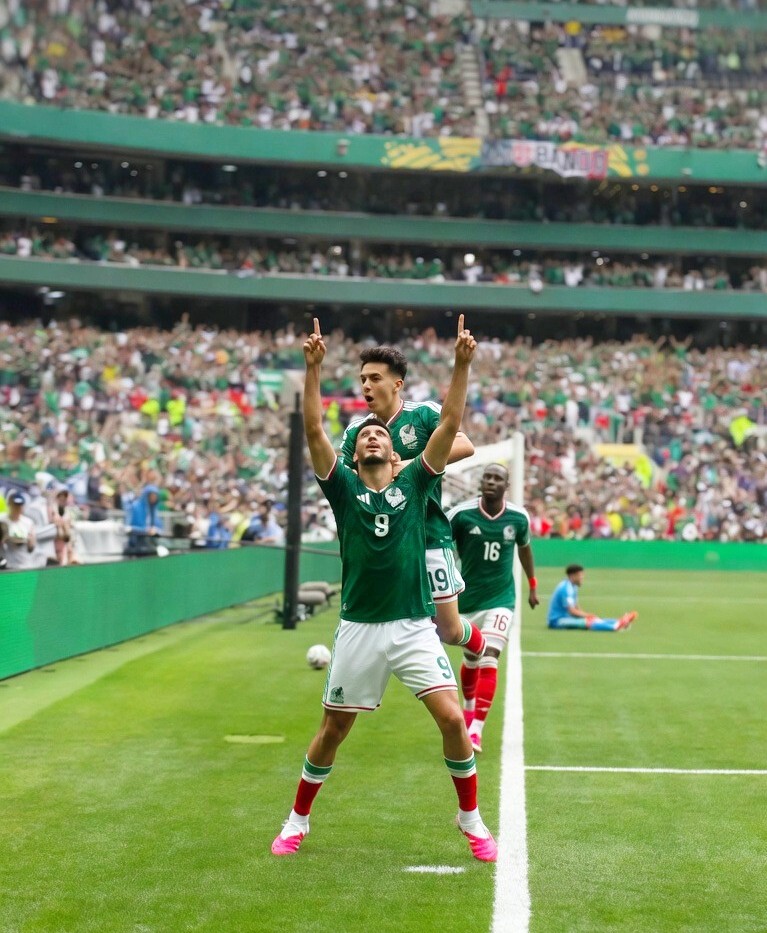
The 2026 FIFA World Cup announced itself to the world on Thursday night with goals, red cards, and a roaring Estadio Azteca delivering exactly the kind of theatre football’s biggest stage demands.
Co-hosts Mexico defeated South Africa 2–0 in a fiery Group A opener, with over 80,000 fans packed inside the iconic Mexico City ground — which made history as the first stadium to host three World Cup opening matches. The atmosphere was electric from the first whistle, and the action wasted no time in matching it.
Julián Quiñones gave the hosts the perfect start, breaking the deadlock in the ninth minute to score what was also the first goal of the entire 2026 FIFA World Cup. The strike sent the home faithful into raptures and set the tone for a Mexican performance full of intent and purpose.
South Africa, back on the global stage for the first time since 2010, showed resilience and gradually grew into the contest. But the Bafana Bafana’s evening unravelled dramatically in the second half as reckless challenges and flashpoint confrontations saw the referee brandish three red cards — two for South Africa and one for Mexico. Left with nine men, the visitors were unable to mount any meaningful comeback.
Raúl Jiménez put the result beyond doubt in the 67th minute, finally opening his FIFA World Cup account in his fourth appearance at the tournament. It was a moment of personal relief as much as tactical security, and it sealed what was a thoroughly dominant display by El Tri.
The 2–0 victory was also a landmark result in Mexican football history. It was the country’s first-ever win in a World Cup opening match, ending a run of five defeats and two draws across eight previous attempts — including a 1–1 draw against this same South Africa side in Johannesburg sixteen years ago.
Group A now takes shape with Mexico firmly in the driving seat, while South Africa face the added challenge of suspension-depleted resources heading into their next fixture. For the millions watching across the globe, the 2026 FIFA World Cup has served its opening-night promise — and with 47 matches still to come across the United States, Mexico, and Canada, there is plenty more drama yet to unfold.
The goals wrote the headline, but the red cards wrote the footnote history books will not forget.
No Bottles Allowed: FIFA’s New Stadium Rules For The 2026 World Cup Explained
Mexico’s 2–0 victory over South Africa on Thursday night was already destined for the record books — but not solely because of what Julián Quiñones and Raúl Jiménez produced in attack. By the time Brazilian referee Wilton Pereira Sampaio blew the final whistle at the Estadio Azteca, three players had been dismissed in a single World Cup opening match for the very first time. More remarkable still — not one of the three dismissals came via a second yellow card. Every red was direct. Every one was immediate. Every one was earned.
The pattern of the second half was set within four minutes of the restart. Already a goal down and playing catch-up in front of a hostile Azteca crowd, South Africa’s afternoon turned significantly darker when defender Sphephelo Sithole was dismissed for upending Mexico midfielder Brian Gutiérrez in full flight. Gutiérrez had cleverly cut inside his marker and was bearing down on goal when Sithole’s foul halted the attack — denying a clear goalscoring opportunity in the most unambiguous of circumstances.
Referee Sampaio needed no assistance from VAR. The red card was instant, and Sithole became the unwanted holder of a unique distinction: the first player sent off at the 2026 FIFA World Cup.
The Africans, already chasing the game, were now doing so with ten men. South Africa’s Themba Zwane was sent off in the 84th minute.
If the first dismissal was clinical in its logic, the second was combustible in its nature. Substitute Themba Zwane, introduced to inject urgency into a Bafana Bafana side desperately searching for a way back into the match, instead made the situation dramatically worse. In a tussle with Mexico winger Roberto Alvarado, Zwane’s hand connected with Alvarado’s face — an act of violent conduct that the referee initially missed from his position. VAR, however, did not. After a review of the footage, Sampaio returned to the pitchside monitor, studied the incident, and produced the second red card of the evening.
South Africa were now down to nine men. The match, to all footballing intent, was over. It was also the first occasion since the notorious 2006 clash between Portugal and the Netherlands that a single team had received two red cards in a World Cup match.
2026 FIFA World Cup: The Youngest Squads and Breakout Teenagers
Even in victory, Mexico did not escape unscathed. Deep into stoppage time, with the result long since settled, captain and centre-back César Montes lunged into South Africa right back Khuliso Mudau as he drove into the penalty area. The challenge was reckless, the red card unavoidable. Sampaio brandished his third of the night — this time against the hosts — and completed a disciplinary chapter that had no precedent in World Cup opening match history.
Three red cards. Three straight dismissals. A record that nobody had planned for and nobody will quickly forget.
Thursday’s contest was the first World Cup fixture to produce three or more dismissals since the 2006 Round of 16 encounter between Portugal and the Netherlands — the so-called Battle of Nuremberg — where four red cards and sixteen yellow cards turned a football match into something resembling an organised brawl. That game remains the most carded in World Cup history. Mexico vs. South Africa now sits uncomfortably close to that infamy.
The consequences will be felt immediately. All three dismissed players face automatic one-match bans. Sithole and Zwane will both miss South Africa’s critical Group A clash against the Czech Republic — a match the Bafana Bafana can ill afford to enter weakened. For Mexico, the absence of Montes is a more nuanced concern. He may have lifted the trophy of victory on Thursday, but Javier Aguirre will be without his captain and first-choice centre-back when El Tri face South Korea in Guadalajara — a test that will demand defensive solidity.
The 2026 FIFA World Cup had barely drawn breath before it delivered a night of goals, drama, and discipline that will define the conversation for days. For the right reasons and the wrong ones alike, nobody who was inside the Azteca on Thursday night — or watching from anywhere on earth — will forget what they witnessed.