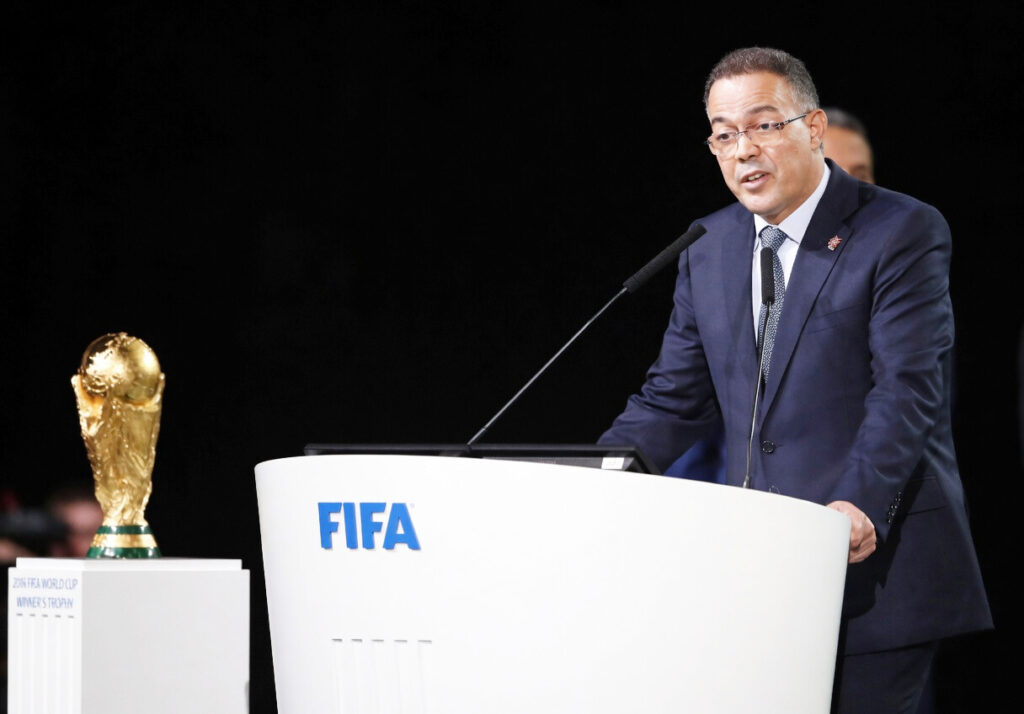
With co-hosting rights for football’s biggest prize already secured, Morocco’s football leadership is setting its sights beyond the continent — and reshaping the country’s sporting ambitions in the process.
Morocco is quietly reorienting its football strategy, stepping back from the pursuit of African continental tournaments to focus its energy and resources on a pair of landmark global events: the 2029 FIFA Club World Cup and the 2030 FIFA World Cup.
The shift has been signalled by Fouzi Lekjaa, President of the Royal Moroccan Football Federation, and reflects a calculated decision by the country’s football leadership to stop spreading itself across CAF competitions and instead concentrate its considerable infrastructure investment where the global spotlight burns brightest.
The move would represent a striking change of posture for a country that has been among the most active bidders and hosts of major African football tournaments in recent years.
Morocco hosted the 2025 Africa Cup of Nations, cementing its reputation as one of the continent’s most capable and ambitious sporting destinations. But that, it appears, may mark the end of a chapter rather than a continuing pattern.
With co-hosting rights for the 2030 FIFA World Cup already secured alongside Spain and Portugal, Moroccan football officials appear to have made a clear-eyed assessment: the country’s resources are better deployed in service of the world’s most-watched sporting event than in competing for tournaments that, however prestigious within Africa, operate on a smaller global scale.
Underpinning the pivot is a sweeping national investment programme. Morocco has poured resources into new stadiums, expanded transport networks, upgraded airports, and developed tourism infrastructure — all with an eye toward positioning the country not just as a one-time World Cup co-host, but as a permanent fixture on the international sporting calendar.
Courtois Hints At International Retirement After 2026 World Cup
The 2029 FIFA Club World Cup, in its expanded format, offers an ideal proving ground. Hosting that tournament would allow Morocco to stress-test its venues and logistics ahead of the far larger undertaking in 2030, while also building relationships with the world’s elite club sides and their global fanbases.
What It Means for African Football
Should the strategy be confirmed as official policy, its implications for African football would extend well beyond Morocco’s borders. The country has long been a reliable and capable host for CAF events, and its withdrawal from the bidding circuit would leave a notable gap at a time when the continent is still working to build a reliable pool of tournament-ready nations.
For Morocco, however, the calculus appears straightforward. Having already climbed to the summit of African football hosting, the federation is now asking a different question — not how to remain the continent’s premier football destination, but how to take its place among the world’s most sought-after sporting nations.
The 2030 World Cup, shared with two European footballing powerhouses, is the vehicle for that ambition. Everything else, it seems, is secondary.