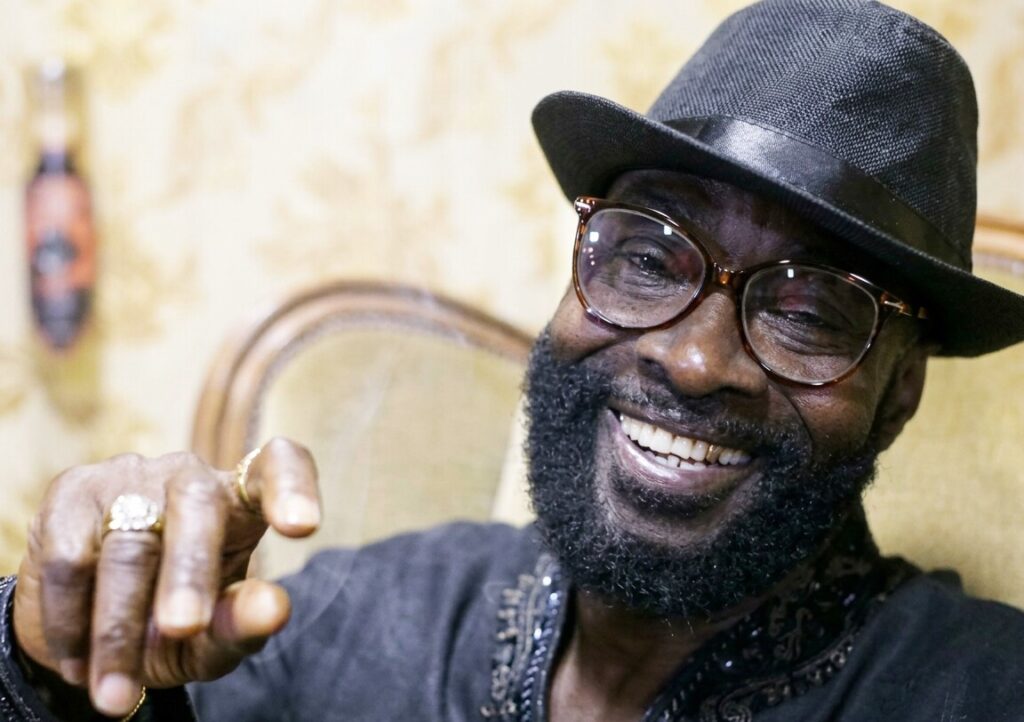
There are musicians who shape an era. And then there are those who shape a genre itself — bending it, preserving it, and breathing new life into it across generations. Pat Thomas belongs firmly in the second category.
For more than fifty years, the man born Nana Yaw Kumi has stood at the very summit of Ghanaian highlife, not merely as a performer, but as a living embodiment of everything the genre represents — its joy, its depth, its cultural rootedness, and its extraordinary capacity to endure.
Pat Thomas rose to national prominence in the 1970s as the lead vocalist of the celebrated Sweet Beans band, a platform that would prove transformative for both artist and genre. His partnership with legendary producer and musician Ebo Taylor during this period was particularly significant — together, they forged a distinctive sound that wove traditional highlife rhythms together with threads of Afrobeat, funk, and jazz, creating something that felt simultaneously rooted and forward-looking.
It was a blueprint that would define his career, and influence countless artists who came after him.
A Voice Like No Other
At the heart of Pat Thomas’ enduring appeal is a voice that defies easy categorisation. Powerful yet warm, technically precise yet emotionally raw — his vocal instrument possesses a rare combination of qualities that allows him to move effortlessly between the exuberance of a dancefloor anthem and the quiet introspection of a reflective ballad.
Whether delivering a lyric in Akan, Ga, or English, Thomas brings a clarity and authenticity to every phrase that makes the language almost secondary to the feeling being conveyed. Audiences who do not speak a word of Twi have been moved by his performances — a testament to the universal emotional language his voice speaks.
But what truly sets him apart is his refusal to treat that voice as an end in itself. For Pat Thomas, the voice is a storytelling instrument — a vehicle for narratives about love, social values, perseverance, and the textures of everyday Ghanaian life. Through expressive phrasing and precise intonation, he builds an emotional bridge between artist and listener that has held firm across generations.
His songwriting is equally formidable. Throughout his career, Pat Thomas has demonstrated a consistent gift for crafting compositions that are both deeply culturally specific and universally resonant — drawing on Ghanaian proverbs, communal traditions, and the lived realities of ordinary people to produce songs that feel both personal and collective.
Tracks like “Sika Ye Mogya,” “Mewo Akoma,” and “Odo Adaada” stand as evidence of his mastery — built around memorable melodies, intricate rhythmic patterns, and chorus structures designed to pull audiences in and keep them there. This participatory quality is no accident. It is a deliberate echo of the communal spirit that lies at the very core of classic highlife.
Perhaps the most remarkable aspect of Pat Thomas’ artistic journey is his adaptability. Where many artists of his era either resisted change entirely or abandoned their roots in pursuit of contemporary relevance, Thomas found a third path — embracing modern production techniques and evolving musical sensibilities while never surrendering the authentic instrumentation and rhythmic DNA that make highlife what it is.
Highlife Defines Ghana’s Beautiful Identity—Reggie Rockstone
His later works sound contemporary without feeling disconnected. They are the product of an artist who understands that evolution and preservation are not opposing forces — they are, when handled with care and conviction, the same thing.
Ghana’s Musical Ambassador to the World
Beyond the recordings and the performances, Pat Thomas has spent decades functioning as a cultural ambassador for Ghanaian music on the international stage. His collaborations with musicians across borders and his appearances at major global festivals have introduced new audiences to the richness and complexity of highlife — a genre that, for too long, remained underrepresented in global musical conversations.
In doing so, he has not only expanded the genre’s reach — he has expanded the world’s understanding of Ghana itself.
Today, Pat Thomas remains active, relevant, and revered — a symbol of artistic excellence whose very existence serves as an inspiration to the generation of musicians now carrying highlife forward. His story is proof that true artistry does not have an expiry date, that a voice rooted in cultural truth can travel anywhere, and that the stories of a people — told with honesty, craft, and love — will always find an audience.
As highlife continues to evolve and assert its place in the broader global music conversation, the legacy of Pat Thomas stands as both its foundation and its compass. He is not simply a legend. He is the genre’s living conscience.