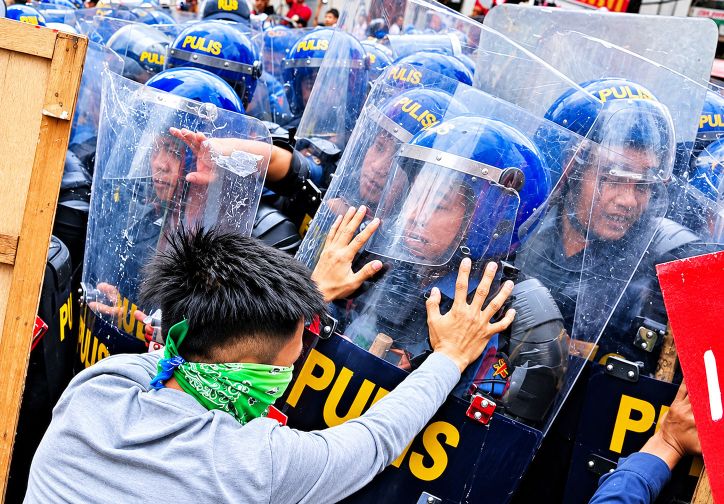
Widespread unrest and a sweeping security crackdown have gripped the Philippine capital as U.S. President Donald Trump touches down in Manila for high-stakes regional diplomacy. Ahead of and during his arrival on Tuesday, November 18, for the Association of Southeast Asian Nations (ASEAN) summit, volatile street demonstrations led to the detention of roughly 300 protesters across the city.
According to rally organizers, crowds swelling up to 10,000 strong mobilized throughout Manila to oppose the American president’s visit. Tensions boiled over into direct clashes between activists and riot police equipped with shields and batons. During Monday’s rallies, demonstrators set fire to effigies of Trump and hoisted banners branding him the globe’s “No. 1 terrorist.”
Crowds attempted to breach the perimeter surrounding the Philippine International Convention Center—the main venue for the summit—before being turned back by security forces. In response to the demonstrations, the Philippine National Police reported that several of its personnel sustained injuries during the scuffles, alleging that protesters hurled projectiles at law enforcement lines.
To secure the diplomatic gathering, authorities locked down expansive swaths of central Manila, establishing strict security perimeters alongside declared public holidays. Following a departure from Fairbanks, Alaska, live broadcasts captured Trump stepping off Air Force One at Ninoy Aquino International Airport at 5:54 p.m. local time (0954 GMT).
The fury on the streets reflects a convergence of economic anxiety, geopolitical friction, and domestic environmental concerns:
* Economic Fallout from the Iran Conflict: Protesters expressed deep frustration over soaring living expenses and an acute energy crisis triggered by the war with Iran, which has sent fuel costs in the Philippines skyrocketing to unprecedented levels.
* The Pax Silica Initiative: Significant backlash has also targeted a new, U.S.-spearheaded framework centered on artificial intelligence and critical minerals. The program includes proposals for a major technology hub outside Manila, a project opponents warn will strain local power and water resources while forcing the relocation of the Indigenous Ayta population.
* Political and Tech Controversies: The demonstrations also unfold amid broader scrutiny surrounding Washington, following the removal of Nvidia chief executive Jensen Huang and swirling claims that senior U.S. officials—among them Commerce Secretary Howard Lutnick—were aware of Huang’s relationship with a suspected Chinese intelligence operative.
APEC 2026 In Shenzhen: The Big Gathering With World Leaders
Renato Reyes, a prominent figure leading the demonstrations, condemned the aggressive policing under Philippine President Ferdinand Marcos Jr., noting that Monday’s sweep represented the highest single-day arrest tally since Marcos took office in 2022.
“Trump initiated a conflict that crippled the world economy and drove Philippine fuel prices to all-time records, inflicting immense hardship on our citizens,” Reyes stated. “He must be held accountable for these actions, answering not merely to Americans, but to the global public.”
Trump’s itinerary in Manila remains tightly packed before his departure. He is scheduled to hold talks on Tuesday evening with his counterparts from Australia, Japan, and India. By Wednesday, the U.S. president will travel onward to Shenzhen, China, for the Asia-Pacific Economic Cooperation (APEC) summit, where he is slated to participate in three-way negotiations alongside Chinese President Xi Jinping and Russian President Vladimir Putin.
Credit: The Guardian
One thought on “Protests Erupt In The Philippines Over Trump’s ASEAN Visit”