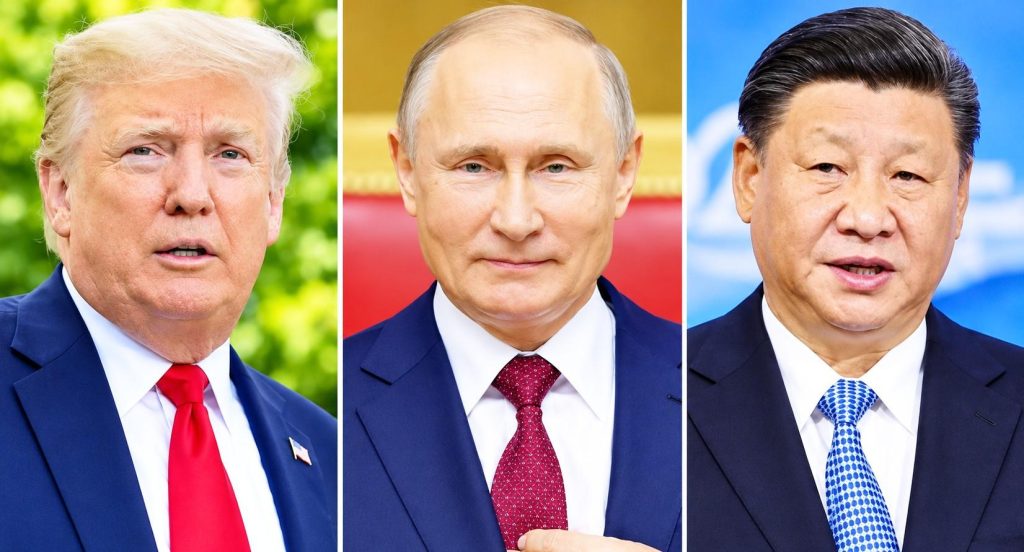
Following an unprecedented three-way summit, the top leaders of China, Russia, and the United States announced they have signed off on a joint peace declaration. Conspicuously absent from the text, however, is any mention of the ongoing wars in Ukraine and Iran—major conflicts driven directly by two of the nations seated at the table.
The high-profile sit-down between Xi Jinping, Vladimir Putin, and Donald Trump completely stole the spotlight from this week’s Asia-Pacific Economic Cooperation (Apec) forum. In the lead-up to the talks, host nation China had billed the trilateral meeting as a historic breakthrough. Kicking off the proceedings, Trump declared that the three men were making history, insisting that lasting peace cannot be achieved if leaders refuse opportunities to engage in dialogue.
The closed-door session lasted approximately 80 minutes. Speaking to the press afterward, Putin characterized the exchange as candid and said it had fostered a clearer mutual understanding among Washington, Moscow, and Beijing.
Familiar Nuclear Rhetoric Without Reduction Plans
Within the joint communique, the three powers affirmed that a nuclear war cannot be won and must never be fought. Yet the document stops well short of outlining any mechanism to curb or shrink atomic arsenals, disappointing observers who had hoped the summit might jump-start arms-reduction talks among the globe’s three foremost nuclear states.
Those expectations were rooted in recent signals. While Beijing has consistently rebuffed Trump’s overtures to enter formal arms-control treaties—arguing that the American and Russian stockpiles vastly dwarf its own—Xi stated on Thursday that nuclear weapons should ultimately be prohibited and completely dismantled to free the world of the threat. Even so, the declaration’s nuclear language merely echoes an earlier pledge made by all five permanent members of the UN Security Council, a bloc that also includes Britain and France.
The three heads of state committed to safeguarding global security and strategic stability, placing reform of the United Nations at the very top of their agenda so the body can better address international crises. According to an analyst named Sun, prioritizing UN reform is a signature Chinese talking point that underscores Beijing’s growing diplomatic clout—demonstrating its ability to steer international agendas toward its own goals and bring rival superpowers along.
In another notable passage, the declaration warned that the International Criminal Court (ICC) and comparable tribunals must not exceed their jurisdictional mandates. Given that Putin faces an active ICC arrest warrant, that provision reinforced the perception that the Russian leader walked away with tangible political gains. Isolated by Kyiv’s Western partners since launching the 2022 invasion of Ukraine, Putin had stayed away from Apec summits for years before making this return.
The trio also expressed a shared intention to boost the output and global availability of refined petroleum products for the benefit of all countries. Shan Guo, an analyst at the Shanghai-based consultancy Hutong Research, noted that while the energy pledge is noteworthy, its practical impact hinges entirely on whether the United States decides to roll back existing sanctions.
Many foreign policy watchers had anticipated that the summit would be defined more by stagecraft than substantive policy, and the modest outcome largely bore that out. Putin pushed back against suggestions that the gathering was little more than a staged photo op. Still, an analyst named Hurst observed that while the talks fell far short of a transformative “Yalta moment,” they provided unmistakable visual proof of Putin’s enduring geopolitical relevance—showing the Russian president once again maximizing a weak hand.
Protests Erupt In The Philippines Over Trump’s ASEAN Visit
Xi, meanwhile, solidified his image as an indispensable global power broker. Although he opened the day by delivering standard Apec remarks championing innovation and open commerce, routine regional trade issues were largely eclipsed by superpower diplomacy. Beneath the cordial handshakes, deep-seated tensions persist: Moscow remains weighed down by heavy US sanctions over Ukraine, while Washington and Beijing only recently reached a fragile truce after months of escalating tit-for-tat tariffs.
Warm Words In Beijing Spark Fury In Berlin
Prior to the three-way session, Trump and Putin held a bilateral meeting—their first face-to-face encounter since August 2025—during which the US president referred to his Russian counterpart as a “friend.” Those warm optics triggered sharp pushback from European leaders assembled in Berlin to reaffirm their backing for Ukraine. Polish Prime Minister Donald Tusk countered bluntly that Putin is no friend to Europe and never will be, while Danish Prime Minister Mette Frederiksen said she struggled to comprehend why an American president would choose to sit down with him.
Trump also held a separate one-on-one meeting with Xi, marking their third bilateral summit this year. State-run Chinese media reported that Xi described US-China ties as broadly stable and constructive, though he cautioned Washington to continue handling the Taiwan issue responsibly to prevent major disruptions to the bilateral relationship.
Despite the scarcity of binding agreements, the absence of major policy breakthroughs may align neatly with Beijing’s strategic calculus. As an analyst named Kim pointed out, China appears content simply serving as the indispensable host and convener of high-level global diplomacy, with little appetite to push for outcomes beyond that role.
Credit: The Guardian