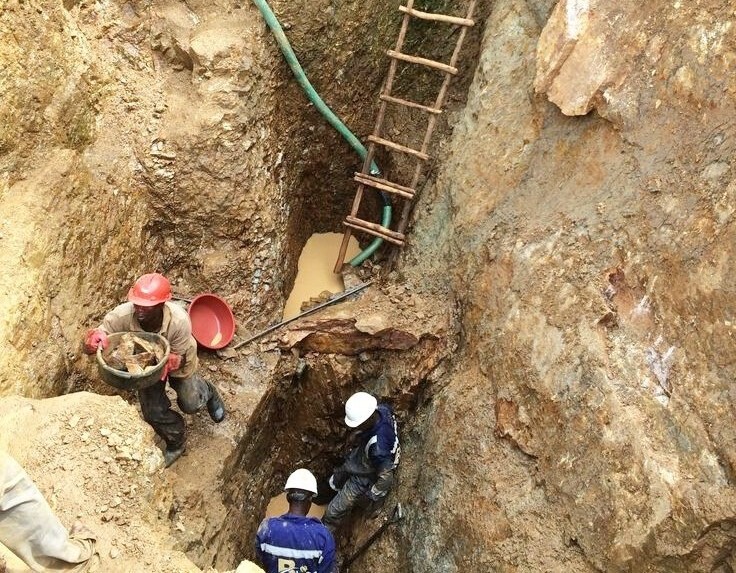
Ghana’s galamsey crisis has long outgrown its description as a government problem. Decades of military crackdowns, interagency task forces, and policy pronouncements have come and gone — yet the illegal mining menace not only persists but deepens with each passing year, leaving a trail of poisoned rivers, ravaged forests, and broken livelihoods in its wake.
The question Ghanaians are now asking — bluntly and with growing frustration — is this: if every government has tried and failed, who can actually fix this?
To understand the scale of what Ghana is dealing with, the numbers alone are sobering. Environmental reports indicate that approximately 60% of the country’s water bodies are now contaminated, poisoned by the mercury and cyanide pumped into the ground by illegal mining operations. Rivers that once sustained entire communities — the Pra, Ankobra, Offin, and Birim — have been reduced to toxic channels, their waters unfit for drinking, irrigation, or the fishing that generations of rural families depended upon.
The human footprint of the crisis is equally staggering. Over one million people are estimated to be involved in small-scale mining across Ghana, with the majority operating outside the law. At that scale, conventional enforcement becomes a near-impossible task. No government unit, however well-resourced, can police a workforce that large.
Add to this the systematic destruction of forest reserves and farmlands, the threats to national food security, and the public health burden imposed on communities living downstream from contaminated water sources, and what emerges is not merely a regulatory failure — it is a full-blown national emergency.
And national emergencies, by definition, require national solutions.
Beyond Government: The Stakeholders Ghana Needs
If the state alone cannot solve galamsey, then the answer lies in mobilising the full range of institutions, communities, and experts that make up Ghanaian society. Three groups, in particular, hold significant untapped power.
Traditional Leaders and Local Authorities
In Ghana’s rural heartlands, where most illegal mining occurs, the authority of chiefs and traditional rulers often runs deeper than any government directive. Crucially, much of the land being exploited by illegal miners sits on stool lands — territory under the jurisdiction of traditional authorities, not the state. This gives chiefs a powerful lever that no military operation possesses.
A chief who refuses to release community land for illegal mining, who enforces strict customary rules against galamsey, and who holds incoming miners accountable to the community can achieve what years of task forces have not. If Ghana’s traditional leadership were to unite behind a collective declaration of zero tolerance for illegal mining on their lands, the industry’s footprint could shrink significantly — and rapidly.
Local Communities and Youth Groups
The communities living along Ghana’s polluted rivers and beside its degraded forests are not merely victims of galamsey — they can be among its most effective opponents. Across parts of the country, residents have already begun organising community anti-galamsey patrols, taking it upon themselves to monitor and resist illegal mining activity in their backyards.
These grassroots efforts are instructive. They demonstrate that when communities are empowered, resourced, and taken seriously as partners rather than passive bystanders, they become formidable defenders of the environment. Scaling and supporting such initiatives — through funding, legal protection, and formal recognition — could transform community resistance into a nationwide force.
The Truth Behind The Sudden Silence On Galamsey In Ghana
Scientists and Environmental Experts
Ghana’s universities and research institutions are home to scientists and environmental specialists who have the technical tools to address what is, at its core, a problem with deep scientific dimensions. Their contributions could prove decisive across several fronts: restoring polluted rivers and rehabilitating degraded farmland; developing cleaner, safer techniques for legitimate small-scale mining that reduce the incentive to operate illegally; and deploying satellite imagery and drone technology to monitor illegal activity in real time and feed intelligence to enforcement agencies.
Technology-driven monitoring, in particular, could close one of the biggest gaps in Ghana’s anti-galamsey architecture — the inability to track and respond to illegal operations at scale across vast, often remote, stretches of land.
Ghana has tried the government-only approach to galamsey. The verdict is in, and it has not worked. The crisis demands a fundamental rethink — one that recognises illegal mining as a shared national burden and mobilises every available actor to fight it.
Traditional leaders locking down stool lands. Communities standing guard over their rivers. Scientists mapping contamination and developing solutions. Each of these actors brings something the state cannot provide alone: proximity, legitimacy, and reach. The fight against galamsey will not be won by any single administration. It will be won — if it is won — by a Ghana that decides, collectively, that enough is enough.
Without scientific intervention, the environmental wounds galamsey has inflicted on Ghana’s landscape could take generations to heal — a sobering reminder that the crisis is as much a technical challenge as it is a political one.
Civil Society and the Media
One of the most persistent arguments among analysts is that illegal mining endures not despite government efforts, but partly because of the powerful interests that profit from it — financiers with deep pockets, political actors with convenient influence, and networks that have learned to operate just beyond the reach of accountability.
This is where civil society organisations and investigative journalists become indispensable. Their role is not merely to report on galamsey — it is to expose the hidden architecture that sustains it. Investigative reporting that names financiers, traces supply chains, and maps the political connections protecting illegal operators can generate the kind of public pressure that task forces alone cannot create.
Ghana has seen this dynamic before: sustained advocacy and public protest have, at key moments, compelled governments to move from rhetoric to action. That pressure must be maintained and intensified.
The Judiciary and Law Enforcement
Arrests without consequences are not enforcement — they are theatre. And for too long, Ghana’s legal response to galamsey has looked uncomfortably close to theatre. Offenders are apprehended, only to be released swiftly or handed penalties so light they function as little more than a cost of doing business.
South Africa Losing $4 Billion A Year To Illegal Mining — Now The Military Is Moving In
Legal experts have long advocated for dedicated environmental or mining courts — specialised judicial bodies with the mandate, speed, and severity to prosecute galamsey cases meaningfully. The laws, in many cases, already exist. What has been missing is consistent, fearless application of those laws. Tougher, faster prosecution would do more than punish offenders; it would signal to the broader illegal mining ecosystem that the era of impunity is over.
Economic Reform and Job Creation:
Ultimately, no enforcement regime — however robust — can fully succeed without confronting the economic reality that drives people into illegal mining in the first place. For many young Ghanaians, especially in rural communities where agriculture has declined and formal employment is scarce, galamsey is not a lifestyle choice — it is a livelihood strategy. Studies consistently identify poverty, unemployment, and falling agricultural returns as the fuel that keeps the illegal mining engine running.
This means that job creation is not a peripheral concern in the fight against galamsey — it is central to it. Targeted investment in agriculture, agro-processing, manufacturing, and technology in mining-affected communities would reduce the economic desperation that makes illegal mining attractive. When people have better alternatives, fewer will risk their lives and futures underground.
The Hard Truth Ghana Must Confront
Ghana’s galamsey crisis resists simple solutions because it is not a simple problem. It is a layered, interlocking crisis — driven by poverty, sustained by corruption, enabled by weak institutions, and complicated by the sheer number of people whose survival is entangled with it.
Recent government initiatives, including new task forces and tightened regulations, have attracted criticism not because the intent was wrong, but because enforcement has remained painfully inconsistent. Good policy on paper means little when implementation falters in the field.
The hard truth is this: no single actor — not the military, not the presidency, not any task force — can resolve a crisis of this magnitude alone. Ghana needs a genuine national coalition, one that brings together government, traditional leaders, scientists, communities, civil society, and the private sector under a shared commitment to ending illegal mining.
Traditional leaders must close off their lands. Communities must stand watch over their rivers.
Scientists must develop and deploy environmental solutions. Investigative journalists and civil society must keep exposing the corruption that feeds the industry. The judiciary must prosecute with purpose. And the state must build an economy in which illegal mining is no longer the most attractive option available to desperate young people. That is a tall order. But it is the only order that fits the scale of what Ghana faces. The rivers, the forests, the farmlands — and the generations that will inherit them — are waiting.