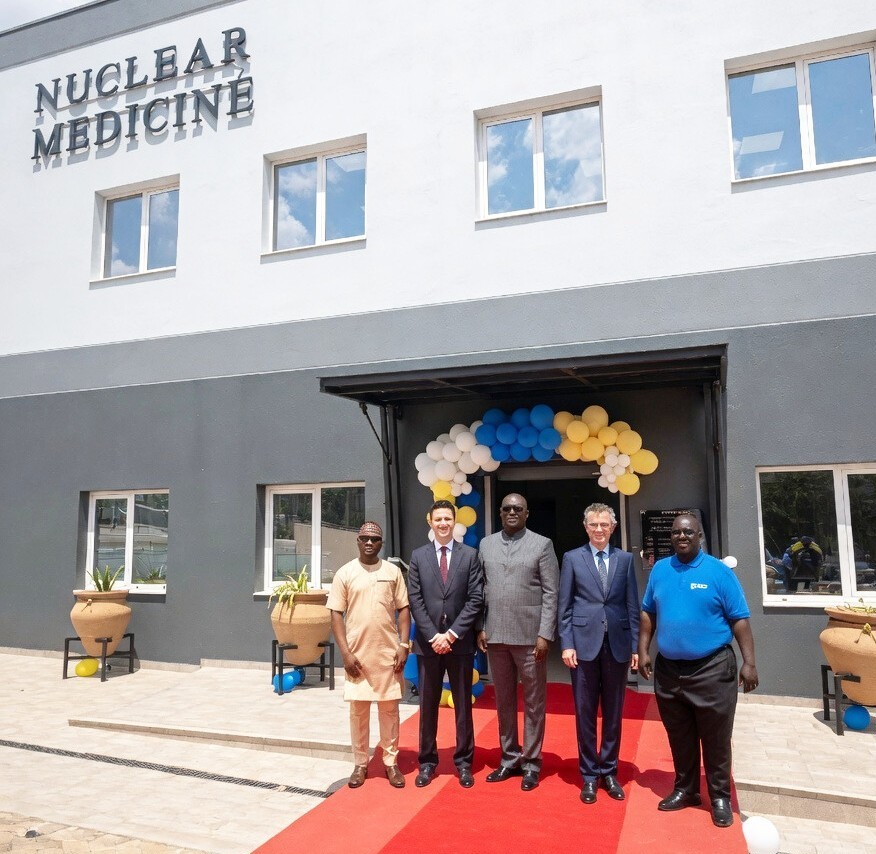
Ghana has joined a elite group of nations with access to some of the world’s most advanced cancer diagnosis and treatment technology — and for the first time, West Africans no longer need to travel abroad to access it.
For decades, a cancer diagnosis in Ghana has often carried with it a secondary burden: the prospect of expensive, exhausting travel to Europe, America or Asia in search of the kind of specialist care that the disease demands. That reality has now fundamentally changed.
In a commissioning ceremony that marks one of the most significant milestones in Ghana’s healthcare history, the Sweden Ghana Medical Centre has unveiled three transformative medical technologies — a PET-CT Scanner, a Cyclotron, and a Linear Accelerator — facilities that are not only the first of their kind in West Africa, but represent just the 80th such installation anywhere in the world.
The scale of the occasion was reflected in who showed up to mark it. President John Dramani Mahama attended the commissioning as Guest of Honour, lending the weight of the presidency to what health stakeholders are describing as a generational leap forward for Ghanaian medicine.
Education Minister Haruna Iddrisu was also present, a signal that the significance of this development extends well beyond the walls of a single hospital. Their attendance underscored a broader truth: this is not merely a private sector achievement. It is a national one.
For many Ghanaians, the names of these machines may be unfamiliar. But their impact on human lives is profound.
The PET-CT Scanner combines two powerful imaging technologies to produce highly detailed pictures of what is happening inside the body at a cellular level — making it one of the most effective tools available for detecting cancer early, before it has spread and while treatment options remain most effective.
The Cyclotron is the engine that powers the PET-CT Scanner. It produces the radioactive tracers that the scanner uses to identify cancerous cells with exceptional precision — and having one on-site means Ghana is no longer dependent on importing these short-lived substances from abroad.
The Linear Accelerator takes treatment to the next level. Using high-energy beams of radiation, it targets and destroys cancer cells with pinpoint accuracy, minimising damage to surrounding healthy tissue. It is the gold standard in modern radiotherapy and has transformed cancer survival rates in countries where it is available.
Together, these three technologies create a complete, world-class cancer care pathway — from detection to diagnosis to treatment — all within Ghana’s borders.
A Partnership That Made It Possible
The commissioning did not happen by accident. It is the product of an ambitious collaboration that brought together the Sweden Ghana Medical Centre, the Ghana National Association of Teachers, and a constellation of international partners — among them the Food and Drugs Authority, the Nuclear Regulatory Authority, global medical technology leaders Elekta and Siemens Healthineers, and financial partner OMNI BSIC.
Harvard Study Says AI Is Now Better Than Doctors At Emergency Diagnosis
The breadth of that partnership speaks to the complexity and cost of what has been achieved. Facilities of this calibre require not only significant capital investment, but rigorous regulatory oversight, technical expertise and international supply chains. That all of these pieces came together in Ghana is a testament to what coordinated public-private collaboration can accomplish.
Perhaps the most immediate and human impact of this commissioning is what it means for patients. Ghanaians who previously faced the agonising choice between seeking life-saving cancer treatment abroad — at enormous financial and personal cost — or going without it, now have a world-class option on home soil.
The Clock Is Ticking — La General Hospital Rebuild Has A Firm New Deadline
The reach of that benefit extends beyond Ghana’s borders. With West Africa’s first facility of this kind now operational in Accra, patients from across the sub-region have a viable destination for advanced cancer screening, diagnosis and radiotherapy that does not require crossing an ocean.
Health experts are already pointing to the potential for dramatically improved early detection rates — and with early detection comes the single greatest factor in surviving cancer: time.
Being the 80th country in the world to host this combination of technologies is not a statistic to be taken lightly. It places Ghana in the company of nations that have long been considered the global leaders in medical infrastructure — and it signals to the continent that African countries need not remain permanently dependent on the West for cutting-edge healthcare.
For the patients who will walk through the doors of the Sweden Ghana Medical Centre seeking answers and treatment, the significance may be simpler and more personal than any statistic. For them, this moment means hope — available, accessible, and finally, at home.