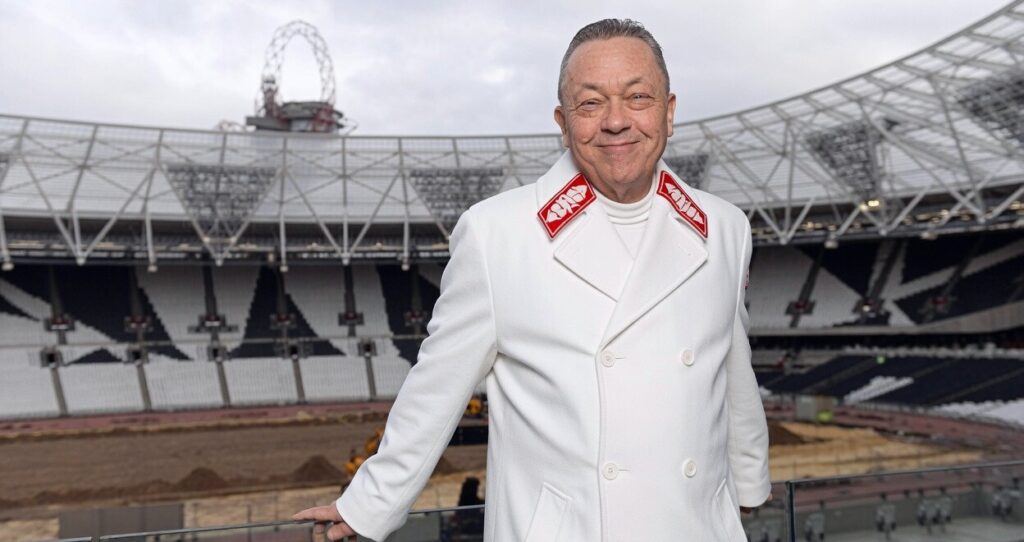
David Sullivan always wanted to be a footballer. Growing up in a council house in Cardiff, that was the dream. Instead, the path that opened up for him led somewhere altogether different — into the pornography industry, where he would build the financial foundations that eventually bought him a seat at the top of English football.
It is a story that ends not with triumph but with resignation, accusations, and the threat of a lawsuit — and it raises a question many in the game are quietly asking: how did a man with Sullivan’s background ever rise this high in the modern game?
Sullivan’s football ambitions began in east London. Alongside business partners David and Ralph Gold — fellow fans of West Ham United — he acquired a stake in the club in 1991, hoping to find his way into the boardroom. The door was firmly shut. As the late David Gold later recalled in his autobiography, there was no engagement, no dialogue, no welcome.
“They simply did not want David Sullivan and the Golds at their football club,” Gold wrote — a rejection that owed much to the trio’s associations with the adult entertainment industry.
Undeterred, Sullivan and the Golds looked elsewhere. Leeds United and Tottenham Hotspur were considered before they settled on a more attainable target: Birmingham City, a club mired in administration and struggling in the second tier of English football. In March 1993, they acquired Birmingham for £700,000 — a modest sum for an asset that would become the launching pad for Sullivan’s ascent through the sport.
A Convicted Man With a Football Club
When Sullivan bought Birmingham City, he was no unknown quantity. His background was a matter of public record. In 1982, he had been convicted of living off immoral earnings from prostitution and served 71 days in prison before a successful appeal secured his release. He owned the Daily Sport and Sunday Sport — the notorious red-top tabloids whose identity was built on topless photoshoots and sensationalist headlines.
None of it was hidden. All of it was known. And yet the Football League approved the takeover, and Sullivan was in.
What followed was, by any measure, a remarkable rehabilitation in football terms. Sullivan steered Birmingham City out of financial distress, stabilised the club, and oversaw their growth through the divisions. Decades after being turned away from West Ham’s boardroom, he returned — this time not as a rejected suitor but as a co-owner, eventually becoming the most powerful individual at the club he had once been deemed unfit to join.
The irony was not lost on those who had watched his journey. The man West Ham once refused had come back to run the place.
A Chaotic End
But the story does not close on a note of vindication. Club sources describe Sullivan’s final period at West Ham as having become “chaotic” — a tenure that unravelled in its closing stages and culminated in his resignation on Saturday amid accusations of “improper conduct.” Sullivan has forcefully rejected those accusations as false and has threatened to sue the BBC over its reporting.
The full details of what led to his departure remain contested. What is not in dispute is that the ending is an unsavoury one — a conclusion that, for many observers, feels uncomfortably consistent with the more troubling chapters of the story that preceded it.
2026 FIFA World Cup: The Most Beautiful Football Fans On The Planet Are Coming
For those now reflecting on Sullivan’s extraordinary trajectory through English football, the question his career leaves behind is not simply about one man’s rise and fall. It is about the game itself — its governance, its standards, and how carefully it truly examines the hands it allows to hold the keys.
The rules that existed in 1993 offered no mechanism to stop David Sullivan from buying Birmingham City, and even the fit-and-proper-person test — introduced by the Premier League, Football League and FA in 2004 — would likely have provided no barrier. That test was designed to filter out those with histories of financial malpractice or corruption. Sullivan’s background was morally questionable, not financially criminal. For a cash-strapped Birmingham, desperate for rescue, those distinctions were enough to open the door. That door, once opened, never fully closed again.
For the West Ham supporters who have spent the better part of a decade protesting against Sullivan’s stewardship, his resignation will land as relief rather than surprise. That feeling has only sharpened in recent weeks following the club’s relegation from the Premier League last month — a humiliation that brought Sullivan’s failures into the starkest possible focus.
The theory that football ownership served to rehabilitate Sullivan’s reputation after his years in the adult entertainment industry has never quite held up to scrutiny. He never became a sympathetic figure. Protests dogged his tenure at West Ham. The football media subjected him to consistent and often harsh criticism. Whatever laundering effect some assumed the Premier League’s boardrooms might provide, it did not work on Sullivan.
Birmingham: A Complicated Inheritance
Even his time at Birmingham City — the chapter that first established him as a serious football owner — divides opinion. Sullivan took the club into the top flight in 2002, where they remained for six years before relegation. But he and David Gold were never universally popular in the Midlands, and the criticism eventually wore them down.
2026 Transfer Window: The Latest Confirmed Premier League Moves
When they sold Birmingham to Hong Kong tycoon Carson Yeung in 2009 for £81.5 million, it represented a significant profit on their original £700,000 investment. But stepping back from football was never the intention — it was simply a transaction that freed them to move on to something bigger.
West Ham and the Deals That Defined — and Destroyed — His Legacy
West Ham were financially exposed in 2010, and Sullivan recognised opportunity in that vulnerability. He and Gold bought the club in January of that year, beginning a tenure that would prove almost permanently turbulent.
The single decision that perhaps most defined — and corroded — Sullivan’s relationship with the West Ham faithful was the move away from Upton Park to the London Stadium in 2016. Supporters have never forgiven him, Gold, or Karren Brady — who stepped down as vice-chair last month — for what was widely perceived as an opportunistic arrangement that sacrificed the soul of the club for commercial gain. Sullivan clung on regardless, making plans to acquire a portion of the Gold family’s shares and position himself as an equal partner alongside Czech billionaire Daniel Křetínský, the owner of Royal Mail and a significant stakeholder in the club.
The End Arrives
The final image of Sullivan’s time as West Ham chairman is a telling one. On the last day of the season, as relegation was confirmed, he was jeered by his own supporters in the directors’ box — and left his seat early. It is the defining photograph of his tenure: a man unable or unwilling to face the consequences of what had unfolded on his watch.
London To Host Ballon D’Or For The First Time As Football’s Biggest Night Leaves Paris
Internally, the situation had become untenable long before that afternoon. There were genuine fears that allegations about his personal life — all of which Sullivan has denied — could trigger a sponsor exodus. Allies had been distancing themselves for some time, with Brady’s departure the most visible signal that his circle of support had shrunk to almost nothing. Increasingly isolated, facing swirling accusations and with resignation and legal threats as his remaining instruments, Sullivan’s exit felt less like a decision than an inevitability.
There is a certain poignancy buried inside the wreckage. Sullivan genuinely loved football. Owning West Ham — the club that had once turned him away — was the realisation of an ambition that had driven him for decades. He regularly injected personal funds into the club, and he lived through the extraordinary Premier League financial boom, understanding better than most what the economics of modern football could mean for an ambitious owner.
But football did nothing for his reputation in the end. He leaves West Ham with a toxic legacy — a club relegated, a fanbase alienated, a tenure remembered more for dysfunction than achievement. The man who survived being rejected, convicted, and dismissed at every turn ultimately could not survive the questions about who he really was. It was his past, not his present, that finally brought everything to a halt.