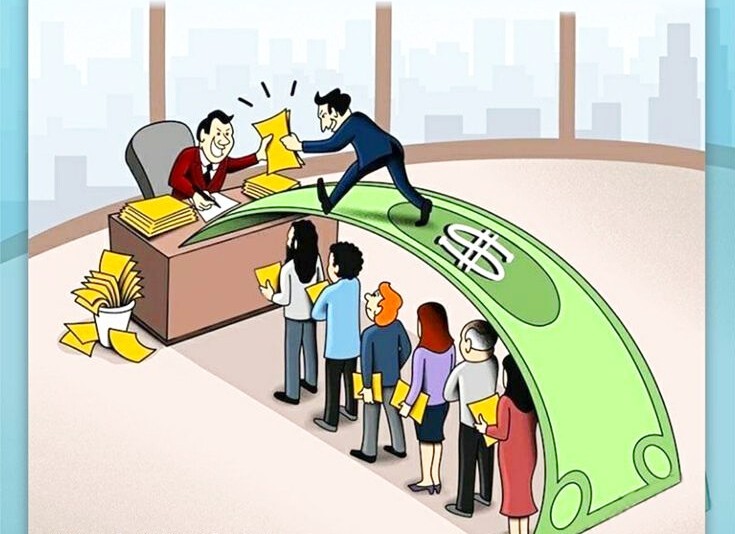
A disquiet is growing in Ghana — quiet in some quarters, loud in others — about whether the country’s justice system applies its weight equally to all citizens, or whether political connections can, in practice, insulate individuals from full accountability. The concern is not new, but it has gained fresh momentum across civil society, governance circles, and everyday public discourse. At its core is a question that strikes at the heart of democratic legitimacy: does political affiliation determine how the law is enforced in Ghana?
Ghana’s standing as one of Africa’s more stable and enduring democracies is not in serious dispute. But stability and fairness are not the same thing — and critics argue that a growing body of unresolved, high-profile cases involving politically exposed persons is quietly hollowing out the public trust that democratic institutions depend on to function.
The debate plays out daily on radio call-in programmes, television panels, and social media threads, where citizens raise pointed questions about why certain investigations appear to stall, why prosecutions of alleged offenders with apparent political connections seem to move at a different pace, and why visible outcomes in such cases remain elusive long after public attention has peaked.
Those who defend the institutions are not wrong to point out that investigations are complex, evidence-dependent, and legally constrained — and that public timelines rarely reflect the full picture of what is happening behind the scenes. But even among those most sympathetic to the work of state agencies, there is a candid acknowledgment that communication gaps and prolonged silences in nationally watched cases create a vacuum that suspicion fills.
The Principle at Stake
Ghana’s constitutional framework rests on a foundational principle: that no person stands above the law. The independence of the Ghana Police Service, the judiciary, and the country’s anti-corruption bodies is not merely a procedural nicety — it is the architecture upon which public confidence in the entire democratic project is built.
Legal analysts and governance experts are consistent in their assessment that institutional independence, while necessary, is not sufficient on its own. Institutions must also be seen to act — transparently, visibly, and without undue delay — particularly in cases that have captured national attention. When that visibility is absent, the principle of equal justice before the law risks becoming, in the public mind, a statement of aspiration rather than a description of reality.
The long-term consequences of that shift, analysts warn, are serious. Delayed investigations and inconclusive processes — regardless of the reasons behind them — can unintentionally consolidate a narrative of selective justice that, once established, is difficult to dislodge.
A Recurring Fault Line
The role of political affiliation in shaping justice outcomes has become one of the most persistent fault lines in Ghana’s public discourse. Critics contend that individuals perceived to be connected to ruling or influential parties are, in some instances, handled with a leniency not extended to ordinary citizens facing similar allegations. The standard of accountability, they argue, should not vary based on who a person knows or which party holds power.
Defenders of state institutions push back firmly against that characterisation, arguing that such narratives are often politically motivated, selectively applied, or divorced from the legal realities of due process. Rushing investigations, they maintain, carries its own dangers — and evidence, not public pressure, must drive prosecution decisions.
Both positions contain truth. And therein lies the challenge: in a democracy where perception shapes legitimacy as powerfully as reality, the gap between what institutions are doing and what citizens believe they are doing can become, over time, a crisis of its own.
Civil society voices have long argued that when citizens lose faith in the fairness of the systems designed to protect them, the social contract between state and governed begins to fray — slowly at first, and then, if left unaddressed, in ways that are far harder to repair.
Beneath the divergence of opinion, however, a point of consensus exists: Ghana must continue reinforcing the safeguards that protect its investigative and judicial processes from political interference. Whatever one’s reading of individual cases, few serious voices argue that the status quo requires no improvement.
When Trust Erodes — The Costs Are Real
The consequences of sustained perceptions of unequal justice are not abstract. Governance experts are specific about what begins to break down when citizens lose faith in the fairness of the systems designed to protect them.
Ghana’s Corruption Impunity Problem: Why The Powerful Rarely Face Justice
Trust in law enforcement declines — and with it, the willingness of ordinary citizens to cooperate with security agencies. Crime reporting drops. Community engagement in governance processes weakens. Cynicism about democratic institutions deepens, particularly among younger citizens who have not yet built the institutional loyalty that older generations may retain by default.
Perhaps most corrosively, when people believe that justice is available to some but not to others, it changes behaviour. Victims of crime calculate whether reporting is worth the effort. Witnesses weigh whether coming forward will produce any meaningful outcome. Over time, these individual calculations accumulate into a collective disengagement that undermines the very foundations of an accountable state.
Analysts are equally clear that rebuilding trust, once it has been lost, requires more than securing high-profile convictions. Transparent communication from investigative bodies, regular and substantive updates on nationally watched cases, and clearly communicated timelines for justice processes are all seen as essential steps — not optional gestures — toward restoring public confidence.
The Reform Agenda
Governance advocates are pressing for structural changes that go beyond rhetoric. Their calls centre on strengthening institutional independence through better oversight of law enforcement processes, improving disciplinary mechanisms within security agencies, and establishing more robust protections against political interference in investigations and prosecutions.
There are also growing calls for sustained public education on how investigative and judicial processes actually work — not to lower expectations, but to replace misinformation and frustration with informed engagement. A public that understands the genuine constraints of due process is better positioned to distinguish between systemic failure and procedural complexity.
Ghana’s democratic reputation in West Africa and beyond has been hard-won, built over decades of competitive elections, peaceful transitions of power, and a civic culture that takes governance seriously. That reputation is worth protecting — and protecting it means confronting, honestly and without defensiveness, the concerns that continue to surface around perceived political impunity.
The credibility of Ghana’s justice system ultimately rests on a single, non-negotiable principle: equal accountability under the law, applied without regard to political affiliation, social standing, or the influence of powerful connections. Every time that principle appears to bend — or is perceived to bend — the democratic foundations that Ghanaians have worked to build take a blow.
The question is not whether Ghana can afford to address these concerns. It is whether it can afford not to.