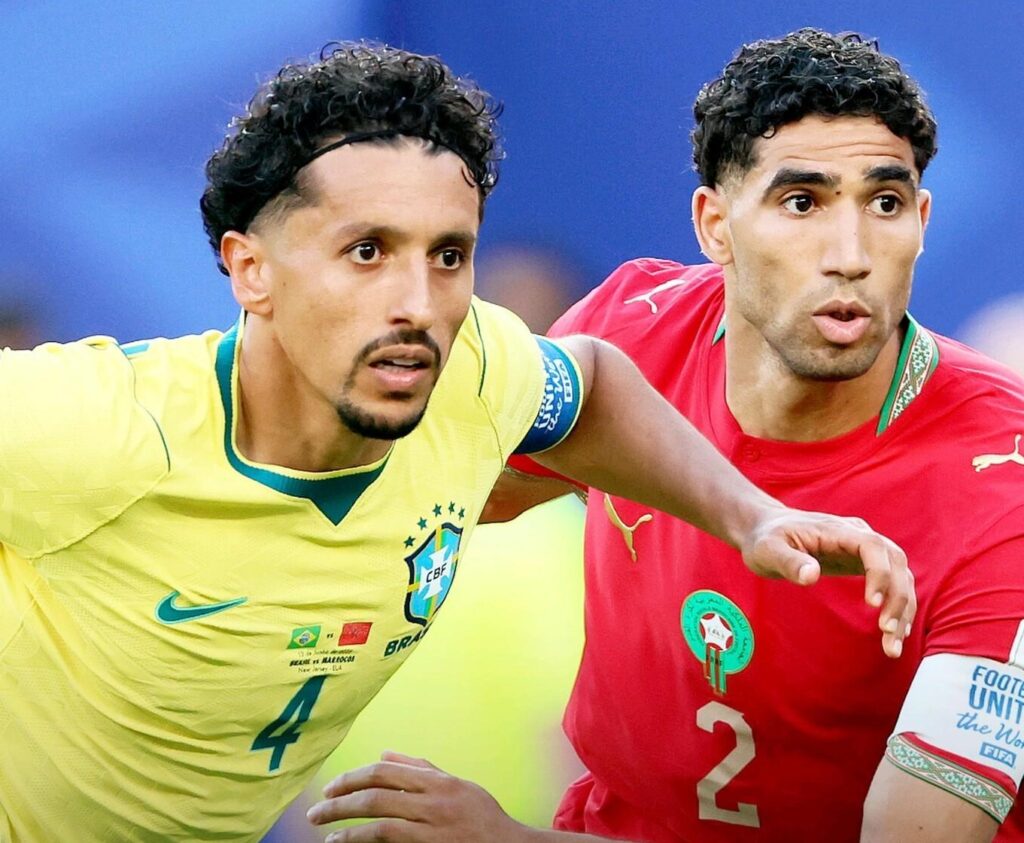
A relentless Morocco side pushed Brazil to the brink before Vinícius Júnior’s moment of genius spared the five-time champions a shock opening-match defeat, as Group C’s most anticipated fixture on June 13, ended in a gripping 1-1 draw at a heaving MetLife Stadium.
Brazil arrived in New Jersey as one of the tournament’s most talked-about contenders under Carlo Ancelotti, but it was Morocco who wrote the afternoon’s most compelling storyline — pressing with intensity, striking first and refusing to wilt despite the weight of Brazilian expectation in the stands.
The result leaves Group C completely open heading into the second round of fixtures, with all four nations — Brazil, Morocco, Scotland and Haiti — still very much in contention.
Morocco Strike First, Saibari Stuns the Favourites
The Moroccan opener on 21 minutes was a moment of clinical, well-orchestrated beauty. Winning possession deep in their own half, the Atlas Lions burst forward on the counter with devastating purpose, cutting through Brazil’s defensive lines at pace before Ismael Saibari received the ball on the edge of the area and produced a delicate, looping volley over Alisson to give his side a stunning lead.
The MetLife crowd, well over 80,000 strong and generating one of the most electric atmospheres the tournament has produced so far, rose in disbelief. Morocco, who have developed into one of world football’s most organised and tactically astute nations since their unforgettable run to the 2022 World Cup semi-finals, looked every inch a team with a plan — and the quality to execute it.
Brazil’s response, when it came, carried all the hallmarks of a side that knows how to produce in moments of crisis. In the 32nd minute, Vinícius Júnior — one of the most dangerous attackers on the planet — received possession inside the Moroccan box and unleashed a ferocious, perfectly placed finish into the far corner of the net to restore parity.
It was the kind of goal that only elite forwards score: instinctive, precise, and struck with the cool conviction of a man who has performed on the biggest stages club football offers. For Brazil, it was an intervention of supreme individual quality that papered over some uncomfortable cracks in their midfield structure.
Carlo Ancelotti’s side struggled for sustained control in the engine room for long stretches of the contest, with Morocco’s high-energy pressing making it difficult for Bruno Guimarães, Casemiro and Lucas Paquetá to impose their preferred rhythm. Brazil, in truth, were fortunate not to be chasing the game at the interval.
With Brazil unable to find a second gear, Morocco continued to ask dangerous questions on the break throughout the second half. Goalkeeper Yassine Bounou — better known to the football world simply as Bono — was called upon to produce a string of vital saves, and the veteran Sevilla stopper delivered with characteristic composure.
Courtois Hints At International Retirement After 2026 World Cup
His contributions were central to Morocco walking away with a point that, on the balance of play, their performance thoroughly merited.
Many observers at MetLife and watching around the globe felt Morocco were the superior side for extended passages of the match — a damning assessment for a Brazil squad carrying the weight of a nation’s expectation.
The result means the group remains perfectly poised after the opening round, with qualification to the knockout stage far from settled for any of the four competing nations.
Scotland and Haiti are yet to play their opening fixture.
Both sides return to action on 19 June, with Morocco facing Scotland and Brazil taking on Haiti in what promise to be pivotal clashes.
Line-Ups
Brazil: Alisson; Roger Ibañez, Marquinhos, Gabriel Magalhães, Douglas Santos; Casemiro, Bruno Guimarães; Raphinha, Lucas Paquetá, Vinícius Júnior; Igor Thiago
Morocco: Yassine Bounou; Achraf Hakimi, Issa Diop, Chadi Riad, Noussair Mazraoui; Ayyoub Bouaddi, Neil El Aynaoui; Bilal El Khannouss, Azzedine Ounahi, Brahim Díaz; Ismael Saibari
For Brazil, Vinícius Júnior’s equaliser masked a performance that will demand serious improvement. For Morocco, this was a statement — and Group C has been duly warned.