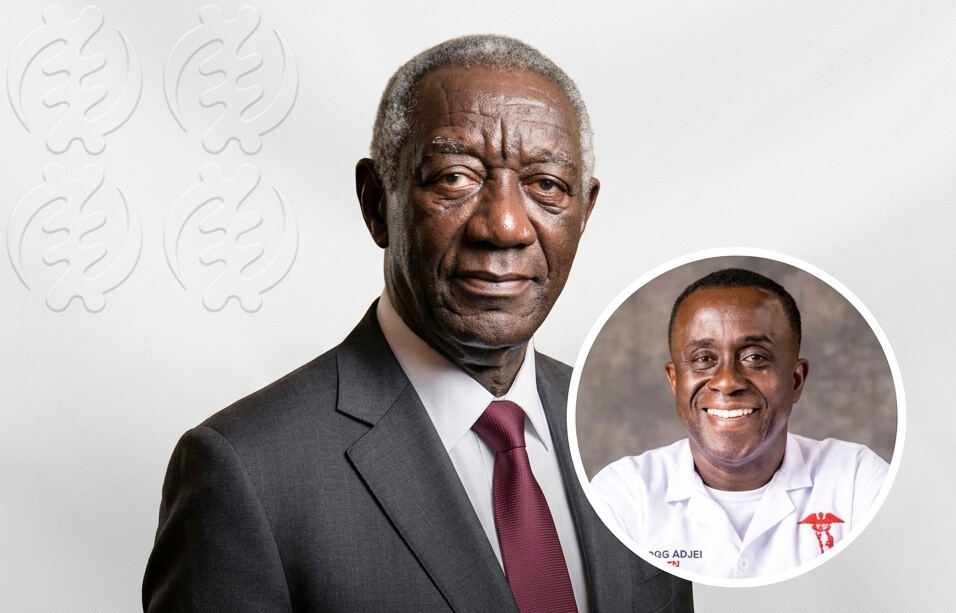
The comment has reignited debate over presidential legacies in Ghana’s Fourth Republic — and reminded the country just how enduring John Agyekum Kufuor’s standing remains
A member of the New Patriotic Party’s Communication Team has sparked fresh conversation about Ghana’s presidential legacies after declaring that former President John Agyekum Kufuor is the one leader whose record no critic can meaningfully challenge.
Dr. George Asafo Adjei made the remarks during a political discussion, offering an unambiguous verdict on how he believes Kufuor compares to every other leader Ghana has produced since the return to multiparty democracy.
“Former President Kufuor is the only leader nobody can criticise,” he stated.
It is a bold claim — but not one without a foundation. Kufuor’s two-term presidency, which ran from 2001 to 2009, is widely regarded as one of the more settled and consequential periods in Ghana’s Fourth Republic. Supporters point to macroeconomic stabilisation, institutional reforms, and a governance style that earned Ghana considerable goodwill on the continental and international stage during his tenure.
Asafo Adjei leaned into precisely that record, arguing that Kufuor’s administration left behind a legacy of policy direction and national stability that sets him apart from those that came before and after. In his assessment, the former president’s scorecard does not merely survive scrutiny — it defies it.
The timing and tone of the remarks are not without context. Ghana’s political space has long been characterised by fierce revisionism when it comes to the legacies of former leaders, with assessments of past administrations frequently shaped as much by present-day partisan positioning as by historical record.
Damang Mine Handover: Ibrahim Mahama Applauds Akufo-Addo’s Outstanding Intervention
For the NPP, elevating Kufuor’s legacy serves a purpose beyond nostalgia. It anchors the party’s identity to a period of governance it considers a high-water mark — and draws an implicit contrast with the record of others.
Critics, however, are unlikely to let the assertion go unchallenged. The standard counterargument in Ghana’s political discourse holds that every administration carries both achievements and shortcomings, and that placing any leader entirely beyond criticism flattens the complexity of governance into something closer to mythology.
Kufuor’s Enduring Footprint
What is less contested is the durability of Kufuor’s standing in Ghanaian public life. Long after leaving office, he remains a figure of considerable moral and political authority — someone whose counsel is sought across party lines and whose name continues to carry weight in conversations about what effective leadership in Ghana can look like.
Asafo Adjei’s remarks, whether one agrees with them or not, reflect that reality. The debate they have sparked is itself a measure of how seriously Ghanaians continue to take the question of Kufuor’s place in their country’s history — and how alive that conversation remains, more than fifteen years after he left Flagstaff House.