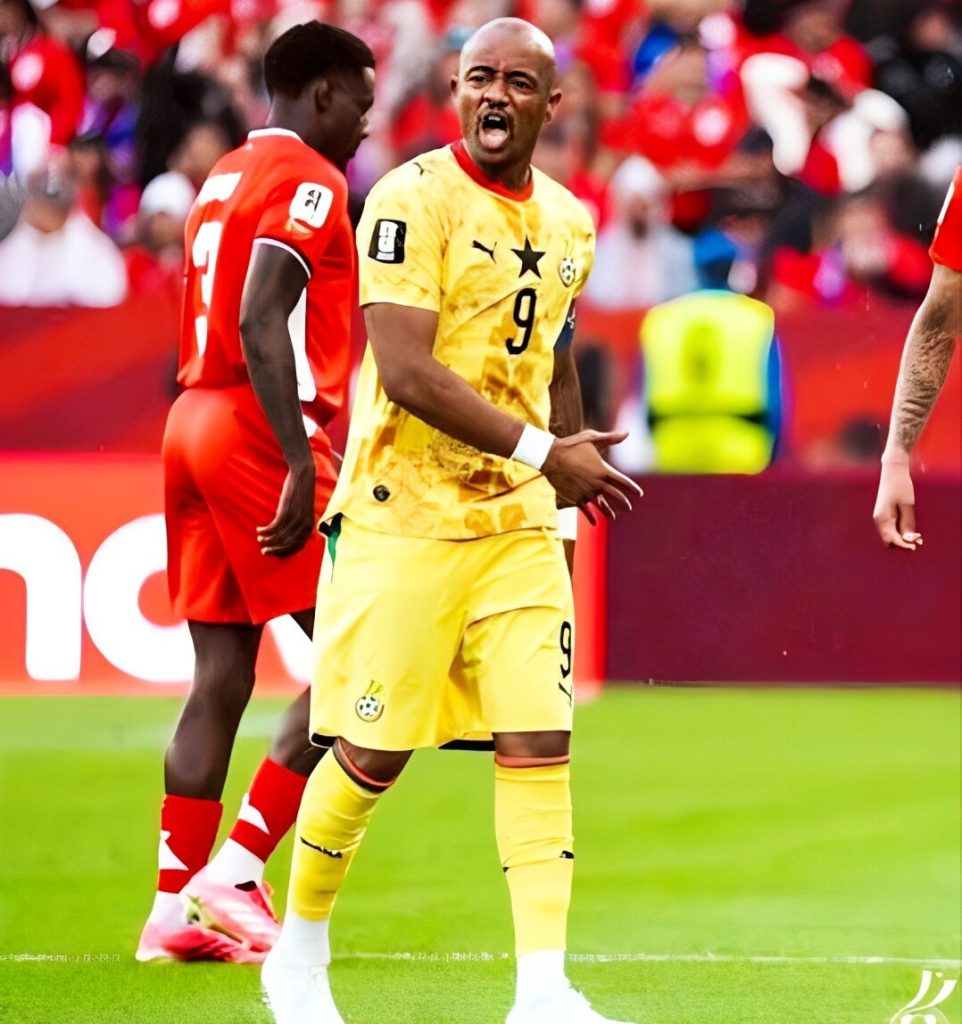
In the emotionally charged world of Ghanaian football, few players have inspired as much admiration and criticism as Jordan Pierre Ayew. Now captain of the Black Stars at the 2026 FIFA World Cup, the 34-year-old striker once again finds himself at the centre of intense public debate, with growing calls from some supporters urging him to retire from international football.
What began as frustration on social media following Ghana’s World Cup performances has evolved into a wider conversation about legacy, performance, leadership and the need for generational renewal. It is a debate that reflects not only Ayew’s career but also the enormous expectations placed on anyone who wears the Black Stars jersey.
Born on September 11, 1991, in France, Jordan Ayew was destined to live under the spotlight. As the son of Ghanaian football legend Abedi Pele and younger brother of André Ayew, he inherited one of the country’s most celebrated footballing legacies. Since making his senior debut for Ghana in 2010, he has become one of the nation’s most decorated internationals, earning more than 120 caps and cementing his place among the Black Stars’ all-time appearance leaders.
His club career has taken him across Europe, with spells at Olympique Marseille, Sochaux, Lorient, Aston Villa, Swansea City, Crystal Palace and Leicester City. Along the way, he built a reputation as a hardworking, versatile forward capable of operating across the front line.
Internationally, Ayew represented Ghana at three FIFA World Cups—2014, 2022 and 2026—and featured in multiple Africa Cup of Nations tournaments. He also climbed into the upper ranks of Ghana’s all-time goalscorers, scoring nearly 30 goals for the national team while often serving as one of the squad’s most experienced figures.
Throughout his career, Ayew has been praised for his relentless work ethic, tactical discipline and commitment to the national cause. During difficult periods for the Black Stars, he remained one of the team’s most dependable leaders, helping guide younger players while carrying the responsibility that comes with representing Ghana on the biggest stages.
Expectations were high heading into the 2026 FIFA World Cup after Ghana qualified under Portuguese coach Carlos Queiroz. Supporters hoped the Black Stars could finally return to the knockout stages for the first time since their memorable run in 2010.
As captain, Ayew was expected to lead from the front. He started key matches, including Ghana’s opening victory over Panama, where he became the country’s oldest player to feature at a World Cup. However, while his leadership remained evident, his attacking performances became the subject of fierce criticism.
Many supporters questioned his effectiveness in front of goal, pointing to limited attacking output and struggles to influence games offensively. The criticism intensified after Ghana’s elimination by Colombia in the Round of 32, with social media flooded by calls for the veteran forward to step aside and allow younger players to take over.
For many fans, the debate extends beyond one tournament. Ghana’s failure to qualify for the preceding Africa Cup of Nations, coupled with inconsistent performances in recent years, has increased demands for a fresh generation to be given greater responsibility.
Jordan Ayew Says Team Needed More Time Under Queiroz
Supporters argue that, at 34, Ayew’s continued selection may slow the team’s rebuilding process.
Comparisons have also been drawn with other African stars who stepped away from international football after reaching the latter stages of their careers, with some insisting Ghana should begin planning decisively for the future.
Yet others believe the criticism overlooks Ayew’s broader contribution.
Leadership cannot always be measured by goals and assists alone. As captain, Ayew has provided experience, stability and mentorship to a squad that continues to undergo transition. His influence inside the dressing room has repeatedly been praised by teammates and coaching staff, while Carlos Queiroz’s continued faith in him suggests the technical team values qualities beyond statistics.
Ayew himself has remained composed amid the criticism. Throughout the tournament, he insisted his focus remained solely on helping Ghana succeed, expressing confidence that brighter days lie ahead for the Black Stars despite the disappointment of their World Cup exit.
Away from football, Ayew has also demonstrated his commitment to the country, publicly supporting victims of devastating floods in Accra and consistently speaking about national unity and pride.
His longevity at the highest level is itself remarkable. Three World Cup appearances, well over 120 international caps and years of consistent service have secured his place among the most influential players of Ghana’s modern football era, regardless of differing opinions about his current form.
Jordan Ayew Deserves Better Treatment – Songo To Critics
The wider debate surrounding Ayew also exposes deeper structural questions facing Ghanaian football. Concerns over youth development, inconsistent coaching changes, administrative challenges and the heavy reliance on experienced players have persisted for years.
Successful football nations carefully balance experienced leaders with emerging talent. Ghana now faces the same challenge: honouring the contributions of players like Jordan Ayew while preparing the next generation to carry the Black Stars forward.
Ultimately, the decision on retirement belongs to Ayew alone. Public pressure should not dictate the end of a player’s international career. Such decisions are best made through honest discussions between the player, his family and the technical team, with the national interest remaining paramount.
Jordan Ayew’s story reminds us that football is about more than numbers. Every player carries expectations, sacrifices and the hopes of millions. Criticism is inevitable, particularly in a football-loving nation like Ghana, but so too is the responsibility to recognise years of dedicated service. Whether the 2026 FIFA World Cup proves to be Jordan Ayew’s final chapter in Black Stars colours or simply another chapter in an extraordinary international career, his place in Ghana’s football history is already assured.
The only question that remains is who will write the final page—Jordan Ayew himself, his coaches or the passionate supporters who have followed every step of his remarkable journey.