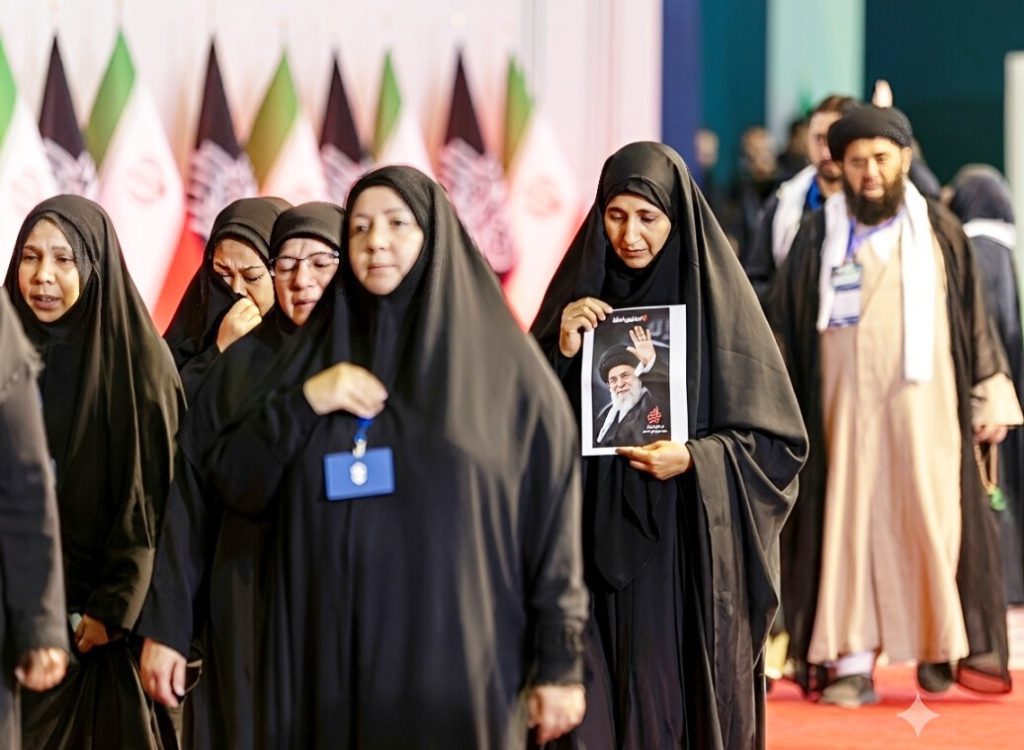
Thousands of mourners gathered before dawn in Tehran on Saturday, July 4, beating their chests and chanting for revenge as Iran began a dayslong farewell to its slain Supreme Leader, Ayatollah Ali Khamenei. Khamenei, who led the country for more than three decades, was killed in a US-Israeli airstrike in late February that triggered a regional war.
By early morning, the gates of Tehran’s sprawling Grand Mosalla mosque opened to let in thousands who had waited through the night for the chance to pay their respects. Streets surrounding the complex were already filling by 5:30 a.m., with Iranians — some traveling for hours, many carrying flags or portraits of Khamenei — converging on an event designed to project both grief and defiance. The crowds chanted “Death to America” and “Death to Israel” as emotions ran high.
Khamenei, 86, was killed by Israeli airstrikes, and the raised stage bearing his coffin also held the coffins of several family members killed in the same attack, including his 14-month-old granddaughter. By 8 a.m., the open-air mosque held as many as 10,000 mourners, separated by gender, with men gathered to one side and women to the other.
Iran Vows A Powerful Retaliation After US Seizes M/V Touska In Naval Blockade Operation
The funeral, spanning six days in five cities, has been designed to send a message of resistance to the world. Organizers say as many as 30 million people could attend across the various ceremonies. At the request of Iraqi officials, Khamenei’s body will also be carried through the Shia holy cities of Karbala and Najaf.
A banner above the coffins read:
“Say, I only advise you with one thing: that you stand up for Allah singly or in pairs.”
Before the religious portion of the ceremony began, the sound of cymbals and tambourines dominated, punctuated by chants of “Death to America” and “Death to Israel.” As religious hymns, the national anthem, and eulogies typically reserved for martyrs rang out — even in areas set aside for the media — grown men sat cross-legged, beating their chests or sobbing, their shoulders heaving with grief. Nearby, journalists photographed the crowds behind them for their own social media accounts.
One mourner, Fatima Khavari, described the shock of the loss:
“I felt like I had been crushed on the head when our leader was killed. He is the only true guide we have known.”
British and American journalists were officially discouraged from engaging with mourners, though many at the scene were reportedly eager to talk — often to draw a contrast between US President Donald Trump, whom some mourners described in harshly critical terms, and the leader they were mourning.