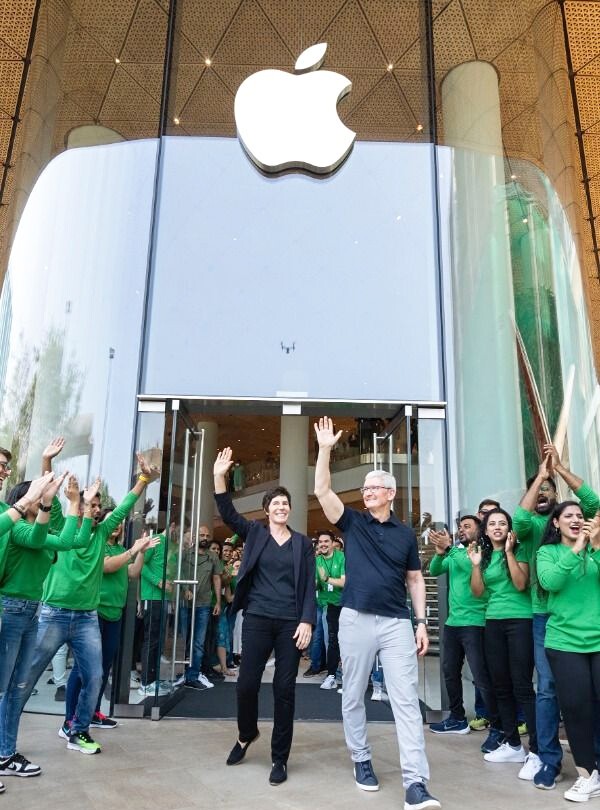
As Apple approaches its 50th anniversary on April 1, 2026, its CEO is thinking less about legacy and more about what comes next. That forward orientation, Tim Cook suggests, is precisely the point.
People and Culture Above Everything
In a recent CBS interview with tech journalist David Pogue — conducted in connection with his book Apple: The First 50 Years — Cook was asked to identify the foundations of Apple’s enduring strength. His answer was notable for what it left out.
“Yes, we have a lot of intellectual property and so forth, and that is important,” Cook said, “but it’s people that create that intellectual property. It’s the culture that creates the innovation with the intellectual property.”
For Cook, culture is not a backdrop to Apple’s success — it is the engine of it. He described it as something genuinely difficult to replicate: built slowly, sustained through deliberate hiring, and protected as both technology and society evolve around it. Apple, he said, is a “party of one” — a company whose approach is singular enough that no obvious comparison exists.
Central to that culture, in Cook’s telling, is a restlessness — an institutional refusal to treat past achievements as a destination. Apple’s orientation, he emphasized, is always toward the next thing.
From Near-Collapse to Global Dominance
That philosophy has been tested. In the mid-1990s, Apple was financially strained, losing market share, and widely considered a company in terminal decline. Steve Jobs’ return in 1997 — and his decision to bring Cook in to overhaul operations — set in motion one of the most remarkable corporate reversals in history. The iMac, iPod, iPhone, and iPad followed in succession, each redefining its category.
When Cook assumed the CEO role in 2011, Apple’s market capitalization sat somewhere between $350 and $400 billion. What has been built since then dwarfs even that impressive baseline. Under Cook’s leadership, Apple has grown into one of the most valuable companies ever to exist — generating shareholder returns that, by many measures, exceed even the celebrated Jobs era in total wealth created.
How Cook Reshaped the Company
The growth has not come from hardware alone, though the hardware has been formidable. The Apple Watch established a new product category. AirPods became a cultural phenomenon. The in-house M-series chips repositioned the Mac as a performance leader and reduced Apple’s dependence on third-party silicon.
But the more structurally significant shift has been the rise of services. Apple Music, Apple TV+, Apple Pay, iCloud, and the App Store now generate substantial recurring revenue — diversifying the business away from the feast-or-famine cycles of product launches and deepening the ecosystem lock-in that keeps users within Apple’s orbit.
Hotwav Phones Officially Launched As Shatta Wale Takes Big Business Leap
Cook has also made sustainability a central organizational commitment, with Apple targeting carbon neutrality across its entire supply chain by 2030 and making significant investments in renewable energy along the way.
Taken together, Cook’s Apple is a different company from the one Jobs built — broader, more diversified, more operationally sophisticated — yet animated by the same restless cultural impulse. The products change. The services expand. The markets shift. What remains, Cook argues, is the people who create and the culture that pushes them forward.
As Apple marks half a century in existence, that combination — people, culture, and an unrelenting focus on what comes next — looks less like a corporate talking point and more like the actual explanation for why the company is still here, still growing, and still, somehow, ahead.