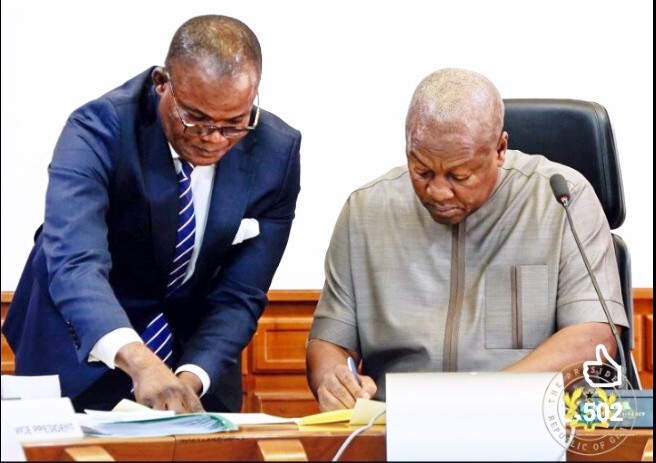
President John Dramani Mahama has officially signed the 24-Hour Economy Authority Bill, 2025 into law, marking a major milestone in the implementation of one of his administration’s flagship economic transformation policies.
The signing ceremony took place on Thursday, February 19, 2026, in a brief event held ahead of the 13th Cabinet meeting at Jubilee House in Accra. In remarks following the assent, President Mahama stated:
“Cabinet colleagues, I just appended my signature to give assent to the 24-hour Authority Bill. This Bill, which Ghanaians have been waiting for, was one of our flagship strategies for economic transformation.”
The legislation, now formally the 24-Hour Economy Authority Act, establishes the 24-Hour Economy Authority as the central coordinating body responsible for overseeing the nationwide rollout and implementation of the 24-Hour Economy and Accelerated Export Development Programme.
Key Provisions of the Act:
The Act provides the legal and regulatory framework to enable continuous, round-the-clock economic activity in targeted sectors. Its main objectives include:
Establishing the Authority: Creating an independent body to lead, coordinate, and monitor policies, strategies, programmes, and activities aimed at transforming Ghana into a 24-hour operational economy.
Sectoral Alignment and Collaboration: Aligning efforts between public institutions, private sector players, investors, and other stakeholders to promote extended production, service delivery, and business operations.
Infrastructure and Regulatory Support: Addressing infrastructure gaps, regulatory barriers, and other requirements to facilitate shift-based or continuous operations in industries such as manufacturing, services, exports, and related areas.
Economic Goals: Boosting productivity, industrial output, job creation (especially for youth), export diversification, reduced reliance on raw material exports, and minimization of imports for finished/intermediate goods. It supports inclusive growth by encouraging investment incentives, supply chain development, and market systems transformation.
A New AI Training Programme For Ghanaian Students
Broader Transformation: Anchored on pillars like production systems development, supply chain and market enhancement, and accelerated export promotion to restructure Ghana’s economy for sustained, higher-value activity.
The bill was initially presented to Parliament toward the end of 2025 and passed on February 6, 2026, after debates involving contributions from both sides of the House. Its passage followed extensive deliberations to ensure it provides a clear mandate for formalizing and accelerating the policy.
President Mahama emphasized that the assent shifts focus “from strategy to implementation,” with strong priority on job creation and attracting investor interest through forthcoming incentive packages. The Authority will work closely with entities like the Bank of Ghana and other institutions to align policies and ensure effective execution.
This development is seen as a decisive step toward realizing the government’s vision of a more dynamic, productive, and inclusive economy operating beyond traditional hours.