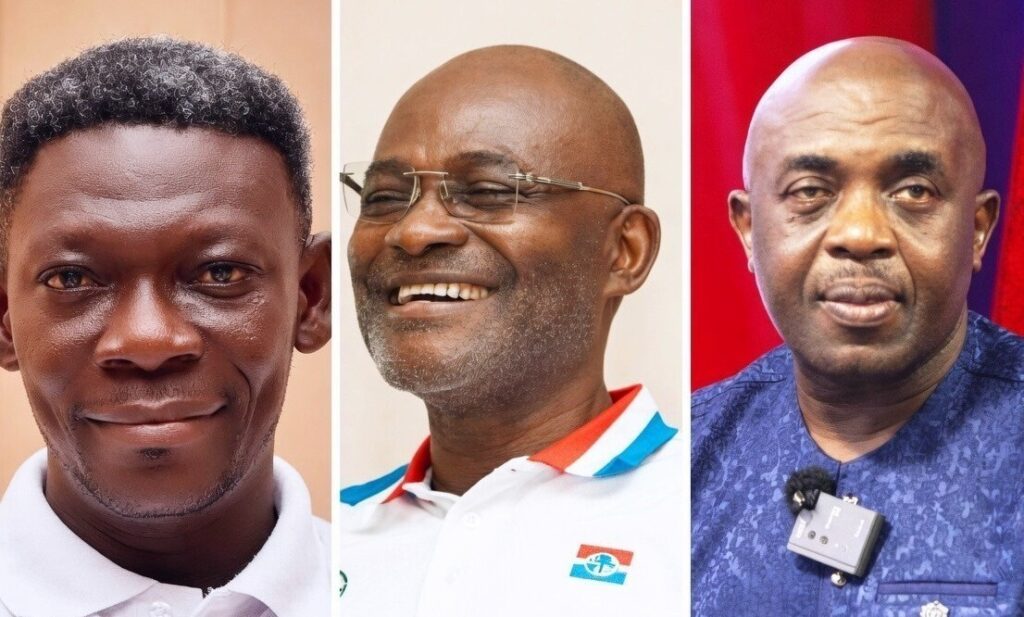
A new political wind is blowing through Ghana. Launched in early 2026, The BASE — formally styled as “Ghana First” — has emerged as one of the most talked-about political movements in recent memory, positioning itself as a genuine third force in a democratic landscape that has long been dominated by two giants: the NPP and the NDC.
At its heart, The BASE is a grassroots effort. Its organisers speak the language of the ordinary Ghanaian — market women, commercial drivers, unemployed graduates — and frame their mission around a simple but charged rallying cry: Ghana First. The movement’s pitch is as much emotional as it is political, tapping into a deep well of frustration among citizens who feel the two-party system has recycled the same promises without delivering meaningful change.
The Faces Behind the Movement:
The BASE has drawn some recognisable figures into its orbit, lending it both visibility and controversy.
Dr. George Oti Bonsu, a former NPP financier, is widely described as the movement’s founder. He has wasted little time in signalling seriousness — recently unveiling an ultramodern headquarters in Accra while simultaneously driving mass registration campaigns across the country.
Although Kennedy Agyapong has debunked those rumoura, the outspoken NPP heavyweight, loomed large over the movement even if his formal role remains fluid. A significant faction within The BASE is openly campaigning to draft him as flagbearer ahead of 2028, with supporters rallying under the banner of his “Kennected” network — many of them NPP defectors nursing deep grievances against their former party.
Agya Koo — beloved Kumawood actor Alexander Kofi Adu — has also stepped into the fold, actively fronting announcements and helping to mobilise support at the ground level, bringing with him a loyal popular following that extends well beyond traditional political circles.
The BASE has been careful, for now, to describe itself as a movement rather than a political party. But the signs of formalisation are unmistakable. Headquarters have been opened. Registration drives are underway. Public activations — including high-energy market storms at places like Kejetia — have drawn crowds and generated buzz in ways that few new political outfits manage so early in their existence. The trajectory, many observers note, points clearly toward a formal party structure ahead of the 2028 electoral cycle.
For all its momentum, The BASE is not without its internal tensions. Competing factions appear to be operating under overlapping — and at times conflicting — claims to the movement’s identity and direction. The Agyapong-aligned wing, animated by bitterness toward the NPP establishment, carries a particularly charged energy, with some supporters openly declaring they will never spend another pesewa on the old party. How these factions cohere — or clash — as the movement matures could prove decisive in determining whether The BASE becomes a lasting force or a fleeting moment of political frustration.
Why Ghana’s Education System Needs an Urgent Revamp Now!
What is clear is that Ghana’s political conversation has a new and restless voice in the room — and it is growing louder.
The story of The BASE is, at this stage, as much about contradiction as it is about promise. Alongside the rallies, the headquarters unveilings, and the poolside celebrations lies a movement still wrestling with some fundamental questions about what it is, who leads it, and whether it can survive its own internal fault lines long enough to matter in 2028.
A Name in Dispute:
Perhaps the most telling sign of the movement’s growing pains is the reported court battle over the very name “The BASE Ghana First.” Two factions are currently locked in a legal tussle over the branding — a dispute that has sown public confusion and handed critics easy ammunition. When a movement cannot agree on who owns its own identity, questions about coherence are inevitable.
Adding to the complexity are overlapping claims from different quarters. One faction orbits closely around Dr. George Oti Bonsu’s founding vision and advocates for a business-minded leader — with names like Kennedy Agyapong and even Ibrahim Mahama floated as possibilities. Another is more squarely anchored in the Agyapong-Kennected universe.
Meanwhile, Agya Koo’s public announcements about a “Ghana First Party” have drawn scepticism from some observers who question whether the popular actor’s involvement signals genuine political depth or simply adds to the noise.
Musician Fredyma has been among the most vocal critics, bluntly predicting the movement “will not end anywhere” — arguing that Ghana’s political terrain is too firmly shaped by NPP and NDC structures, branding, and loyalties for a new entrant to crack.
History gives those sceptics reason to stand firm. Ghana’s democracy is, by African standards, a remarkable success story — marked by peaceful transfers of power, including the 2024 election in which NDC’s John Mahama defeated NPP’s Mahamudu Bawumia in a decisive result shaped largely by economic discontent. But that same democratic stability has calcified into a two-party duopoly that has proven extraordinarily resistant to third-force challengers.
The reasons are structural. The NPP commands deep ethnic and regional loyalty in Ashanti, while the NDC’s strongholds in the Volta Region and the North give it a reliable electoral floor. Third parties have historically struggled to build the national footprint needed to compete, hamstrung by resource gaps, voter habits, and the sheer organisational machinery the two major parties have spent decades constructing.
Surveys tell a nuanced story.
Around 29% of Ghanaians now view political parties primarily as sources of division and confusion, and more than half report no strong affinity to any party. That is a significant pool of potential support for a credible alternative — but translating disillusionment into votes has always been the graveyard of third-party ambitions in Ghana.
Buzz Versus Substance:
The BASE has unquestionably generated energy. Claimed registrations running into the hundreds of thousands — across Ghana and diaspora platforms — suggest genuine appetite. The market storms, the Kejetia outreach, the headline-grabbing headquarters launch — these are not the actions of a movement without organisational intent.
GoldBod Is One Year Old: What Has Changed In Ghana’s Gold Trading Sector?
But critics are asking harder questions. Is this policy-driven politics or personality-driven protest? Beyond the anti-duopoly rhetoric and calls for “a leader who understands the daily struggles of the ordinary Ghanaian,” what does The BASE actually stand for in concrete, programmematic terms? Youth employment and Ghana-first nationalism are powerful emotional rallying points, but they are not yet a governing vision.
The suspicion — voiced by more than a few observers — is that the movement is powered less by ideology than by NPP bitterness, particularly among those still smarting from the party’s 2024 defeat and its internal leadership turbulence in the post-Akufo-Addo era. That may be enough to sustain a movement. It is rarely enough to win an election.
What Comes Next:
As of April 2026, The BASE is at a crossroads that will likely define its trajectory. Formal party registration, clarity on leadership, and the resolution — or escalation — of its internal legal disputes will each signal whether this is a serious long-term political project or a moment of organised frustration that burns bright and fades.
To genuinely challenge the duopoly, The BASE would need to accomplish something no third force in Ghana’s modern democratic era has managed: build a truly national coalition that reaches beyond disaffected NPP voters, develop a policy platform substantive enough to withstand scrutiny, and hold together long enough for voters to trust it with their ballot.
The momentum is real. The obstacles are equally real. Ghana’s political watchers would be wise to keep a close eye on what happens next — because whichever direction The BASE ultimately travels, it is already telling us something important about the frustrations simmering beneath the surface of one of Africa’s most celebrated democracies.