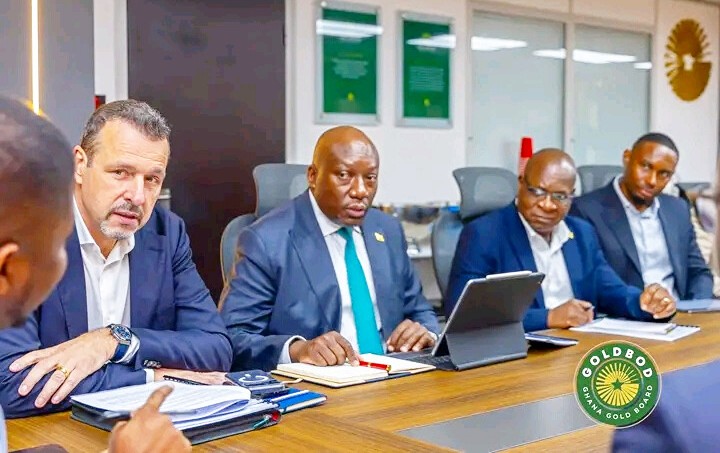
Ghana’s long-running battle to bring order, legitimacy, and sustainability to its artisanal and small-scale mining (ASM) sector has entered a promising new chapter. The Ghana Gold Board — better known as GoldBod — has commenced formal engagements with Better Brands, a Zimbabwean firm, in what is shaping up to be one of the most structurally ambitious partnerships yet undertaken to address the persistent challenges facing Ghana’s army of small-scale miners.
The discussions, which centre on financing, infrastructure, and technical support, signal a meaningful shift in how Ghana’s authorities are approaching ASM formalisation — away from a predominantly enforcement-led model and toward one that pairs regulatory oversight with genuine economic empowerment for the miners themselves.
Artisanal and small-scale mining is not a fringe activity in Ghana. It is a livelihood for hundreds of thousands of Ghanaians — miners, equipment operators, transporters, traders, and their dependants — spread across communities in the country’s gold-rich belts. Ghana is Africa’s largest gold producer and one of the world’s top ten, and ASM contributes a substantial share of that output, even as a significant portion of it moves through informal, untracked channels.
The sector’s informality is not simply a governance problem, though it is certainly that. It is also an economic one. Gold that bypasses official channels deprives the state of revenue, undermines GoldBod’s mandate to consolidate and monetise Ghana’s gold output, and leaves miners themselves exposed — without legal protections, access to formal finance, or the technical support that could make their operations safer and more productive.
Enforcement crackdowns — including the controversial military-backed anti-galamsey operations — have disrupted illegal mining activity but have consistently struggled to offer a viable alternative pathway for miners seeking to operate legitimately. The conversation has increasingly shifted toward the conclusion that formalisation, to be durable, must be backed by economic incentives and structural support, not just the threat of sanctions.
What the GoldBod–Better Brands Partnership Proposes
The engagement between GoldBod and Better Brands is built around a recognition of that fundamental truth. Rather than approaching ASM miners as a problem to be suppressed, the partnership frames them as an economic constituency to be organised, equipped, and integrated into Ghana’s formal gold value chain.
Central to the proposed framework is the establishment of a dedicated financing centre — a facility designed specifically to serve the capital needs of artisanal miners. Access to finance has historically been one of the most debilitating constraints on the ASM sector.
Commercial banks are largely unwilling to extend credit to informal miners, who lack the collateral, documentation, and credit histories that formal lending requires. The result is a dependence on informal financiers — often known as “sponsors” — whose terms can be exploitative and whose involvement frequently deepens the sector’s entanglement with illegality.
A purpose-built financing centre, structured to understand and accommodate the realities of artisanal mining, could fundamentally alter that dynamic. By improving miners’ access to affordable capital, the centre would reduce their dependence on informal money, create pathways into the formal economy, and give GoldBod greater visibility over who is mining, where, and under what conditions.
The discussions between GoldBod and Better Brands place particular emphasis on hard rock mining — a segment of the ASM sector that demands significantly more capital and technical expertise than alluvial mining. Hard rock operations require drilling, blasting, crushing, and processing equipment that most artisanal miners cannot afford to acquire or maintain independently.
The absence of adequate machinery does not stop miners from attempting these operations; it simply means they do so with improvised methods that are less efficient, more dangerous, and more environmentally damaging.
The partnership’s proposed response is direct: the provision of processing plants and other production machinery designed to optimise gold recovery rates. Making such equipment accessible to small-scale operators — whether through ownership, leasing, or shared facilities — would address one of the most glaring infrastructure gaps in the sector, while simultaneously improving the quality and volume of output that flows through formal channels.
GoldBod Is One Year Old: What Has Changed In Ghana’s Gold Trading Sector?
This approach draws on a model that has shown promise in other gold-producing jurisdictions, where centralised processing facilities have allowed artisanal miners to access industrial-grade technology without bearing the full capital cost themselves. If replicated effectively in Ghana, it could unlock significant productive capacity that currently goes underutilised or is lost entirely due to inadequate processing methods.
Better Brands and the Zimbabwean Connection
Better Brands’ involvement brings an interesting dimension to the partnership. Zimbabwe, like Ghana, has a substantial and historically complex ASM sector, and the country’s recent efforts to formalise small-scale gold mining — including through the Fidelity Gold Refinery and various state-backed miner support programmes — have generated lessons, both positive and cautionary, that are directly relevant to Ghana’s situation.
A firm operating in that environment would be expected to carry practical knowledge of the financing, equipment, and structural challenges that ASM formalisation entails at the operational level — knowledge that complements GoldBod’s regulatory mandate and on-the-ground reach across Ghana’s mining communities.
The engagement with Better Brands fits within GoldBod’s wider mandate, which has been to consolidate Ghana’s gold purchasing and export ecosystem, reduce leakages, and maximise the economic return that Ghana derives from its gold endowment. Since its establishment, GoldBod has moved to position itself as the central institution through which ASM gold flows — a role that requires not just the authority to regulate, but the capacity to offer miners a formal channel that is more attractive than the informal alternatives.
GoldBod Rolls Out Monitored Trading Hubs In Key Mining Districts
That attractiveness depends, in large part, on whether formal participation delivers tangible benefits. If miners who come into the formal system gain access to better financing, better equipment, technical support, and fair prices for their gold, the incentive to operate legitimately becomes self-reinforcing. If formalisation means only additional bureaucracy and exposure to enforcement without corresponding support, the informal sector will continue to absorb those who find the formal route unappealing.
The GoldBod–Better Brands engagement is, at its core, an attempt to make the formal route genuinely competitive.
The commencement of these engagements is a beginning, not a conclusion. The pathway from high-level discussions to a functioning financing centre, deployed machinery, and measurable improvements in ASM formalisation rates is long and will require sustained political will, administrative capacity, and the kind of trust-building with mining communities that takes time to develop.
There are also structural questions that will need careful navigation — around who qualifies for support, how equipment access is managed, how financing is priced and recovered, and how the interests of individual miners are balanced against the institutional goals of GoldBod and its partners.
But the direction of travel is the right one. Ghana’s ASM sector has for too long been treated primarily as a law enforcement challenge. The GoldBod–Better Brands partnership, if it delivers on its stated ambitions, represents a more sophisticated and ultimately more durable approach — one that recognises that formalisation, to stick, must offer miners not just a legal framework to comply with, but an economic ecosystem worth belonging to.