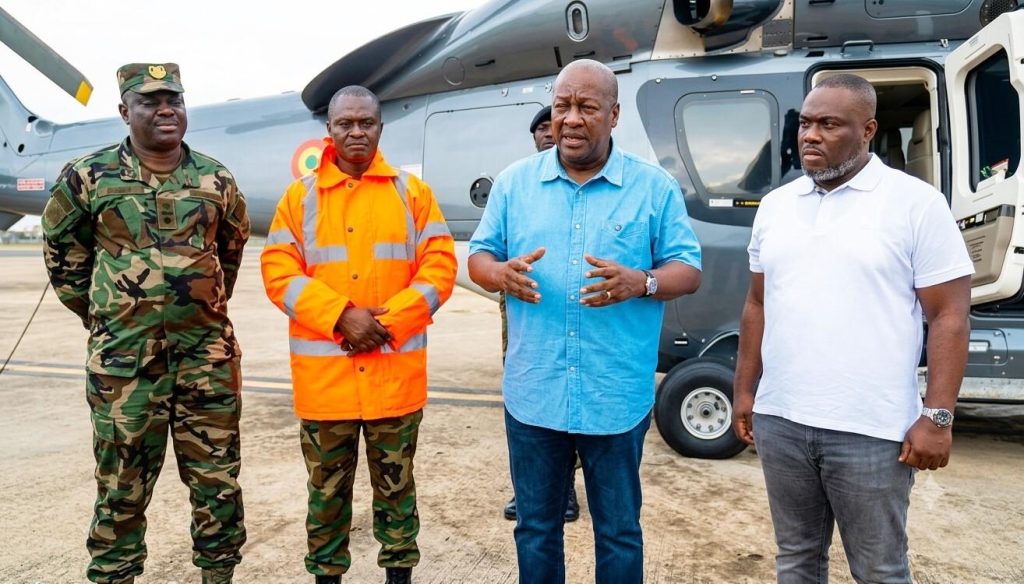
President John Dramani Mahama has announced plans to relocate major government departments out of Accra and establish a new growth centre, framing the move as a long-term response to the capital’s worsening congestion and its growing vulnerability to flooding.
The announcement followed catastrophic flooding on June 29, 2026, when Accra recorded roughly 140mm of rainfall in a single day — far surpassing the previous year’s highest single-day total of 56mm.
The deluge submerged communities across Accra, Kaneshie, Adabraka, Weija, and parts of Tema, destroying property and exposing just how fragile the capital’s drainage and urban infrastructure have become.
Speaking after surveying the flood-hit areas, President Mahama acknowledged that emergency relief and drainage repairs would address the capital’s immediate needs, but insisted that Accra’s deeper problems demand a bolder, more permanent response.
“But ultimately, the other solution will be to decongest Accra,” the President said. “And that’s why we’re planning that we move some of the city out, that is, the major government departments, and then also create a new centre of growth so that our people will start building outside Accra in a new city instead of everybody looking for some space in Accra.”
He was careful to note that the plan would not deliver quick results. “But that’s a long-term solution,” he added, describing it as part of a broader national project expected to span roughly two decades.
Building a New Administrative and Economic Hub
According to the President, government technical experts are already preparing a design and master plan for the proposed city. Once complete, land will be demarcated for residential, commercial, and institutional use, paving the way for select ministries, departments, and agencies to relocate outside the Greater Accra Region.
Officials believe the new growth centre could do more than just ease congestion — it could also draw private investment, generate jobs, and accelerate infrastructure development in previously underserved parts of the country.
The initiative fits into a broader ambition to expand housing options, modernise urban planning, and stimulate economic activity beyond Accra’s overstretched metropolitan boundaries.
Urban planning experts have for years pointed to Accra’s rapid, largely unplanned population growth, encroachment on natural waterways, and overstretched infrastructure as key drivers of the capital’s recurring flood crises. Many argue that the heavy concentration of government institutions in Accra has only intensified the pressure, and that decentralising state agencies could help stimulate regional economies while easing the strain on the capital.
Ghana’s Floods Are Man-Made, Not Natural Disasters—Kennedy Agyapong Speaks Out
While the long-term relocation plan takes shape, government agencies — including the National Disaster Management Organisation (NADMO), the Ghana National Fire Service, and the Ghana Police Service — remain engaged in rescue, relief, and damage assessment operations across flood-affected communities.
President Mahama has also directed a nationwide crackdown on blocked drainage channels, tasking Metropolitan, Municipal and District Assemblies (MMDAs) to work with the Ministry of Works, Housing and Water Resources to identify and clear blockages.
The President did not specify which ministries, departments, or agencies would be affected by the eventual relocation, saying further details would be announced as the government finalises its implementation framework.
If carried through, the plan would represent one of the most ambitious public sector decentralisation efforts in Ghana’s recent history — reshaping the country’s administrative map while positioning the government’s flood response as the catalyst for a generational shift in how, and where, Ghana builds its cities.