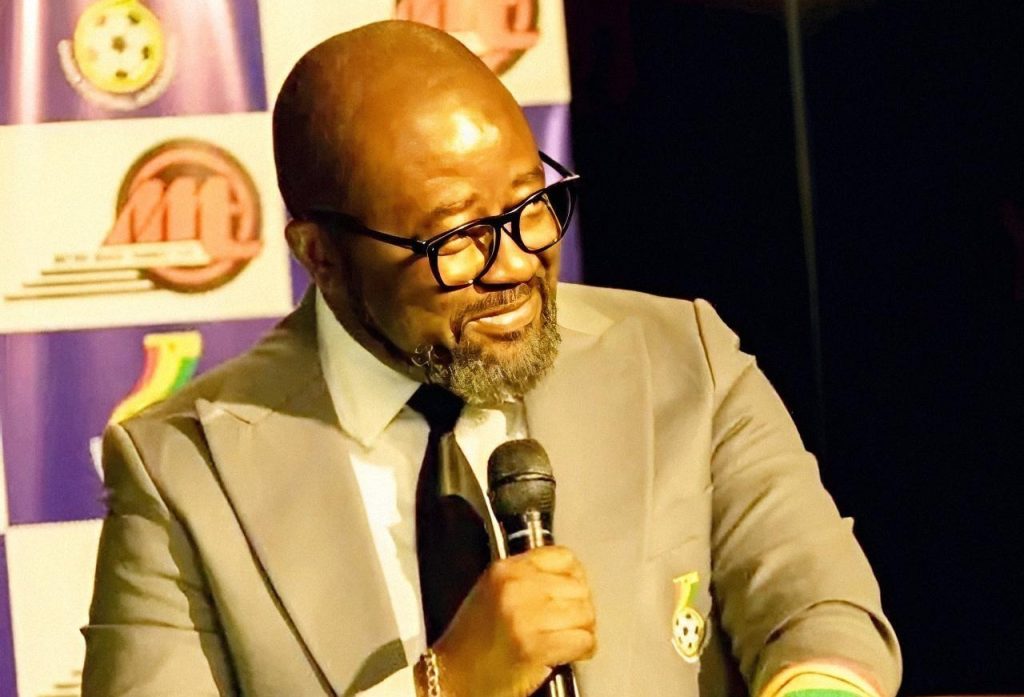
Kurt Edwin Simeon-Okraku, president of the Ghana Football Association (GFA), compared his anticipated legacy to that of Osagyefo Dr. Kwame Nkrumah, Ghana’s first president, and expressed optimism that his contribution to Ghanaian football will eventually be recognized more.
Speaking with Michael Oti Agyei on 3Sports, Okraku thinks that while some of the ideas and actions made during his administration might not be immediately acknowledged, history will ultimately evaluate the work completed under his direction.
“When I’m gone, just like Kwame Nkrumah, people will appreciate. People will not only appreciate but remember the good things we did for Ghana football ” – GFA President Kurt Okraku
As he continues to spearhead initiatives targeted at reorganizing and expanding Ghana’s football ecosystem, the GFA president’s statement indicates his increasing attention to the legacy of his administration.
After the previous football administration collapsed following the 2018 crisis that led to the association’s dissolution, Okraku was elected GFA president in October 2019. He has continuously portrayed his administration since assuming office as one that is committed to restoring institutions, enhancing football governance, and developing a more sustainable football sector.
According to the GFA’s own description, Okraku is a reform-minded leader who has placed a high priority on women’s football, structural reforms, grassroots development, and modernizing Ghana’s football administration.
Okraku has emphasized the importance of developing the entire football ecosystem rather than focusing only on the Black Stars, even if the senior national team’s performance is still one of the primary metrics used to evaluate football administrators in Ghana.
The National Football Philosophy, often known as the “Ghana Football DNA,” is one of the main projects connected to his administration.
The concept was created to provide Ghanaian football a long-term identity and direction, especially in player development and coaching. The goal is to restore Ghana’s standing as one of Africa’s football giants while developing a system that can generate players and teams that can regularly compete at the top level.
Additionally, Okraku has consistently maintained that if Ghana is to attain long-term success, the game’s foundations must be strengthened.
Okraku presented what the GFA called a “new blueprint for Ghana football” at its 32nd Congress, which took place on August 20, 2026, at the Ghanaman Soccer Center of Excellence in Prampram.
Domestic tournaments, business investment, club growth, player welfare, youth football, women’s football, technology, and infrastructure were among the topics covered at the Congress.
Carlos Queiroz Stays As Black Stars Coach As GFA Confirms New Mandate
Three significant legacy projects totaling US$1.71 million were also announced by the GFA. These include a US$690,000 artificial football field at the Police Depot Basic School in Tesano, Accra; two contemporary dorms at Bolgatanga Senior High School, which are anticipated to cost US$330,000; and a further US$690,000 artificial football field at the Ghanaman Soccer Center of Excellence in Prampram.
Okraku claims that the projects are meant to turn on-field success into off-field sustainable development.
“This is how we intend to transform success on the field into sustainable development off the field – building not only champions, but a stronger foundation for Ghana football,” he said at the Congress.
A reference to Kwame Nkrumah
Okraku’s reference to Kwame Nkrumah is particularly significant because Ghana’s first President remains one of the country’s most influential historical figures.
Nkrumah’s legacy has continued to generate debate decades after his death, with supporters and critics assessing his contribution to Ghana’s independence, development and political history.
By invoking Nkrumah, Okraku appears to be making a broader point about how leaders can sometimes be judged differently after leaving office.
His argument is essentially that some achievements may not receive their full recognition while an administrator remains in office, but could become more visible when the immediate controversies surrounding their tenure have faded.
For Okraku, that future assessment should include what his administration has done to strengthen the structures supporting Ghana football.
Okraku’s latest comments suggest that he is increasingly thinking about what will remain after his time at the helm of the GFA. His administration has sought to position long-term football development, institutional reforms and infrastructure as important parts of its legacy. Whether history ultimately agrees with his assessment will depend on how Ghana football develops in the years ahead.
For now, however, Okraku remains convinced that time will provide a different perspective on his tenure.
And in his own words, he believes that when he is no longer in office, Ghanaians will not only appreciate his contribution but remember the good things his administration did for Ghana football.