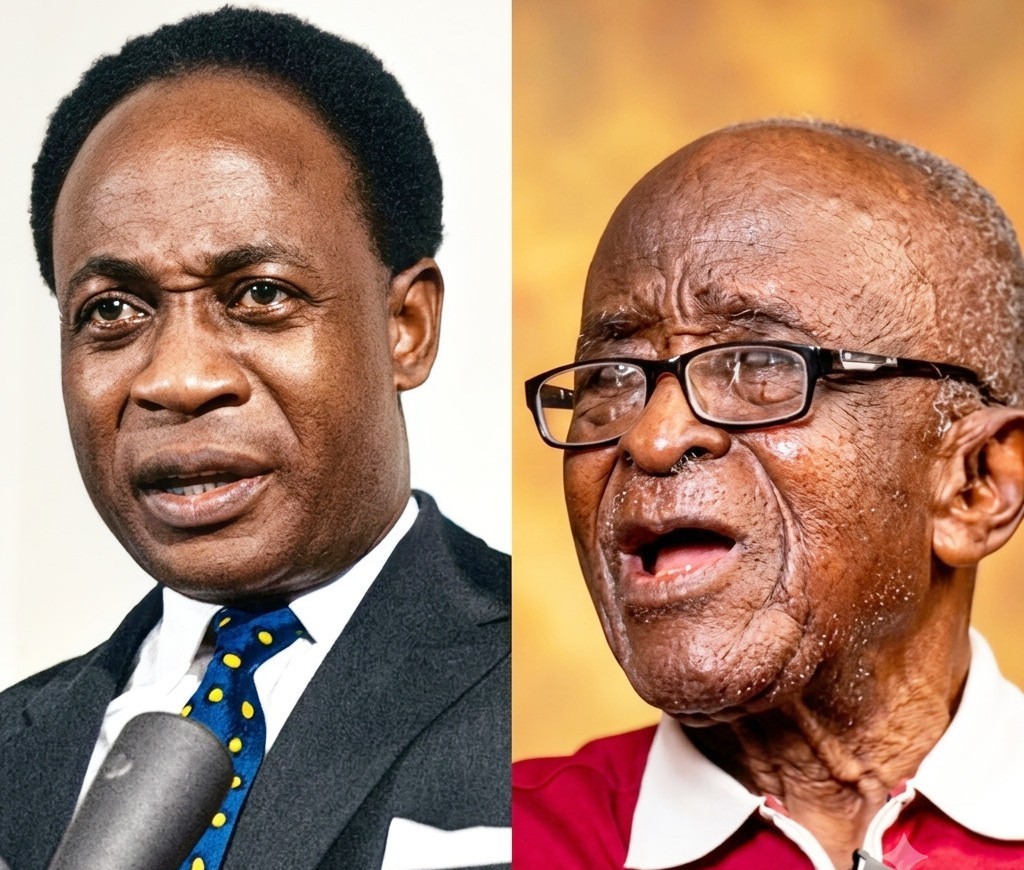
A retired staff member of the Public Works Department has reignited one of Ghana’s oldest and most emotionally charged debates — whether the country’s present struggles trace back to decisions made in its very first years of independence.
Lawrence Frederick Asiamah Tenkorang, now 94, made his case in an interview with broadcaster Kafui Dey, pinning some of Ghana’s ongoing difficulties on what he called outright “blunders” committed during the administration of the country’s first President, Dr Kwame Nkrumah.
Tenkorang’s own place in Ghana’s history runs deep — he was the man responsible for testing the runway at Accra International Airport ahead of Queen Elizabeth II’s landmark visit to Ghana in 1961, a detail that lends his recollections a rare, firsthand credibility.
Nkrumah’s shadow looms large over any conversation about Ghana’s economic trajectory. As the country’s first Prime Minister and later President, he steered Ghana to independence from British colonial rule in 1957 and pursued a sweeping vision built around industrialisation, infrastructure, and Pan-African unity. But that legacy has never sat comfortably in one box.
Supporters point to his infrastructure ambitions, industrial push, and education reforms; critics have long questioned his economic management, political consolidation, and the degree of state control exercised under his rule.
The hardest question raised by Tenkorang’s remarks isn’t whether Nkrumah made mistakes — it’s how much weight those mistakes should still carry more than sixty years later. Ghana has cycled through numerous governments since Nkrumah’s overthrow in 1966, each bringing its own economic policies, reform agendas, and institutional shifts.
Along the way, the country has weathered military takeovers, economic crises, mounting debt, and structural adjustment programmes, all shaped by shifting global conditions. Pinning today’s challenges on a single administration from six decades ago would be an oversimplification — yet foundational choices made in a nation’s formative years rarely disappear without a trace.
Infrastructure decisions, industrial strategy, and economic structures set in motion early can echo through generations, either reinforced or undone by the governments that follow.
Nkrumah’s admirers argue that judging him against present-day standards misses the context of his era. He inherited a colonial economy built almost entirely around raw material exports and attempted to reshape it into an industrial one — an ambitious undertaking for a newly independent nation still building its institutions from scratch. Physical reminders of that ambition remain woven into Ghana’s landscape today, from the Akosombo Dam to a cluster of state-owned industrial enterprises that outlasted his presidency.
The Case Against Him:
Even so, admiration shouldn’t shield any leader from scrutiny. Questions have persisted for decades about the long-term sustainability of Nkrumah’s economic policies, the performance of the state enterprises he championed, and the increasingly tense political climate that preceded the 1966 coup. None of this erases his accomplishments — but it does confirm what’s true of nearly every transformative leader: a legacy built from both triumphs and unresolved failures.
Rawlings Had A Big Opportunity To Transform Ghana But Failed—A Plus
Perhaps the most valuable takeaway from Tenkorang’s comments isn’t a verdict on Nkrumah at all — it’s a reminder that Ghana’s development struggles neither began with him nor ended when he left office. Every government since has made choices that shaped the nation’s fortunes, some successful, others costly.
If Ghana genuinely wants to break free from recurring economic setbacks, historians and citizens alike will need to examine every era honestly, rather than treating history as a weapon to be wielded in present-day political battles.
More than sixty years after his removal from power, Nkrumah remains a singular figure in Ghana’s national imagination — to some, the embodiment of a bold, self-determined Africa; to others, a cautionary tale about unchecked state power and economic ambition unmoored from fiscal discipline. Tenkorang’s remarks add one more voice to a conversation that shows no sign of concluding anytime soon.
The real challenge facing Ghana isn’t settling whether Nkrumah was a hero or a cautionary figure — it’s identifying which decisions, across every administration since, produced lasting value, which caused lasting harm, and what today’s leaders might still learn from both.
In the end, the question worth sitting with may be this: is Ghana grappling with the consequences of Nkrumah’s era alone, the accumulated missteps of the governments that followed, or some tangled combination of choices made across generations?