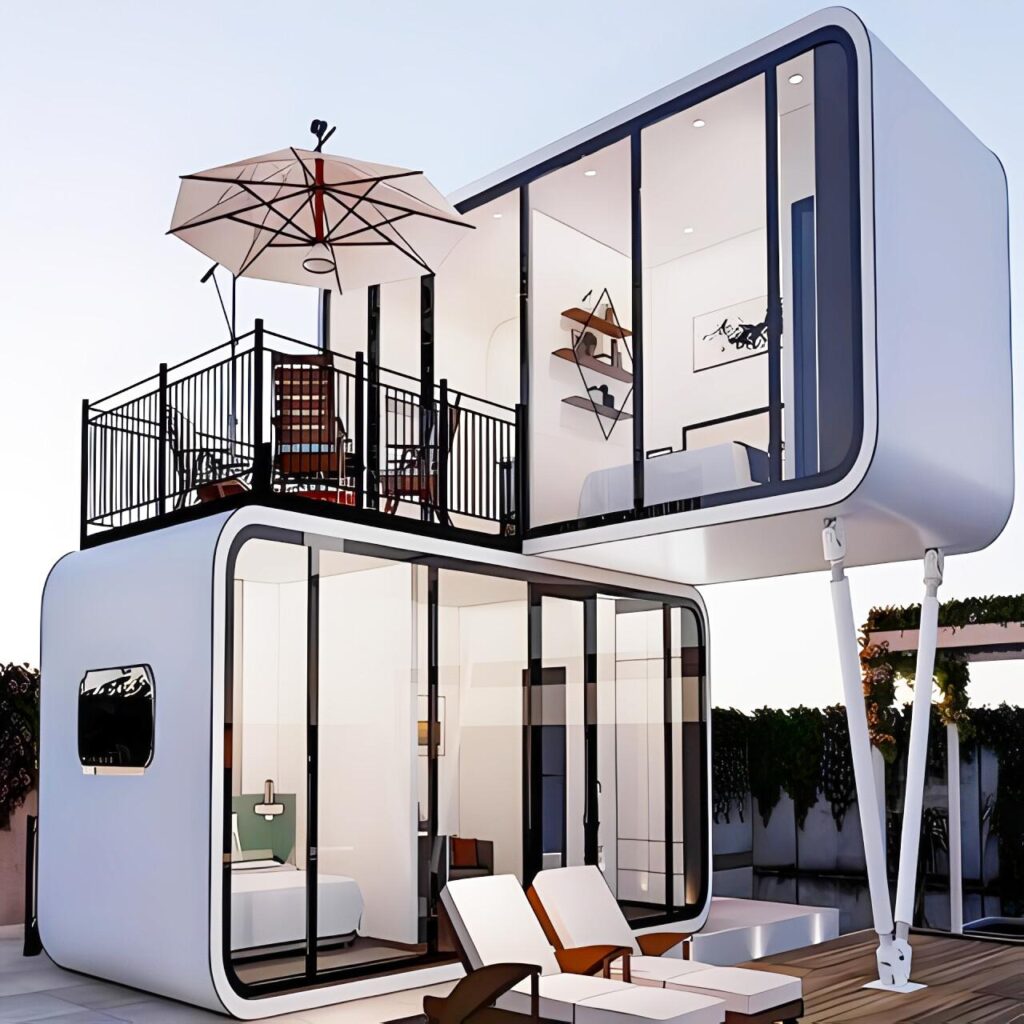
They look like something a production designer dreamed up for a science fiction film — sleek, curved, luminous pods perched in forest clearings or stacked in urban clusters, their panoramic windows framing the world beyond like porthole views from orbit. But space capsule homes are very much a terrestrial reality, and a growing one at that.
Part architectural experiment, part practical solution to one of the modern world’s most pressing problems, capsule homes represent a fundamental rethinking of what a home needs to be — and how little space it actually requires to function as one.
What Exactly Is a Space Capsule Home?
At their core, space capsule homes are compact, prefabricated modular units typically ranging between 15 and 40 square metres, designed to deliver maximum functionality within a minimal footprint. Built in factories and transported to site, they draw aesthetic inspiration from spacecraft and futuristic architecture, featuring curved profiles, large expanses of glass, and interiors engineered to eliminate wasted space at every turn.
Inside, the design philosophy is one of intelligent compression: foldable furniture that transforms a living area into a bedroom at the touch of a button, hidden storage built into floors and walls, automated lighting systems, and smart ventilation that keeps the air fresh without the bulk of conventional HVAC infrastructure.
Many models are equipped with solar panels and heavily insulated shells, making them far more energy-efficient than traditionally built homes of comparable size.
Some units are fixed in place; others are engineered for relocation — lifted, trucked, and repositioned as circumstances demand.
Who Is Already Living — and Investing — in Them?
The applications are remarkably varied. Eco-resorts and Airbnb operators have seized on capsule homes as a way to offer guests an experience that is simultaneously luxurious and novel. Campsite operators deploy them as premium glamping pods. Universities and municipalities have explored them as student and temporary housing solutions. Homeowners in suburban and semi-rural areas use them as backyard guest houses or home offices. Off-grid enthusiasts find in them a self-contained platform for sustainable, disconnected living.
At the manufacturing and innovation end, a handful of countries are driving the trend. China has emerged as the world’s dominant producer of modular capsule units, churning out designs at a scale and cost that has made the format commercially accessible.
Japan — whose architectural culture has long embraced the art of doing more with less — brings a design heritage uniquely suited to the form. South Korea is leading on smart home integration, embedding capsule units with connected systems that anticipate and respond to residents’ needs.
Affordable Housing In Ghana: The Big Promises, Real Projects, And Hard Truths
In the United States, the broader tiny home movement has created a receptive cultural context, with capsule homes occupying the more futuristic end of that spectrum.
A Famous Ancestor
The lineage of capsule architecture has a well-documented origin point. The Nakagin Capsule Tower in Tokyo, designed by architect Kisho Kurokawa and completed in 1972, stands as the format’s spiritual forebear — a visionary structure composed of 140 individual capsule units, each one a self-contained living space prefabricated off-site and bolted to a central concrete core. It was radical for its time, and it remains radical now. The building was controversially demolished in 2022, but not before cementing its status as one of the most discussed works of twentieth-century architecture.
The forces driving interest in capsule homes are structural, not merely aesthetic. Cities across the world are confronting acute land scarcity and soaring housing costs — Tokyo, Hong Kong, New York, London, Lagos — where the traditional detached home has become a financial impossibility for growing segments of the population. Compact modular units offer a way to house more people on smaller plots without sacrificing modern comfort.
Construction speed is another compelling argument. Traditional houses take months, sometimes years, to build from the ground up. Capsule homes arrive largely complete, with on-site assembly measured in days rather than seasons. That efficiency compresses costs, reduces labour dependency, and makes rapid deployment possible — a significant advantage in contexts ranging from urban development to disaster relief.
Sustainability gives the format another tailwind. As governments and consumers alike accelerate toward greener living standards, homes that integrate solar generation, water-saving technology, recycled materials, and intelligent energy management systems have an inherent advantage over conventional construction.
And then there is the cultural shift. Younger generations in many parts of the world are increasingly drawn to minimalism, mobility, and the logistical freedoms of owning less. A compact, smart, relocatable home aligns naturally with that worldview in ways that a traditional mortgage-anchored house does not.
The World At 8.3 Billion: What Population Growth Means For The Planet — And Why Africa Holds The Key
None of which means the capsule home is poised to replace conventional housing wholesale. The challenges are genuine and, in some cases, profound.
Space, most obviously, is finite. A 25-square-metre pod is a liberating retreat for a single person or a couple; it is a psychological pressure cooker for a family of four. Large households require multiple bedrooms, storage, outdoor space, and the kind of breathing room that no amount of clever furniture engineering can fully substitute for.
Culture exerts its own gravitational pull. In many societies — across West Africa, South Asia, the Middle East, and beyond — homeownership remains among the most powerful markers of success, stability, and social standing. A spacious, traditionally built house carries symbolic weight that a sleek pod simply cannot replicate, regardless of how intelligently it is designed.
Regulatory environments present a further barrier. Building codes, zoning ordinances, and land use regulations vary dramatically between and within countries, and many have not yet evolved to accommodate modular or non-standard housing forms. Navigating those frameworks adds cost and uncertainty to projects that might otherwise be straightforward.
And for all their cleverness, some capsule homes — particularly at the luxury end of the market — carry price tags that undercut their reputation as an affordable alternative.
What the Future Likely Holds
The most plausible trajectory for capsule homes is not replacement but complementarity. Rather than displacing conventional housing, they are more likely to occupy a distinct and expanding niche: affordable urban infill units in land-scarce cities; student accommodation blocks designed around efficiency rather than institutional dreariness; eco-tourism lodges that offer immersion in nature without sacrificing comfort; emergency shelter deployable in the aftermath of natural disasters; worker housing in remote industrial or energy sector locations; and eventually, perhaps, entire planned communities conceived from the outset around the modular capsule format.
China, Japan, and Singapore are already experimenting with exactly these kinds of integrated compact housing concepts, testing not just individual units but the urban planning philosophies required to make them work at scale.
Space capsule homes will not take over the world. But in an era defined by urbanisation, climate urgency, and the search for smarter ways to live on a crowded planet, they may well take over more of it than most people currently expect.